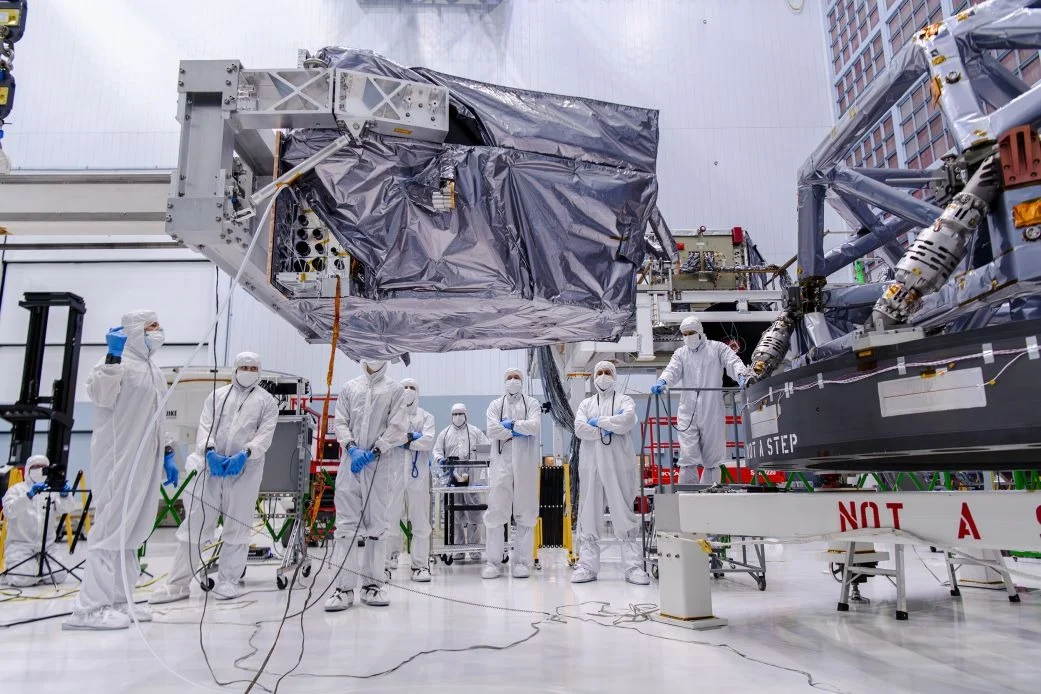









NASA’s Jet Propulsion Laboratory in Pasadena, California, houses a high-security clean room where engineers have spent years developing a sophisticated instrument for the upcoming Nancy Grace Roman Space Telescope. To enter this facility, personnel must wear specialized white “bunny suits” that leave only their eyes exposed, a precaution necessary to protect the sensitive hardware from contamination. The team even prohibited the use of makeup, lotions, and scented products to ensure the integrity of the equipment.
The centerpiece of this mission is a coronagraph, an experimental instrument nicknamed “starglasses.” By blocking the intense glare of distant stars, this technology allows the telescope to capture faint light from planets, including Jupiter-sized worlds, and potentially identify cloud formations. Its flexible mirrors are designed to adjust in real time, maintaining high precision for deep-space imaging. If the technology performs as expected, it could eventually assist in the search for Earth-like planets capable of supporting life.
NASA Administrator Jared Isaacman noted during the telescope’s unveiling in April that the mission will investigate dark energy, dark matter, and the fundamental structure of the universe, while accelerating the discovery of potentially habitable planets. Named after NASA’s pioneering chief of astronomy, the observatory is designed to complement the capabilities of the Hubble and James Webb Space telescopes. The telescope is scheduled for launch as early as this weekend.
Beyond the telescope, researchers have recently utilized new methods to identify two “ghost” human ancestors in the history of evolution. While Neanderthals and Denisovans left behind fossilized DNA, these two newly identified lineages left only traces in modern human genomes. One of these ancestors may have interbred with Homo sapiens in Africa over 50,000 years ago, while the second lineage remains more mysterious.
In other scientific developments, researchers at the University of California, Los Angeles, have turned to the subscription platform OnlyFans to fund a long-running study on yellow-bellied marmots. Their page, OnlyMarms, features footage of the rodents and their frequent scuffles. Meanwhile, the scientific community is tracking several other major updates: China has postponed its Chang’e-7 lunar mission for at least six months, and SpaceX is planning to develop a massive launch site on the Louisiana coastline capable of supporting over 30 Starship flights per day.
Celestial events have also captured attention, with August’s full moon coinciding with a partial lunar eclipse that cast a shadow over parts of the moon visible from North and South America. Elsewhere, conservationists are racing to locate a viable population of the critically endangered Ganges shark in Indonesia, as the species has never been photographed alive and is currently known only through fishing bycatch in rivers across Asia.
Finally, the global community is mourning the loss of musician and humanitarian Dolly Parton, who famously inspired the name for Dolly the Sheep, the first mammal cloned from an adult cell in 1996. Last week’s most popular science story featured the effort to vaccinate over 5,000 fairy penguins against a deadly bird flu outbreak. The report also notes that louisiana’s coastline could soon host the “ biggest launch site on Earth,” where SpaceX plans to enable more than 30 flights per day of its mega Starship rocket, according to CEO Elon Musk. The report also notes that called a coronagraph, is so sensitive to contamination that I was given a list of things forbidden from entering the hallowed space — no makeup, lotion or scented products of any kind could be on my skin, the instrument. The report also notes that the instrument team invited me to step inside the coronagraph virtually by equipping me with a pair of VR glasses to see all its components and how they ultimately fit together. The report also notes that this crucial sci-fi-like process is employed early on when assembling such a complex feat of engineering. The report also notes that meeting people who had spent years developing the device — and hearing their hopes for what it could reveal to us — opened my eyes to the extreme dedication it takes to build a single space mission. The report also notes that as NASA’s newest flagship observatory, Roman will seek out previously hidden aspects of the universe to solve some of its biggest lingering mysteries, such as dark energy and dark matter.