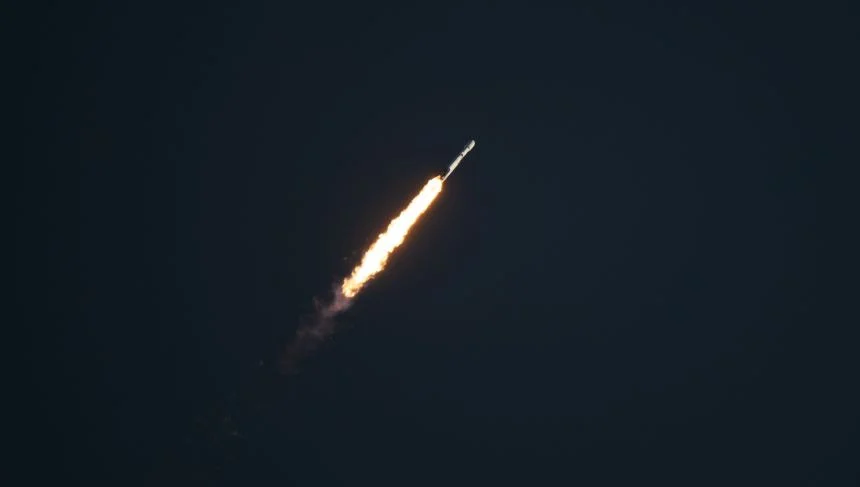








NASA has successfully launched the Nancy Grace Roman Space Telescope, a massive observatory designed to function as a “discovery machine” capable of transforming our understanding of the cosmos. The telescope lifted off aboard a SpaceX Falcon Heavy rocket at 7:26 a.m. ET on Sunday, reaching orbit approximately 10 minutes later. It is now beginning a three-month journey to its final destination at Lagrange Point 2 (L2), located about 1 million miles (1.6 million kilometers) from Earth—roughly four times the distance to the moon.
During a post-launch news conference, Dr. Nicky Fox, associate administrator for NASA’s Science Mission Directorate, described the emotional experience of watching the mission depart. “You see it growing up, and then it literally feels like it’s part of your team,” Fox said. “But there is that moment where you think, ‘I’m never going to see that spacecraft again.’ I liken it to sending your kids to college.” President Donald Trump also joined the event via call to congratulate the team, labeling the United States the “hottest in space.”
The $4.3 billion project, which has been in development for a decade and was prioritized by the scientific community 16 years ago, aims to provide a new atlas of the universe. With surveying capabilities more than 1,000 times faster than the Hubble Space Telescope, Roman is poised to capture scientific data that neither Hubble nor the James Webb Space Telescope can obtain. According to NASA Administrator Jared Isaacman, these three missions will eventually work in tandem to provide a comprehensive view of the universe.
The telescope is equipped with an experimental coronagraph that is 100 to 1,000 times more precise than any predecessor. Bertrand Mennesson, a deputy project scientist at NASA’s Jet Propulsion Laboratory, noted that the instrument is designed for autonomous operation, stating, “You send the coronagraph into space, and it’s set it and forget it.” This technology serves as a critical stepping stone toward the future Habitable Worlds Observatory, with experts like Dominic Benford noting that while Roman won’t reach that goal alone, the mission is essential to making it possible.
As the observatory undergoes commissioning, it will deploy its antenna to begin transmitting an estimated one terabyte of data per day. The mission, which has the potential to be extended up to 10 years, will focus on mapping dark matter and investigating dark energy, the force driving the universe’s accelerating expansion. By measuring how gravity bends light across vast distances, Roman will create a 3D map of dark matter, which is believed to constitute 85% of the universe’s total matter.
The telescope is named after Nancy Grace Roman, NASA’s first chief of astronomy in the 1960s, who pioneered the concept of space-based observations. Her legacy continues through the mission’s unprecedented survey capabilities. Senior project scientist Dr. Julie McEnery explained that the telescope will conduct the largest census of planets ever attempted, repeatedly scanning patches of the sky to detect elusive phenomena like rogue planets, small wandering black holes, and thousands of supernovas.
The first images from the telescope are expected in January. With a field of view more than 100 times larger than Hubble’s, Roman will allow astronomers to observe the forest of the universe while simultaneously capturing the sharp details of individual stars and galaxies. As Dominic Benford summarized, the mission is designed to provide humanity with the tools to ask questions about the cosmos that have not yet been conceived. The report also notes that eT Sunday from Kennedy Space Center in Florida. The report also notes that the bus-size telescope’s observations could reveal answers to enduring mysteries such as dark energy, which fuels the inexplicable accelerating expansion of the universe, and dark matter, which provides the cosmos with structure but remains unseen, over the next five years. The report also notes that “It’s actually the member of the team that’s going to go on this grand expedition and send all that incredible treasure back to us here on Earth. The report also notes that “Roman will give the Earth a new atlas of the universe,” NASA Administrator Jared Isaacman said as the space agency unveiled the completed telescope on April 21 at the Goddard Space Flight Center in Maryland. The report also notes that scientists around the world are anticipating the unprecedented insights Roman could deliver. The report also notes that “When you develop a tool that is radically different from anything you’ve had before, you will discover things that you didn’t know were out there,” said Dominic Benford, Roman program scientist at NASA who has been involved with projects related to the concept for more than 20 years.