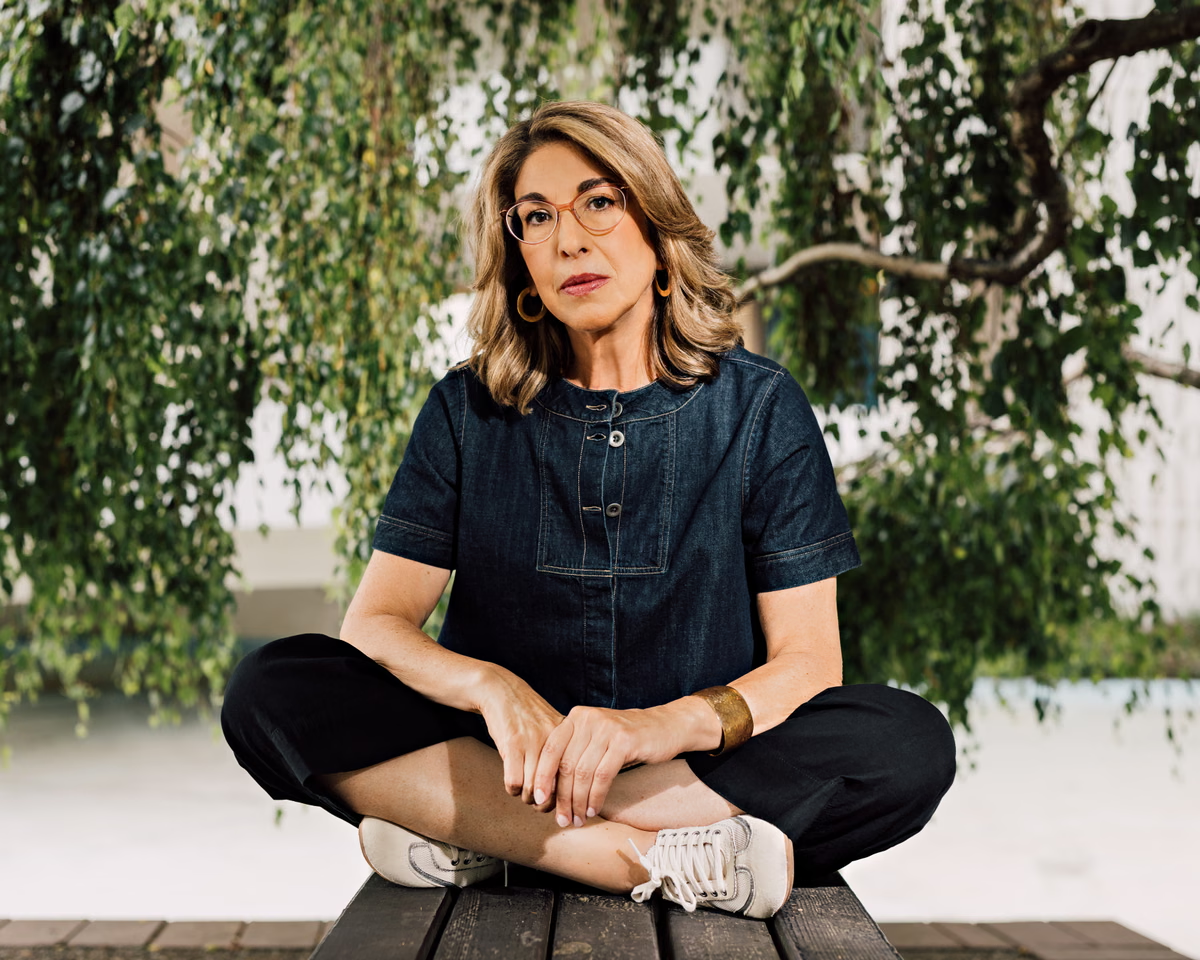







Naomi Klein’s latest work, End Times Fascism, opens on a mountaintop where two men gather an audience to share a vision of a gated, utopian city for the wealthy, free from the threats of the outside world. This scene, co-authored with Astra Taylor, sets the stage for an examination of how extreme wealth creates a deranging effect, transforming the ultra-wealthy into figures who operate with a sense of supremacy.
The narrative draws heavily from the atmosphere at the World Economic Forum in Davos, Switzerland. Klein observes that the event serves a dual purpose: providing a platform for the elite to showcase their supposed efforts to address poverty and climate change, while simultaneously offering a window into their opulent lifestyles. This year, the forum featured the world’s wealthiest individuals gathering to discuss their influence, even as Donald Trump used the platform to announce a Board of Peace for the reconstruction of Gaza. Seven months later, that initiative has yielded no substantial results, a fact Klein highlights as part of a broader pattern where the public is bombarded by so many extraordinary events that it becomes difficult to process the significance of such announcements.
Speaking from her home in British Columbia, Klein emphasizes that wealth compounds, a reality well understood by the rich, though the broader societal implications of this concentration of capital are rarely scrutinized. Despite the gravity of her subject matter, Klein maintains a calm, buoyant demeanor, similar to when she discussed her 2023 book, Doppelgänger, which explored how the digital landscape erodes our connection to reality and one another. Her career has long been defined by this analytical clarity, dating back to her 1999 breakthrough, No Logo, where she identified the hidden harms of neoliberalism.
End Times Fascism maps the current global surge in authoritarianism, citing examples such as anarcho-libertarian economic policies in Argentina, the suppression of free press in Russia, the erosion of democratic institutions in Hungary—prior to Viktor Orbán’s removal—and the rise of anti-immigrant neofascism in Italy. The project originated from a viral article published in. Klein and Taylor decided to expand the reporting, despite the psychological toll of immersing themselves in the ideologies of those they were investigating.
The book delves into the influence of religious fundamentalists, including Christian Zionists and Christian Nationalists in the United States, who are preparing for the second coming. The authors describe a “bunkered state” where climate-related disasters, the militarized enforcement of immigration policies by ICE, and a political culture saturated with misinformation create a society that struggles to discern truth. Klein notes that these trends are not new; she observed the rise of privatized enclaves during her reporting in Iraq, where the Green Zone in Baghdad functioned as an Emerald City built by private contractors like Halliburton.
Klein cautions against the trap of assuming that history is simply repeating itself. Instead, she advocates for the concept of a “spiral” to understand how our current era is both familiar and fundamentally different. She and Taylor also invoke Walter Benjamin’s idea of “jetztzeit,” or “now time,” to describe a moment so charged with the urgency of potential revolution that it captures the energy of all preceding movements. While she typically prefers a measured tone, Klein admits she feels she has earned the right to escalate her rhetoric given the severity of the current crisis.
Reflecting on the neoliberal era—the period between the end of the Cold War and the onset of Covid—Klein characterizes it as a time when capitalism lacked competition and became increasingly unchecked. She recalls the era of large conferences, such as the Skoll foundation awards, where journalists were wined and dined while witnessing the wealthy distribute small grants to grassroots projects. This performative philanthropy often masked the deeper systemic issues at play.
The book also critiques the shifting allegiances of tech leaders, noting that Mark Zuckerberg’s past expressions of concern for democracy and climate change were, in her view, insincere. Conversely, she highlights grassroots resistance, such as the efforts of KeShaun and Justin Pearson, who have fought against Elon Musk’s Colossus 2 data center in Memphis by grounding their struggle in the history of the civil rights and environmental justice movements.
In the lead-up to the 2024 presidential election, the book points to events like the gathering at the Faena Hotel in Miami, where Peter Thiel hosted panels that framed sustainable development goals and social responsibility as enemies, concluding with an “apocalypse ball”-themed party. These instances, Klein argues, illustrate a political environment built on false promises and a desire to capitalize on the very chaos that threatens the stability of the world. The report also notes that gated at every entrance, no need for weapons there, everyone in it rich, it’s a vision of a paradise city. The report also notes that one of the men has tears in his eyes as he describes its beauty. The report also notes that the men are Jared Kushner and Steve Witkoff. The report also notes that the mountain is Davos, the year is 2026. The report also notes that quite brazenly, the world’s richest men gathering to discuss the real estate possibilities of a mass grave, this year what we witnessed was. The report also notes that “But I don’t feel like we spend a lot of time really thinking about the implications of what it means for that much wealth to be compounded, and what that does psychologically. The report also notes that mediagenic, technological and military weaponry is concentrated in the hands of this very small, unaccountable group of people, part of the new shamelessness we’re seeing is just what happens when this amount of financial.