
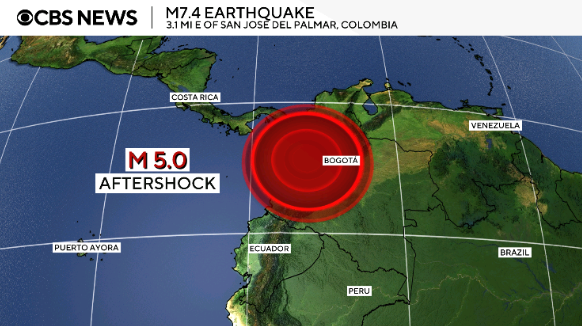







A severe 7.4-magnitude earthquake struck western Colombia on Monday, resulting in at least 51 deaths and leaving numerous people trapped beneath debris. The seismic event caused significant structural damage across the region, with officials reporting an unspecified number of injuries alongside the fatalities.
According to the U.S. Geological Survey and Colombian authorities, the epicenter was located in San José del Palmar, a community of approximately 4,800 residents in the Chocó region, situated about 250 miles west of the capital, Bogotá. A 5.0-magnitude aftershock was recorded by the USGS less than an hour following the initial tremor.
Regional impacts have been severe. Chocó Governor Nubia Carolina Córdoba-Curi confirmed at least four deaths and 69 injuries within her province. Further casualties were reported in neighboring areas, including 27 deaths in the Valle de Cauca department—home to the city of Cali—18 in Pereira, and two in Manizales. The governor noted that at least three of the victims in Valle del Cauca were children.
The impact was felt far beyond the epicenter, triggering evacuations in Bogotá and shaking areas as distant as the coast in Barranquilla and neighboring Ecuador. Valeria Polo, a 29-year-old content creator in Bogotá, described the event by stating, “The quake was very, very strong.”
Emergency teams and residents are currently navigating the wreckage of collapsed buildings in cities including Cali, Manizales, Pereira, and Quibdó. Colombia’s interior minister indicated that more than 20 municipalities have sustained damage. In Manizales, Mayor Jorge Eduardo Rojas reported that over a dozen buildings and 20 homes were destroyed, with images showing a partial collapse of the city’s neo-Gothic cathedral.
In Cali, a city of 2 million, Mayor Alejandro Eder reported that residents remain trapped in at least 20 collapsed structures. Local taxi driver Jorge Moncayo described the scene, noting that his house shook violently as plumes of dust rose across the city, adding, “I’ve never lived through such a powerful earthquake.”
Transportation infrastructure has been significantly disrupted, with flight operations suspended at airports in Pereira, Manizales, Quibdó, and Armenia. In Armenia, residents have been evacuated from their homes due to concerns regarding structural integrity, though Bogotá Mayor Carlos F. Galán reported no such damage in the capital.
Colombian President Abelardo de la Espriella announced he is personally overseeing the emergency response and intends to travel to the affected zone. Meanwhile, U.S. Secretary of State Marco Rubio stated that the Trump administration is monitoring the situation closely and stands ready to provide support.
Colombia’s Geological Service characterized the event as the highest magnitude earthquake recorded in the country in the last decade. While smaller tremors are common in the region, quakes exceeding 6.0 are rare. The affected area, known as Colombia’s coffee region, was previously devastated by a 1999 earthquake that claimed over 1,200 lives. This disaster follows two major earthquakes in late June in neighboring Venezuela, which resulted in more than 5,000 deaths.
“The quake was very, very strong,” Valeria Polo, a 29-year-old content creator in Bogotá, told the Agence France-Presse news agency.
Over a dozen buildings and more than 20 homes were partially or totally destroyed in Manizales, Mayor Jorge Eduardo Rojas said in a video posted on social media.
Jorge Moncayo, a 64-year-old taxi driver in Cali, said he saw plumes of dust shoot up across the city from his home.
In Pereira, photos and videos published by local media showed pieces of the airport ceiling falling down on travelers taking shelter and screaming, and people running through rubble in a panic.
Small earthquakes, known as “temblores,” are common in central and western Colombia, but those above 6.0 magnitude are rare.
Luis Giraldo contributed to this report.