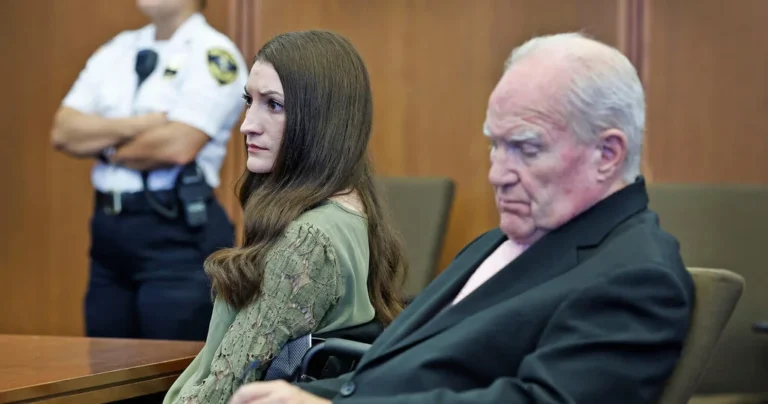
The high-profile trial of 36-year-old Lindsay Clancy has reached a critical juncture, with the central question shifting away from the facts of the incident to the legal definition of criminal responsibility. On January 24, 2023, Clancy’s three children—Cora, 5, Dawson, 3, and 8-month-old Callan—died in their Duxbury home. The prosecution contends that Clancy, who has been held for court-ordered mental health treatment at Tewksbury Hospital since May 2023, meticulously planned the act by sending her husband, Patrick Clancy, on errands before using exercise bands to strangle the children in the basement.
Clancy does not contest the physical acts, which also included her own attempt to take her life by jumping from a second-story window, an event that left her paralyzed. Instead, her defense attorney, Kevin Reddington, argues that she is not guilty by reason of insanity. He maintains that she was suffering from a severe psychotic break triggered by postpartum psychiatric illness and exacerbated by the medications she was prescribed at the time.
Legal analyst Margaret McLean, a former Essex County prosecutor and Boston College law professor, notes that the case hinges on a specific legal threshold. Under Massachusetts law, a defendant is not criminally responsible if a mental disease or defect prevents them from appreciating the wrongfulness of their actions or conforming their behavior to the law. Unlike many other jurisdictions, Massachusetts places the burden of proof on the prosecution to demonstrate beyond a reasonable doubt that the defendant was legally sane at the exact moment of the offense.
McLean described this requirement as a significant hurdle for the state, characterizing the prosecution’s task as a “Mount Everest” of legal challenges. “Even though there’s all this horrible evidence, they still have to prove beyond a reasonable doubt that Lindsay Clancy was legally responsible and legally sane at the exact moment of the offense,” she stated.
The prosecution rested its case on August 17 after presenting testimony from over 70 witnesses, including first responders, medical professionals, and Patrick Clancy. Plymouth County Assistant District Attorney Shanan Buckingham argued that the defendant was a “controlling, meticulous and manipulative” individual who sought “quick and easy” fixes for her anxiety rather than genuine treatment. Buckingham emphasized that the trial is focused strictly on the defendant’s actions, stating, “This is not a public debate about women’s mental health and how the medical system treats women. This case is about this defendant, Lindsay Clancy.”
The defense has countered with testimony from family members, including Clancy’s mother and sister, who detailed her deteriorating mental state in the months leading up to the tragedy. Psychologist Paul Zeizel, a witness for the defense, testified that he believed Clancy was experiencing psychosis and “had no appreciation for the wrongfulness of her act” when the deaths occurred. Reddington has consistently portrayed his client as a loving mother who was overwhelmed by a medical crisis.
Despite the defense’s strategy, legal experts remain divided on the outcome. Chris Slobogin, director of the criminal justice program at Vanderbilt University, noted that while the burden of proof shift is notable, juries are historically skeptical of insanity defenses. Research suggests such defenses succeed in only about 25% of cases, and the specific impact of the burden of proof on jury deliberations remains uncertain.
As the trial moves toward a verdict, the jury faces the difficult task of reaching a unanimous decision. McLean warned that the emotional and complex nature of the evidence will likely lead to intense debate in the jury room. If found not criminally responsible, Clancy would typically be committed to a state facility for ongoing mental health evaluation and treatment. If convicted of first-degree murder, she faces a mandatory sentence of life in prison without the possibility of parole. The report also notes that the defense has to prove a lack of criminal responsibility, more commonly known as an insanity defense, but Massachusetts shifts that burden onto the prosecution, McLean explained, in most states. The report also notes that prosecutors questioned Patrick Clancy about her efforts to get mental health treatment and played the heart-wrenching 911 call he made in January 2023 when he found his children for the courtroom. The report also notes that asked which side she believes has the greater challenge, McLean said the prosecution. The report also notes that whether in fact the switch of the burden to the prosecution makes a big difference is not at all clear,” he said. The report also notes that and described her as a doting mother who “tried very hard to get the help she needed, he alleged that she heard a male voice telling her to commit the killings. The report also notes that these children were loved and nurtured and cared for by her,” he said. The report also notes that she didn’t want to get rid of her kids because of her selfish life as the government indicates.