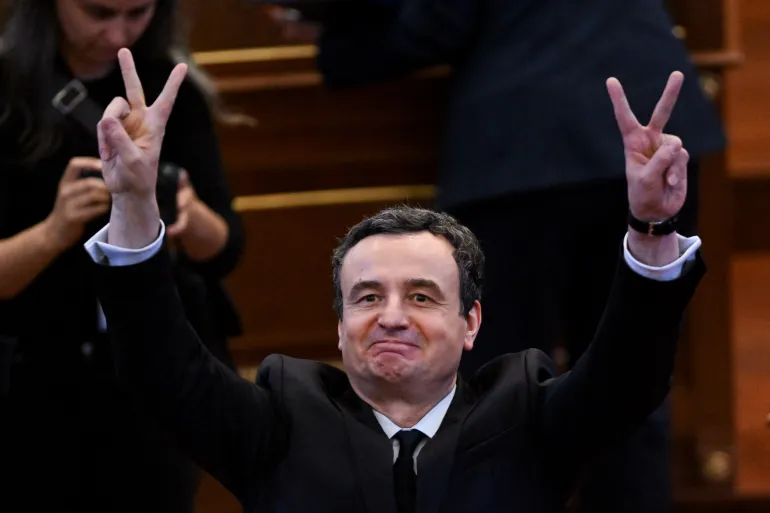







Kosovo’s parliament has officially ratified a new government led by acting Prime Minister Albin Kurti, an outcome that concludes three months of severe political inertia. According to Parliamentary Speaker Albulena Haxhiu, the administration secured the backing of 62 lawmakers within the 120-seat assembly on Sunday. Despite this success, the administration faces an immediate and uncertain road ahead regarding the selection of a new head of state, an issue that threatens to force the country into its fourth snap election in just two years.
The current instability stems from the requirement that the president must be elected by a two-thirds majority in parliament. Although Kurti’s Vetevendosje party has consistently outperformed its rivals in three legislative cycles since February 2025—most notably in snap polls held in December 2025 and June 2026—it has been unable to bridge the gap with opposition groups to clear that parliamentary threshold. In a late August effort to resolve the stalemate, Kurti secured an agreement with the Democratic League of Kosovo (LDK) to endorse law professor Bekim Sejdiu for the presidency. However, the coalition remains fragile, as six LDK parliamentarians publicly declared they would not adhere to their party leadership’s support for the candidate.
This political dysfunction is significantly exacerbated by the government’s approach to Serbia. Critics and opposition factions have accused Kurti of undermining Kosovo’s relationships with Western partners, specifically the United States and the European Union. These international allies previously pressured the administration to lower regional tensions after violent encounters occurred between local police and armed Serbian “paramilitary formations” in the north. The resulting diplomatic friction has complicated internal negotiations, with many opposition parties hesitant to align with a government they believe has isolated the nation on the international stage.
Beyond the constitutional crisis, the ongoing lack of a functional political consensus has brought tangible negative consequences to the country. The protracted deadlock has effectively frozen critical legislative reforms intended to advance Kosovo’s European Union integration process. These delays have jeopardized the country’s access to vital pre-accession financial support, leaving the government to balance a fragile domestic mandate against growing external and economic pressures as they prepare for the inevitable showdown over the presidency. The report also notes that it is currently unclear when a presidential vote will take place.