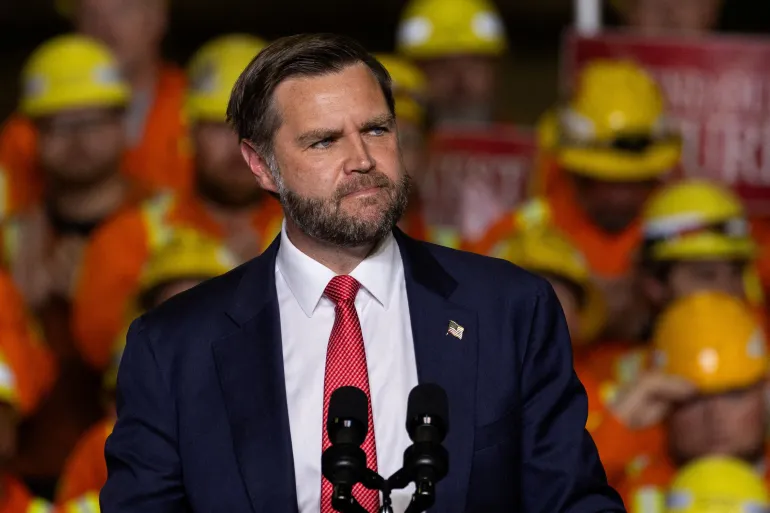







Vice President JD Vance returned to his hometown of Middletown, Ohio, on Friday to rally Republican support ahead of the critical November midterm elections. Speaking at the steel plant where his late grandfather once worked, Vance sought to energize the base while addressing shifting voter sentiment regarding the national economy.
A centerpiece of his appearance was the announcement of a $1 billion investment from steel manufacturer Cleveland-Cliffs, bolstered by $500 million in government awards. Vance framed this funding as evidence of the current administration’s commitment to revitalizing the American manufacturing sector and strengthening the national economy. He acknowledged the challenges ahead, noting that while progress is not instantaneous, the administration has overseen significant rebuilding in the American heartland over the past 18 months, attributing this growth to President Donald Trump’s policies.
The rally comes at a pivotal moment for the Republican Party, which is fighting to maintain its majorities in both chambers of Congress. The outcome of these midterm races will determine the legislative landscape for the final two years of Trump’s presidency, with potential implications for his policy agenda and political standing. Recent polling data suggests the economy remains the primary concern for voters, though public confidence in Republican economic management has wavered. A July survey indicated that 37 percent of voters favored the Democratic approach to the economy compared to 36 percent for Republicans, a shift further supported by a Reuters-Ipsos poll this month that showed Democrats gaining a slight edge on the issue—a reversal of a trend that had persisted since 2017.
While President Trump has dismissed concerns over the cost of living as a partisan “con job,” Vance adopted a more measured tone during his address. He admitted that there is still significant work to be done but emphasized ongoing efforts to improve housing affordability. “We got a lot of work to do, but we’re making progress on all the things that matter the most,” Vance stated.
The event also served as a platform to attack Democratic opponents. Vance criticized former Senator Sherrod Brown, who lost his seat to Republican Bernie Moreno two years ago, accusing him of failing to represent Ohioan interests. He specifically blamed Brown for aligning with the policies of former President Joe Biden, alleging that those actions contributed to inflation and harmed American industry. Furthermore, Vance repeated claims targeting Michigan Senate candidate Abdul El-Sayed, alleging that the candidate supported the implementation of Sharia law in the United States—a claim El-Sayed has faced previously.
As the campaign intensifies, Republicans are working to defend their influence in regions like the Rust Belt, which has trended conservative since 2016. The special election to fill the Senate seat vacated by Vance remains a focal point, with Republican nominee Senator Jon Husted appearing alongside the vice president to rally supporters. With Trump’s current approval rating at 33 percent according to recent Reuters-Ipsos polling, the party is intensifying its outreach efforts to secure a favorable outcome in November. The report also notes that “I’m not saying it’s going to be easy – or it’s all going to happen overnight – but in just 18 months, we have seen an explosion of rebuilding in the American heartland,” Vance said, crediting the growth to policies under President Donald Trump. The report also notes that should their hold on the legislature slip, Democrats could stymie Trump’s policy priorities for the last two years of his presidency — or even impeach him, as Trump himself has suggested. The report also notes that polls have shown that the state of the economy remains the top issue ahead of the midterms. The report also notes that but how voters perceive each party’s ability to address economic strain has shifted. The report also notes that the Pew Research Center found that voters were more likely to favour Republican policies on the economy, before the start of Trump’s second term. The report also notes that in July, however, the dynamic had switched: Thirty-seven percent of those surveyed backed the Democratic approach to the economy, compared with 36 percent for Republicans. The report also notes that another poll this month from the news agency Reuters and the firm Ipsos likewise found slightly more respondents siding with the Democrats on economic policy than Republicans, upending a longtime trend that stretched back to 2017. The report also notes that trump, for his part, has publicly appeared to dismiss cost-of-living issues as a partisan invention, calling questions of affordability a “hoax” and a “con job” engineered by Democrats.