








Qatari Prime Minister Sheikh Mohammed bin Abdulrahman bin Jassim Al Thani is traveling to Tehran this Thursday to lead discussions aimed at lowering regional tensions and reviving stalled negotiations between Iran and the United States. As both Qatar’s foreign minister and a key behind-the-scenes mediator, Sheikh Mohammed intends to meet with various Iranian officials to explore ways to end ongoing hostilities and establish conditions conducive to renewed dialogue.
A central focus of these discussions is the status of the Strait of Hormuz. The vital waterway, which handled over one-fifth of global oil and gas supplies prior to the conflict, has remained largely shuttered since early March. Sheikh Mohammed is expected to advocate for a return to the operational status quo that existed before February 28, a move essential to stabilizing global energy markets currently gripped by crisis.
The Qatari visit follows a series of high-level diplomatic missions to Tehran. On Monday, Pakistan’s army chief, Asim Munir, held meetings with Iranian President Masoud Pezeshkian, Parliament Speaker and chief negotiator Mohammad Bagher Ghalibaf, and General Mohsen Rezaei, the recently appointed secretary of Iran’s Supreme National Security Council. During these interactions, Iranian officials signaled deep-seated distrust toward the United States, with Rezaei emphasizing that Tehran prefers to negotiate from a position of strength rather than weakness.
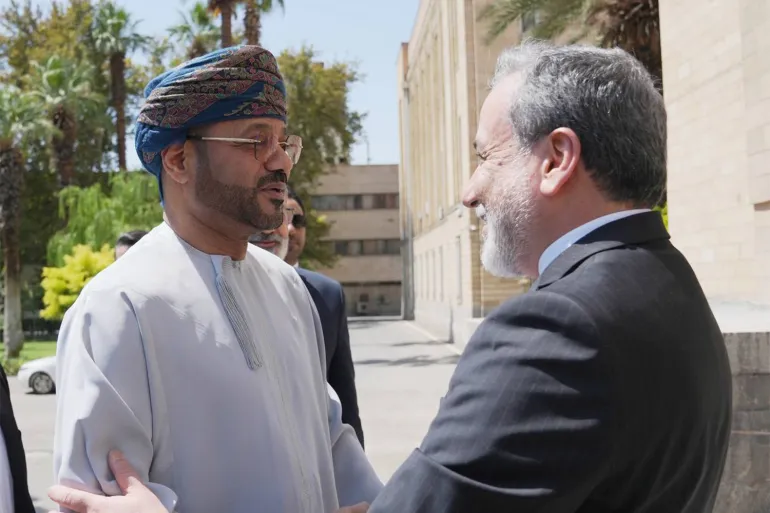
Oman has also been deeply involved in the mediation process. On Tuesday, Omani Foreign Minister Badr Albusaidi met with his Iranian counterpart, Abbas Araghchi, to address the Strait of Hormuz, which serves as the conflict’s primary flashpoint. Following these talks, Iranian Deputy Foreign Minister Kazem Gharibabadi announced a tentative agreement on a temporary shipping route. This arrangement would allow vessels to enter through Iranian waters while granting Tehran partial control over exit routes. However, Iran maintains that the strait will not fully reopen until the United States lifts its sanctions and unfreezes Iranian assets.
Despite these diplomatic overtures, the official state of war persists, with both Washington and Tehran claiming the other is defeated. The United States has pivoted toward a strategy of economic pressure, recently announcing a broad set of sanctions targeting over 60 individuals and organizations across the digital asset, technology, gold, aviation, and shipping sectors. These measures affect entities in countries including China, the UK, Syria, France, Malaysia, and Singapore. In a letter to the United Nations on Wednesday, Foreign Minister Araghchi condemned these actions as “state and economic terrorism.”
Washington’s current approach, characterized by a naval blockade of Iranian ports and secondary sanctions on trade partners, aims to create what analyst Ali Vaez of the International Crisis Group describes as a “financial apocalypse.” While President Donald Trump stated on Wednesday that he is in “no hurry” to resume direct talks, believing that economic and military pressure remains effective, the administration is simultaneously adjusting its diplomatic footprint in the region.
Starting next week, the United States will begin returning diplomatic staff to various Middle Eastern stations that were evacuated following the February strikes on Iran. While the full scope of this return remains unclear, reports indicate that posts in Jordan, Israel, and Oman will be fully restored. Missions in the UAE, Saudi Arabia, Qatar, and Lebanon will be capped at 85 percent capacity, while those in Iraq, Kuwait, and Bahrain will operate at 75 percent. Analysts suggest this move reflects a growing confidence in Washington that the conflict will not escalate into a broader military confrontation, even as face-to-face negotiations remain difficult.
The situation remains complex, as the US continues to oppose Iranian control over the Strait of Hormuz, favoring a return to unrestricted international passage. Although President Trump recently declared that all sea mines had been cleared from the area, experts warn that residual hazards persist. As the diplomatic push continues, the international community remains focused on whether these regional visits can bridge the wide gap between the two nations’ entrenched positions. The report also notes that with mediators rallying to persuade the warring sides back to the negotiating table despite continued hardline posturing on both sides, his visit comes amid a flurry of high-level delegations travelling to Tehran in recent days. The report also notes that qatar is a key behind-the-scenes negotiator between Washington and Tehran and was pivotal in securing a memorandum of understanding (MoU) in June that briefly paused hostilities, but the deal has since expired. The report also notes that the two countries have been negotiating how to jointly govern the shared passageway for weeks. The report also notes that a major obstacle is the closed Strait of Hormuz. The report also notes that are there signs diplomacy is working. The report also notes that uS staff and their family members were withdrawn after the US and Israel launched strikes on Iran in late February. The report also notes that uS embassies in Saudi Arabia and Kuwait were temporarily shut down after coming under fire. The report also notes that however, statements from both sides stand in stark contrast to the new push for peace.