
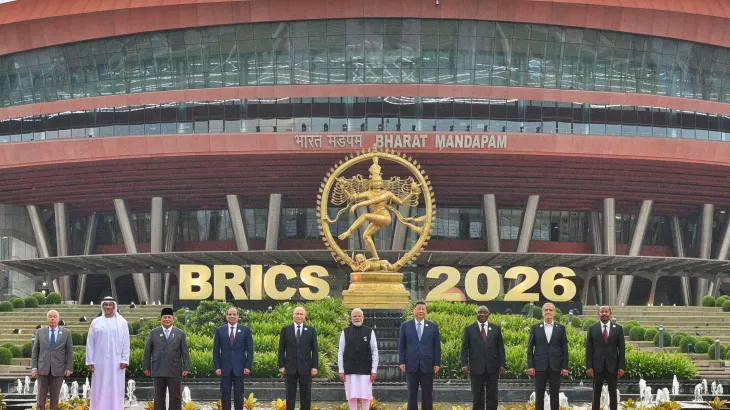






The BRICS group of nations has officially adopted a joint declaration during its summit in New Delhi, emphasizing the urgent need for stability in the Middle East and the preservation of global trade, energy, and supply chain integrity. Indian Prime Minister Narendra Modi is hosting the two-day event, which marks a significant moment for the 11-member bloc as it navigates complex geopolitical divisions and economic pressures.
The summit, which began on Saturday, includes high-profile attendance from leaders such as China’s President Xi Jinping, Russia’s President Vladimir Putin, and Iran’s President Masoud Pezeshkian. This gathering takes place as the organization marks its 20th anniversary, with the presidency currently held by India. The bloc faces a challenging landscape defined by ongoing conflicts in Ukraine and the Middle East, which have severely disrupted global shipping and energy markets.
In their joint statement, the member nations expressed “deep concern over the continued escalation of tensions” across the Middle East. The declaration explicitly called for “maximum restraint” and issued a warning against targeting civilian infrastructure or nuclear facilities. Regarding the situation in Palestine, the bloc reaffirmed its “firm opposition” to the forced displacement of Palestinians and any attempts to alter the demographic or geographic character of the occupied territories. Furthermore, the group advocated for an end to violence in Gaza, support for UNRWA, and the full integration of Palestine into the United Nations.
President Xi, making his first visit to India in seven years, remarked that the regional conflict serves no one’s interests. He noted that the ongoing instability has caused significant suffering and does not align with the common goals of the international community. During bilateral discussions on Friday, Prime Minister Modi met with President Putin to discuss strengthening ties, and separately with President Pezeshkian to address maritime security concerns, specifically the freedom of navigation for crews in the Strait of Hormuz.
The summit also serves as a platform for discussing broader economic initiatives, including the development of non-Western cross-border payment systems and cooperation on artificial intelligence. A significant portion of the agenda focuses on opposing unilateral sanctions and tariffs. Finance ministers and central bank governors within the bloc have voiced strong objections to trade measures they argue are inconsistent with World Trade Organization (WTO) rules and distort global markets.
These economic concerns are heightened by the stance of the United States, where President Donald Trump has labeled the bloc “anti-American” and threatened to impose punitive tariffs on nations that align with it. The U.S. has already implemented various tariffs on several BRICS members, often linking their removal to specific policy shifts within those countries. This creates a delicate balancing act for New Delhi as it attempts to manage trade, finance, and energy security while fostering unity among an expanded membership.
The summit features participation from a wide array of global leaders, including South Africa’s Cyril Ramaphosa, Egypt’s Abdel Fattah el-Sisi, Ethiopia’s Abiy Ahmed, and Indonesia’s Prabowo Subianto. The United Arab Emirates is represented by the Crown Prince of Abu Dhabi, Sheikh Khaled bin Mohamed bin Zayed Al Nahyan, while Brazil’s Foreign Minister Mauro Vieira is attending on behalf of President Luiz Inacio Lula da Silva. High-level officials from the UN, WTO, and WHO are also in attendance.
During a closed session, Egypt’s President el-Sisi highlighted the critical link between regional security and economic development, urging the international community to protect the stability of global navigation. The presence of both Iran and the UAE at the summit underscores the bloc’s internal diversity, as these nations find themselves on opposing sides of the ongoing conflict involving the United States and Israel.
While last year’s summit resulted in a joint declaration condemning the U.S.-Israeli bombing campaign against Iran’s leadership and nuclear program, recent diplomatic efforts have been more strained. A meeting of BRICS foreign ministers in May concluded without a consensus statement on the conflict, highlighting the difficulty of maintaining a unified front. As the alliance looks toward the future, the primary test remains whether its expanded membership can effectively empower the Global South in the face of these mounting international pressures. The report also notes that “As the situation in the Middle East and the Gulf region continues to evolve, the war there has caused serious losses to people across the region,” China’s Xinhua quoted Xi as saying. The report also notes that it has since expanded to include other states.