
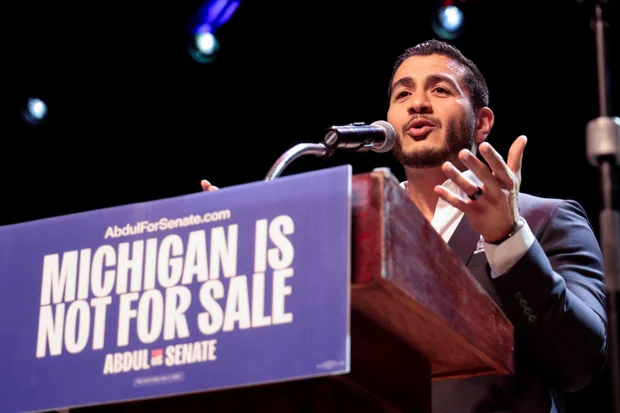









WASHINGTON — projects that former Michigan health official Abdul El-Sayed has defeated Rep. Haley Stevens in the state’s Democratic Senate primary. The outcome serves as a significant indicator of the current ideological tensions within the Democratic Party.
El-Sayed, 41, campaigned on a progressive platform, earning endorsements from high-profile figures such as Sen. Bernie Sanders and Rep. Alexandria Ocasio-Cortez. The race narrowed into a clear ideological choice after state Sen. Mallory McMorrow withdrew from the contest last month. Conversely, 43-year-old Rep. Stevens, who has served in the House since 2019, ran with the support of Senate Minority Leader Chuck Schumer and outgoing Gov. Gretchen Whitmer, positioning herself as the moderate alternative.
The vacancy emerged following Sen. Gary Peters’ decision not to seek reelection. With his primary victory secured, El-Sayed will now face Republican former Rep. Mike Rogers in the November general election. Rogers, who ran unopposed in his primary, previously challenged Sen. Elissa Slotkin for Michigan’s other Senate seat in 2024. That earlier race provided Rogers with an extended period to refine his general election strategy while the Democratic primary became increasingly contentious.
Following the results, Stevens congratulated El-Sayed on Wednesday morning and pledged her support for the general election. She emphasized the importance of party unity, stating, “Donald Trump and Mike Rogers want us to come out of this primary tired and divided, so their billionaire backers can come in and let multimillionaire Mike Rogers walk away with this Senate seat. I’m not going to let that happen,” while warning of the consequences if the GOP captures the seat.
Michigan remains a critical battleground state that has fluctuated between parties in recent presidential cycles. National Democrats had favored Stevens, arguing that her moderate profile offered a more electable path in a swing state. Addressing these concerns, El-Sayed noted that the state’s history of voting for Donald Trump twice suggests a deep-seated frustration with the political establishment rather than a preference for moderate candidates. He expressed confidence in his ability to offer a different alternative, stating, “I’m willing to test that proposition,” and contrasting his background as a doctor who focuses on public health with the “narcissistic, megalomaniacal” nature of his opponents.
El-Sayed’s campaign focused on policies such as Medicare for All and included vocal criticism of the Israeli government and the conflict in Gaza. These positions resonated in a state that hosts the largest concentration of Arab Americans in the U.S. Throughout the race, he faced scrutiny for his association with left-wing podcaster Hasan Piker, while simultaneously criticizing Stevens for accepting significant financial support from pro-Israel organizations.
This victory follows a trend of insurgent Democratic candidates challenging the party establishment in regions like Colorado and New York City. As Democrats look to overcome a 53-seat Republican majority in the Senate, they must flip four seats while defending vulnerable territory in Michigan. In a joint statement, Schumer and Democratic Senatorial Campaign Committee chair Sen. Kirsten Gillibrand praised El-Sayed for his “energetic campaign that inspired thousands of Michiganders.” They added, “Democrats are united by a common purpose: putting a check on Donald Trump by defeating his Republican enablers and taking back the Senate. We look forward to working with Abdul and Democrats across Michigan to win this seat in November.”
El-Sayed, 41, ran on a leftist platform and secured the backing of prominent progressives like Rep.
Elissa Slotkin in the 2024 race for Michigan’s other Senate seat, giving him months to home in on his general election pitch while Democrats’ primary fight grew increasingly ugly.
Asked about the dynamic, El-Sayed told ‘ Ed O’Keefe ahead of the primary that “it’s always funny to me that people want to say that this state votes for moderates when it voted for Donald Trump twice.”
“It may just be that the better explanation is not that the state wants moderates, it’s that it’s so sick and tired of the establishment bought off by corporations on both sides of the political aisle, that it was willing to hold its nose and vote for Donald Trump twice,” he added.
“Now, what happens if the alternative to the bought-off establishment happens to be instead of a narcissistic, megalomaniacal billionaire, a doctor who rebuilds health departments to eliminate medical debt and put glasses on kids’ faces?
The dynamic has been a defining feature of the primary cycle so far.
But how it will play in November — especially in battleground states like Michigan — remains to be seen.
The issue has been central to the campaign in the Great Lakes State, which is home to the largest concentration of Arabs in the U.S.
With 53 Republicans in the Senate, Democrats need to flip four seats, while fending off GOP inroads in Michigan and elsewhere to take the majority.