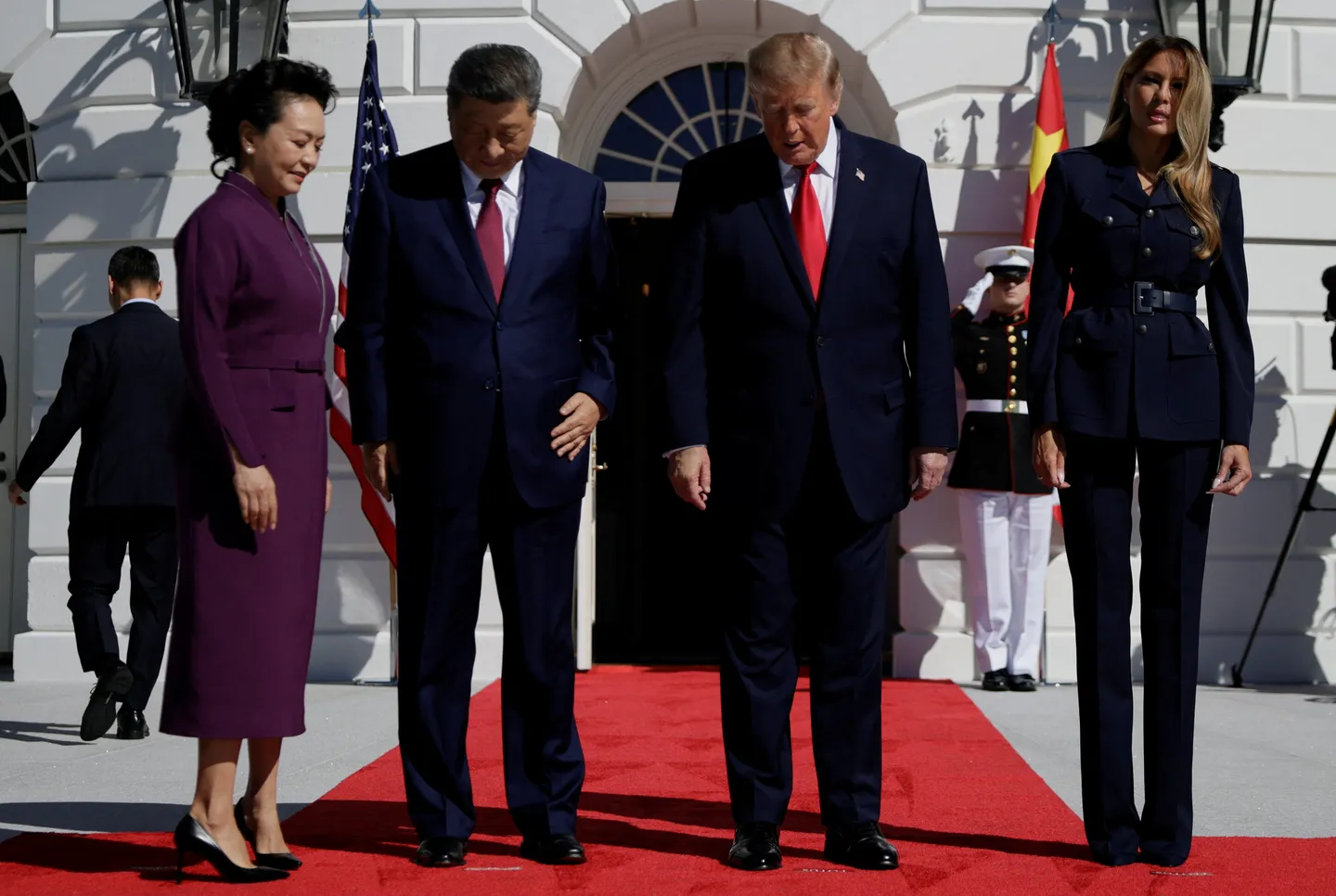




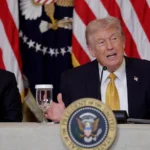



Chinese President Xi Jinping and US President Donald Trump met at the White House in Washington on September 24, amidst ongoing conflicts across Eurasia, spanning from Ukraine to the Persian Gulf and Gaza. The meeting sparked hopes for improved relations between the two global powers. Since Trump’s May meeting with Xi in Beijing, US-China relations have faced disruptions on several fronts, from the collapse of the Iran ceasefire and the closure of the Strait of Hormuz to new US sanctions on buyers of Russian oil, accusations over AI model theft and tensions over Taiwan. Despite these disruptions, Xi, who was notably absent from last week’s UN meeting, travelled to Washington, where Trump greeted him at the airport with a red-carpet welcome.
The leaders engaged in a cordial exchange, with President Trump expressing optimism for “harmony, peace and success” in future US-China ties. President Xi, in turn, spoke of “charting the course for the great shift of China-US relations,” suggesting a significant turning point in their relationship.
Despite the positive tone, the summit concluded without substantial agreements on critical disputes. A two-month truce was established for $30 billion in goods, but key issues such as a timeline for resolving tariff differences, the status of Taiwan, and the conflict with Iran were left unaddressed, effectively deferring these contentious matters to future discussions.
Analysts emphasize the importance of such high-level meetings, even when they primarily serve as diplomatic holding patterns. Dan Steinbock, an international economist and geopolitical analyst, said that the current international landscape is “potentially more perilous than at any time since 1945,” citing a stagnant global economy and highly fractured geopolitics. He stressed that a US-China summit, even if just to manage friction and ensure future exchanges, is vital.
Compared to the former Soviet Union, China presents “fundamentally different, and in many ways more difficult, challenges” to the Western world, according to Steinbock. He noted that China’s “ideological system and approach are more sophisticated,” bolstered by its expanding economic and technological capabilities.
The cordial meeting, described by President Xi as a “historic juncture,” holds significance for both US interests and the broader direction of global politics. Xi stated that “China and the United States must act as responsible major countries to meet the expectations of our peoples, keep pace with the trend of our times, and explore a new approach for major countries to get along with each other.” “That is a strong signal that both sides want to keep moving forward. “Trump admires strong men such as Xi, and Xi almost certainly knows that the best way of handling Trump is to smile and be polite.
Altay Atli, a senior scholar at Sabanci University’s Istanbul Policy Center, highlighted the importance of the meeting itself, regardless of immediate problem-solving. “We shouldn’t judge these summits by whether they solve problems, because that’s not their purpose,” Atli explained. “The fact that this meeting took place at all is in itself a good thing.
The visit marked a notable diplomatic gesture, as it was the first time in 11 years that a US president personally greeted a Chinese leader at the airport. Atli characterized the visit as a “significant political development,” viewing it as a “summit of stabilisation rather than radical change.” “It would be unwise to speculate on what goes through the mind of either leader. But certainly Xi came to Washington with a clear idea of what he has been seeking for some time and there is no indication or likelihood that he deviated from that,” he tells.
Despite conciliatory gestures, experts remain skeptical that the two-month trade truce will lead to lasting economic peace. Atli emphasized that “truces happen during wars, but this is far more than a trade or economic war. As Chinese leaders often say internally, it is primarily a science and technology war, then a systems war, an values/ideology war.”
Unlike the Soviet Communist Party, the Chinese Communist Party (CCP) has undergone various transformations under different leaders, adopting a semi-capitalist model in response to Western global dominance. Washington, conversely, perceives Beijing as actively “trying to unseat it as the leading global power.”
These increasingly negative perceptions on both sides suggest that the recent summit is unlikely to provide “a recipe for lasting peace.” Atli further noted that while “Xi can afford to wait but Trump can’t,” both leaders ultimately seek “a stable balance, where competition and cooperation exist side by side,” which he considers “more realistic and achievable than a permanent economic peace.” While still seeing potential for a managed relationship in which the two countries develop mechanisms to address their differences, other analysts also caution against expecting a permanent settlement.
The next scheduled meeting between the two leaders is set for the APEC summit in Shenzhen in November, followed by the year’s final meeting at the G20 gathering in Miami in December.
Since 2017, Beijing has made significant advancements in areas such as electric vehicles, clean energy, and AI, while strengthening its global standing through international groupings like BRICS and the Shanghai Cooperation Organisation (SCO).