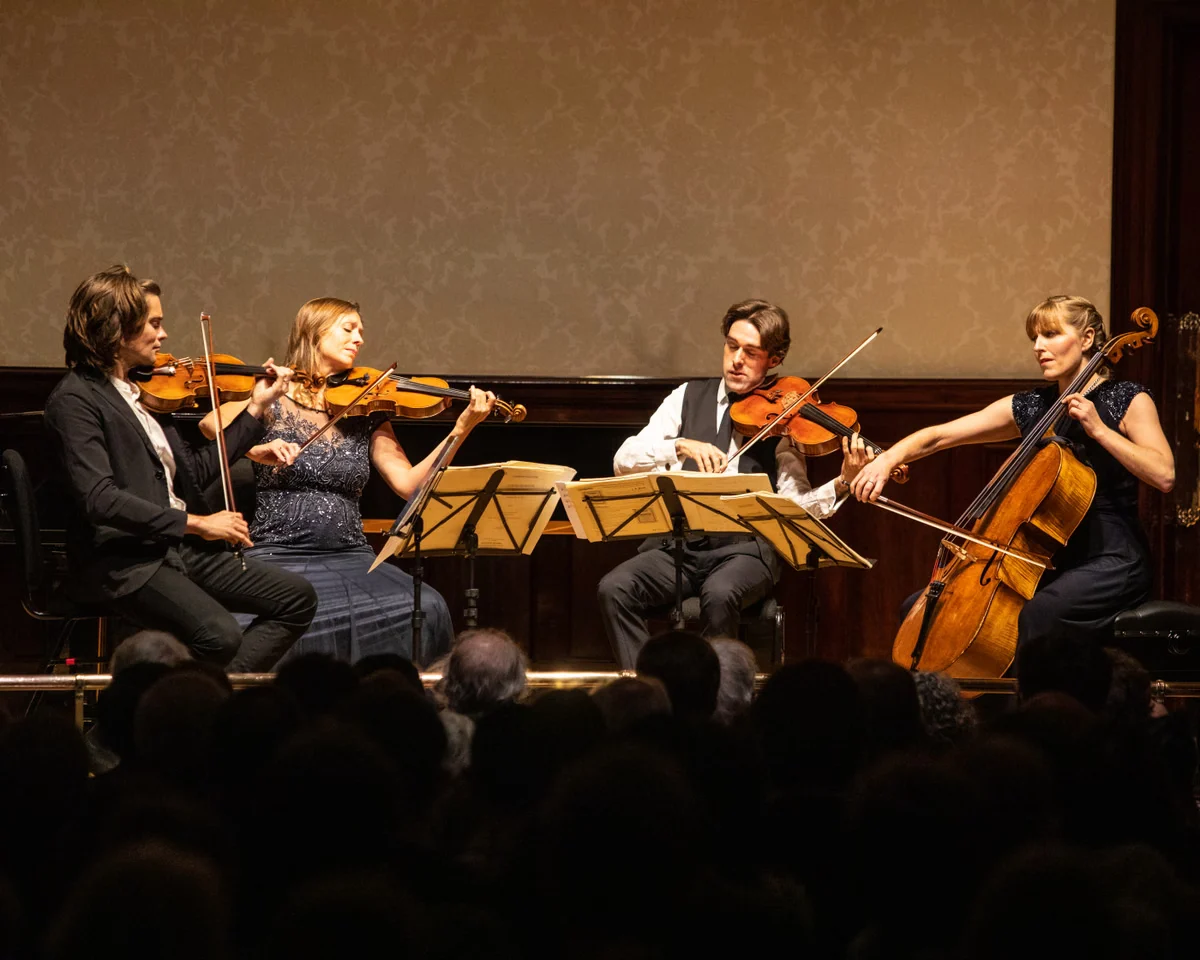









For generations, musicologists have grappled with the elusive quality that distinguishes the masters of the classical canon, often relying on subjective analysis to define their greatness. An 18-year-old student from Philadelphia, Linus Chen-Plotkin, has taken a more rigorous approach, utilizing data and statistical modeling to measure the unpredictability of compositions by Mozart, Haydn, Beethoven, and Schubert.
By processing 600 movements of piano sonatas and string quartets through custom software, Chen-Plotkin applied Markov chains and other mathematical tools to identify patterns in their melodies. The findings suggest that Mozart’s compositions possess a shorter musical memory compared to his contemporaries. This indicates that Mozart frequently established listener expectations only to deliberately confound them, creating a melodic flow that feels consistently surprising.
This analytical result mirrors observations long held by musicians, such as the unexpected harmonic shifts found in the opening of Mozart’s E flat major quartet (K428) or the Dissonance Quartet (K465). However, Chen-Plotkin cautions that his data has limitations. He suggests that while Mozart’s melodies are uniquely unpredictable on a moment-to-moment scale, Beethoven or Haydn might prove more innovative if the study focused on broader structural unpredictability across entire movements.
Chen-Plotkin maintains that his research is intended to complement, not replace, traditional musicology, and he remains skeptical of utilizing generative AI in creative pursuits. As he prepares to begin his university studies this autumn—with plans to apply similar computational techniques to the works of Chaucer—he underscores the potential for statistical analysis to illuminate the mechanics of human creativity.
Coinciding with these musical discoveries, the Royal Philharmonic Orchestra (RPO) is marking its 80th anniversary this week. The ensemble holds a storied legacy, from its pioneering 1950s and 60s recordings of Sibelius under founder Thomas Beecham, to its transformative years with Rudolf Kempe. Despite its artistic heights, the orchestra’s history is complex; Beecham enforced a men-only policy until his death in 1961, and the RPO did not hire its first female musician, clarinettist Prudence Whittaker, until over a decade later.
The RPO has traversed a wide spectrum of the musical landscape, from performing the Champions League theme and achieving 1980s pop-culture kitsch with “Hooked on Classics,” to playing at King Charles’s coronation in the 2020s. More recently, the ensemble made headlines for a performance featuring Mandle Cheung, who reportedly paid an undisclosed sum for the opportunity to conduct Mahler’s Resurrection Symphony.
Under the music directorship of Vasily Petrenko since 2021, the orchestra continues to navigate its diverse history. Meanwhile, contemporary explorations of the repertoire, such as Riccardo Minasi’s recent recording of Mozart’s final three symphonies with Ensemble Resonanz, continue to highlight the volatility and imagination embedded in the composer’s work. The ferocity of such interpretations proves that the unpredictable nature of Mozart’s music is not an anomaly, but a fundamental element of his enduring appeal. The report also notes that an 18-year-old US student has managed to prove through a combination of data and interpre, what generations of music analysts have tried and largely failed to do through imperfect means of variously subjective techniques. The report also notes that you can instinctively hear that at work in so many moments of his string quartets: the opening idea of the E flat major quartet, K428, which is already slipping out of the realms of the expected as early as its third no. The report also notes that i t’s a question that has taxed musical thinkers for centuries: just what is it about one composer’s music that makes it more distinctive than anyone else’s. The report also notes that of music analysis and historical musicology, as well as the formation of classical music’s canon of “great” composers, have been given over to this single idea: can it be proved that Mozart, say, was measurably “better” than other composers, entire disciplines of academic thought. The report also notes that but accounting for precisely how his pieces can sustain a lifetime of listening, why their pleasures never seem to pall and are still capable of seeming to surprise us even when we know them inside out: that’s the million-dollar musicological question, our instinctive feeling about the sensual magic of Mozart’s music is part of the equation. The report also notes that that means the way they move is less predictable: that Mozart sets up patterns of expectation in his melodies and ideas that he confounds rather than confirms.