
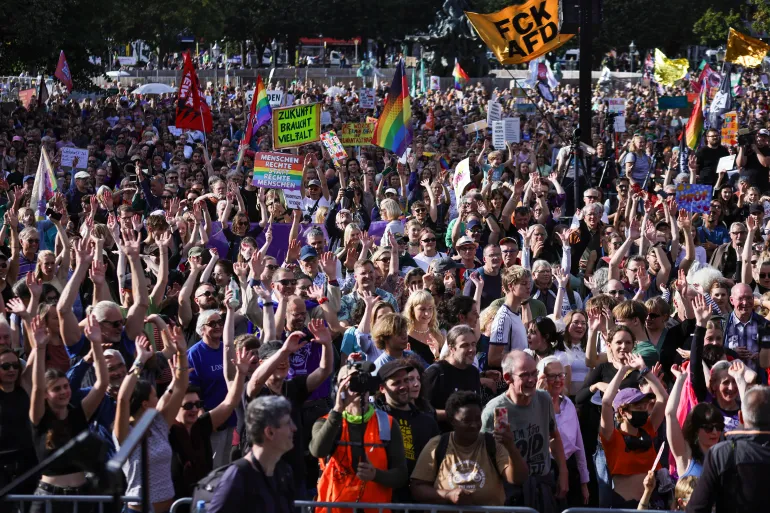









Massive demonstrations took place across Germany on Saturday as approximately 150,000 citizens mobilized in roughly 20 cities to voice their opposition to the far-right Alternative for Germany (AfD). The rallies, spearheaded by the campaign group Pruef, included significant turnouts in Berlin, Hamburg, and Munich. Participants carried signs with messages such as “Ban the AfD now” and “Democracy needs no alternatives.”
The wave of protests was prompted by the AfD’s significant performance in the September 6 election in Saxony-Anhalt. The party captured nearly 44 percent of the vote, significantly outpacing the Christian Democratic Union (CDU) led by Chancellor Friedrich Merz, which secured roughly 17 percent. Christoph Bautz, head of the activist group Campact, described the protests as a broad societal effort to prevent entities deemed enemies of the constitution from securing government power. Campact reported turnout figures of 25,000 in Hamburg and 12,000 in Munich, while police confirmed several thousand additional protesters gathered in the capital.
While the protest movement intensified, the AfD conducted its own counter-rally in Berlin featuring regional lead candidate Kristin Brinker. The party is currently projected to win 39 of the 83 seats in the Saxony-Anhalt state parliament, leaving it just three seats short of an outright majority. This creates a challenging political landscape, as the AfD must secure a coalition partner to govern. Historically, mainstream parties have maintained a “firewall” policy, refusing to enter governing coalitions with the AfD at any level.
AfD state leader Ulrich Siegmund characterized the election results as a historic mandate for political change, signaling a potential shift in strategy by expressing openness to working with other parties despite earlier suggestions that he preferred to govern alone. If the party succeeds in forming a government, it would mark the first time a far-right group has led a German state since 1945.
The potential for the AfD to gain regional power has caused widespread concern in Germany, a nation deeply committed to preventing a recurrence of its mid-20th-century history. Although these developments have sparked urgent calls to legally ban the AfD, experts note such a move would face substantial legal hurdles, and Chancellor Merz has thus far shown reluctance to pursue that path. The report also notes that the AfD, known for its anti-immigration stance and friendly posture towards Russia, fell just short of an outright majority and is now in talks with other parties to try to form a government, which would make it the first far-right party to lead a German state since the Nazi era ended in 1945.