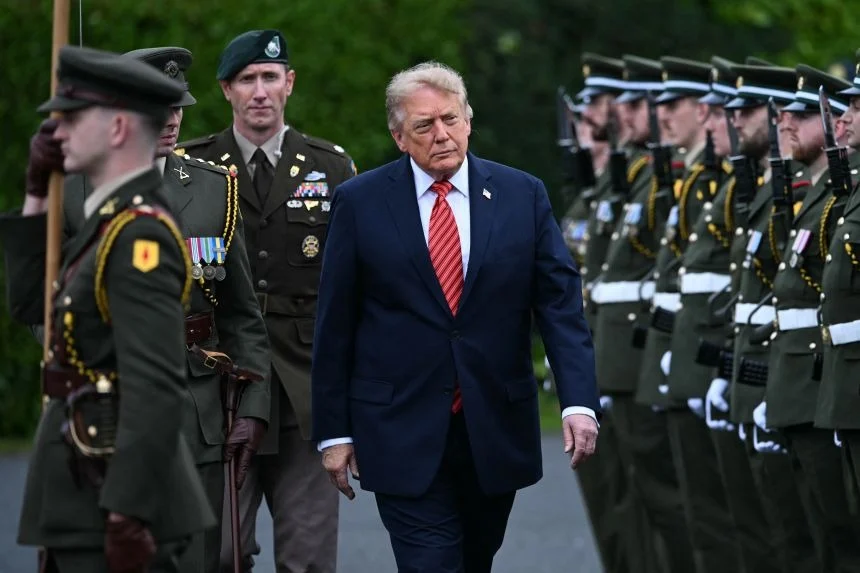







President Donald Trump arrived in Ireland on Saturday for a series of high-level meetings, using the visit to voice support for the eventual reunification of Ireland. During a bilateral session with Taoiseach Micheál Martin, the president remarked that reunification “would be a fantastic thing” and suggested it is a development that is “going to happen eventually.” While acknowledging the sensitivity of the topic, Trump stated he would “love to see it unified,” characterizing such a move as a potential “great feather in everybody’s cap.”
The comments drew immediate pushback from political figures in the United Kingdom and Northern Ireland. Downing Street referenced recent remarks by Prime Minister Andy Burnham, who in August dismissed the prospect of an imminent border poll in Northern Ireland, noting the issue is currently “off the table.” Burnham further affirmed his commitment to the 1997 Good Friday Agreement, which established the framework for peace in the region. Gavin Robinson, leader of the Democratic Unionist Party, asserted that the future of Northern Ireland remains a matter for its own people rather than external commentary from London, Dublin, or Washington.
The reunification of Ireland remains a deeply divisive subject, historically split between Unionists who favor remaining part of the United Kingdom and those seeking a united Ireland. The Good Friday Agreement mandates that any change in status would require a majority of voters in both the north and south to support such a move in border polls. Despite the complexity, Trump expressed confidence in the process, telling Martin, “You’ve got the right man over here to get it moving.”
The president’s visit comes at a pivotal political moment, occurring just weeks before US midterm elections and amid rising international tensions, including the rapid advance of Iran-backed Houthi forces in Yemen. Upon landing in Dublin, Trump was greeted by officials alongside his son, Donald Trump Jr., and his wife, Bettina. The visit included a formal courtesy call with Irish President Catherine Connolly, during which the two leaders observed a performance of the American and Irish national anthems. In a statement, Connolly’s office noted she had conveyed the Irish public’s view that the “normalization of war and genocide can never be accepted.”
Security measures were tight throughout the trip, with the president largely shielded from public view as he traveled between official government residences in Phoenix Park. Despite these precautions, thousands of demonstrators gathered in central Dublin for an anti-Trump march, with many participants carrying Palestinian flags. Smaller protests were also documented in Doonbeg and Shannon, where activists have historically opposed the US military’s use of the airport for refueling operations. When asked about the demonstrations, Trump claimed he was unaware of them, describing the protests as “friendly” and emphasizing his belief in a “great relationship with Ireland.”
Beyond the political agenda, the president is scheduled to travel west on Sunday to his golf course in Doonbeg to attend the Irish Open. His son, Eric Trump, defended the family’s investment in the region, noting that the golf course serves as a significant local employer. The visit underscores a complex balancing act for the Irish government, which must manage its vital economic ties to US corporations while navigating public opposition to the president’s policies. President Connolly, who was critical of Trump during her 2025 campaign, remains a prominent voice of dissent within the Irish political establishment. The report also notes that “Well, I don’t want to cause any trouble,” Trump said Saturday. The report also notes that dividing opinion among the Unionists, typically from Protestant backgrounds, who would like Northern Ireland to remain part of the United Kingdom and Republicans, typically from Catholic backgrounds, who would like to see it reunited with the Republic of Ireland, the reunification of Ireland has long been considered a contentious issue. The report also notes that for nearly 30 years, Northern Ireland was plagued by significant sectarian violence and disorder, in a period known as the Troubles. The report also notes that wary of such sensitivities, US presidents have typically avoided explicitly commenting on the issue, even President Joe Biden who frequently referenced his Irish heritage. The report also notes that that is currently “off the table,” he said, later confirming he would “100%” follow the Good Friday Agreement. The report also notes that however, Trump seemed confident that the move would happen eventually and questioned how it could be a negative thing. The report also notes that “But yeah, I think it would be a fantastic thing.