





Retired Army Colonel Matthew Klimow describes the events of September 11, 2001, as a profound test of leadership and emotional restraint. Reflecting on the day he arrived home from the Pentagon, he wrote, “All day I had been a good soldier: stolid, resolute, unemotional, rational, and dispassionate.” He notes that the nation was deeply humbled by the tragedy, which claimed the lives of 64 people on the hijacked airliner and 125 individuals inside the defense headquarters.
Klimow’s career, which spanned over 50 years of military and diplomatic service, began after his 1974 graduation from West Point. By September 2001, he was serving as the executive assistant to General Richard Myers, the vice-chair of the Joint Chiefs of Staff. With the chair, General Hugh Shelton, traveling in Hungary, Myers was acting in the top role, with his full confirmation expected by October 1.
On that morning, Klimow arrived at his office by 5:15 a.m. Around 8:45 a.m., Myers departed for Capitol Hill to attend Senate confirmation hearings, accompanied by his aide-de-camp, Captain Chris Donahue. Klimow remained behind, only to be confronted by news reports of the World Trade Center burning. He recalls being “dumbfounded” by the sight of the disaster against a clear blue sky.
The situation escalated when the secure “red switch” telephone began to bleep. On the line was General Ralph Eberhart, commander of the North American Aerospace Defense Command (Norad). Klimow informed him that Myers was at the Capitol, prompting an urgent demand from Eberhart to reach the general immediately. Klimow contacted Donahue, ordering him to interrupt the senator’s office to retrieve Myers. A second call from Eberhart followed, warning that multiple aircraft were in the air on suspicious paths.
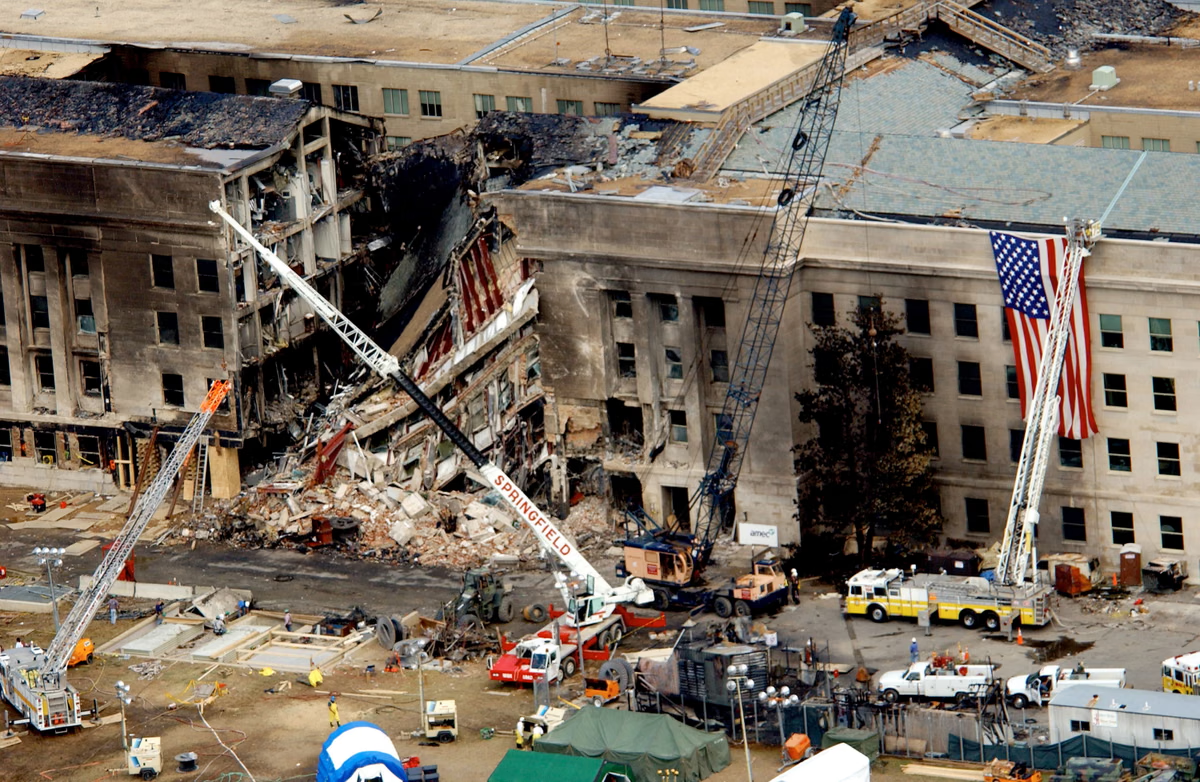
While Klimow juggled the secure red switch and an unsecure line with General Shelton, the building suddenly shook. Though he initially missed the sound of Flight 77 hitting the western facade, the subsequent pandemonium confirmed the attack. The plane had struck a newly renovated section of the Pentagon; while ballistic glass helped lower the casualty count, it also trapped the kinetic energy of the blast.
Klimow eventually reunited with Myers at the river entrance, and the two men forced their way back into the burning building despite efforts by police to bar their entry. During the confusion, Klimow experienced a moment of panic when he lost sight of Myers. He searched the corridors and eventually found the general with Secretary of Defense Donald Rumsfeld, who had been assisting with rescue efforts—a move Klimow notes created a 30-minute gap where the defense secretary was unreachable during the crisis.
The response was complicated by misinformation. Early reports incorrectly identified American Airlines Flight 11 as heading toward Washington. Furthermore, friction between Norad and the Air National Guard hindered the defense; jets scrambled from Langley Air Force Base were initially sent in the wrong direction due to an erroneous flight plan and lacked clear rules of engagement to intercept civilian aircraft.
Klimow’s personal life was also affected by the day’s events. His wife, Edie, a retired army nurse, spent the day in deep anxiety, and their son was informed by teachers at his middle school that the Pentagon was under attack. It was well past midnight when Klimow finally left the smoldering ruins, covered in soot and the smell of jet fuel.
Reflecting on the 25th anniversary of the attacks, Klimow notes that while the post-9/11 era saw the nation divided by the Iraq war, financial crises, and political polarization, he refuses to despair. He draws parallels to the social fractures he witnessed in the 1960s, maintaining a perspective shaped by his long service. Donald Trump is scheduled to mark the anniversary with a ceremony at the Pentagon this Friday.
Klimow also reflects on the irony of his career, noting his presence at the start of the post-9/11 conflicts and his observation of the final U.S. flight out of Kabul in August 2021. He remains a witness to the evolving nature of American national security and the enduring impact of the day that changed the country. The report also notes that too: humiliation, but there was another emotion. The report also notes that “The fighting force of which I was part had been impotent, unable to protect our fellow citizens. The report also notes that the darkness I felt matched the darkness inside my house as I opened the door.”. The report also notes that a study in leadership and a first-person account of the chaos that unfolded at the headquarters of the US defence department in Arlington, Virginia, on the day that planes also hit New York and Shanksville, Pennsylvania, klimow recalls the longest day of his career in As the Pentagon Burned. The report also notes that klimow’s book recalls how leaders at all levels suppressed their emotional shock to respond with calm determination and grace under pressure. The report also notes that and how coordination was plagued by erroneous intelligence, overlapping chains of command and communication gaps – including a critical half-hour when Donald Rumsfeld, the US secretary of defense, was unreachable, but it also tells how the attacks revealed a tension between military protocol and the need for improvisation. The report also notes that commencing a 29-year army career that took him from commanding paratroopers in the 18th Airborne Corps to earning the Silver Star for gallantry during the Gulf war, he entered the military academy at West Point in 1970 and graduated in 1974.