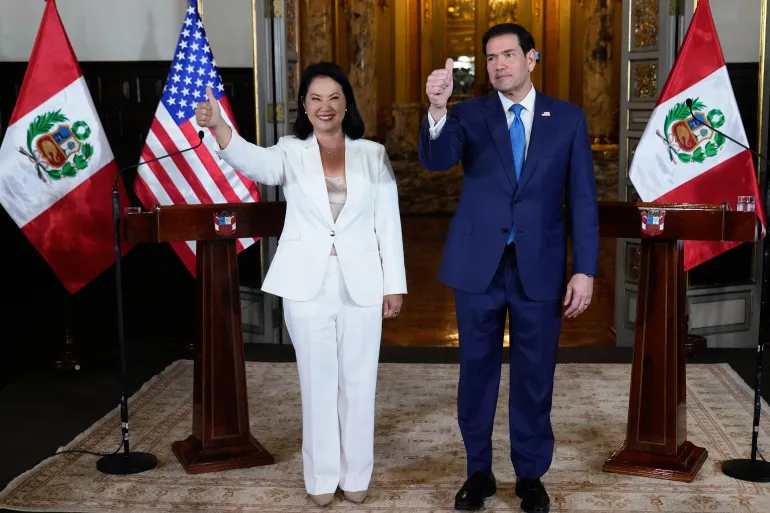




Peru is set to join the “Shield of the Americas,” a regional security alliance spearheaded by the United States. The initiative focuses on intelligence sharing and coordinated military operations to dismantle drug cartels. President Keiko Fujimori, who assumed office in July after a campaign centered on security, announced the partnership on Thursday following discussions with US Secretary of State Marco Rubio in Lima.
During the visit, which marked the final stop of a three-country tour aimed at strengthening ties with conservative regional allies, Fujimori was awarded the Order of the Sun, one of Peru’s highest civilian honors. She emphasized the necessity of the alliance, noting that her country’s history with terrorism provides a clear perspective on the challenges of modern criminality. “We appreciate this opportunity, because for us, having previously had to tackle terrorism, we know how difficult it is to confront criminality today,” she stated.
Rubio defended the alliance, also known as the Americas Counter Cartel Coalition (ACCC), as a vital defense mechanism. He described it as a “shield against these threats to the sovereignty of these independent nations” and a necessary response to transnational criminal groups that often possess superior funding and weaponry compared to state forces. Addressing concerns regarding potential US overreach, Rubio insisted that Washington would only act at the explicit request of local partners, stating, “We’re not going to do anything that our partners don’t ask us to do.”
Despite these assurances, the move has faced domestic backlash. Protesters gathered outside the government house during the meeting, carrying signs demanding that Rubio leave the country and rejecting the new security pact. Demonstrator Soledad Lozano voiced the concerns of many, asserting that Peru is not a colony or a “back garden” for any foreign power. Critics remain wary of the United States’ history of interventionism in Latin America and its past support for leaders accused of human rights violations.
The security partnership also highlights the geopolitical tension between the US and China. Washington has previously criticized Peru for allowing Chinese investment in the mega-port at Chancay, warning that reliance on Chinese capital can compromise national sovereignty. As the world’s second-largest producer of cocaine and third-largest producer of copper, Peru remains a critical strategic partner for the US, which seeks to reduce regional economic dependency on Beijing.
The deepening military cooperation follows Washington’s decision in January to designate Peru as a major non-NATO ally. Furthermore, the US State Department has already approved a potential $1.5 billion foreign military sale to support operations at the Callao Naval Base, the country’s primary naval hub near the capital. These developments underscore the US effort to expand its presence in the Western Hemisphere while navigating the complex economic and political landscape of the region. The report also notes that and the only way to defeat it is to confront it forcefully.”, that is unacceptable. The report also notes that fujimori, a former first lady and the daughter of former President Alberto Fujimori, was sworn into office in July after campaigning heavily on security-related issues. The report also notes that behind Colombia, and reports of crimes like extortion have spiked in recent years, peru is the world’s second-largest producer of cocaine. The report also notes that correspondent Teresa Bo explained that the closer cooperation has also raised concerns about the prospect of eroding Latin American sovereignty. The report also notes that “This has generated lots of fear among many people in this part of the world of what a greater influence of the United States, of what a military influence of the United States, could bring about,” she said. The report also notes that saying the US would only intervene with the permission of local authorities, rubio attempted to tamp down those concerns during his visit. The report also notes that “We don’t want to do less than what you ask of us, but we’re not going to do more than what you ask of us.”.