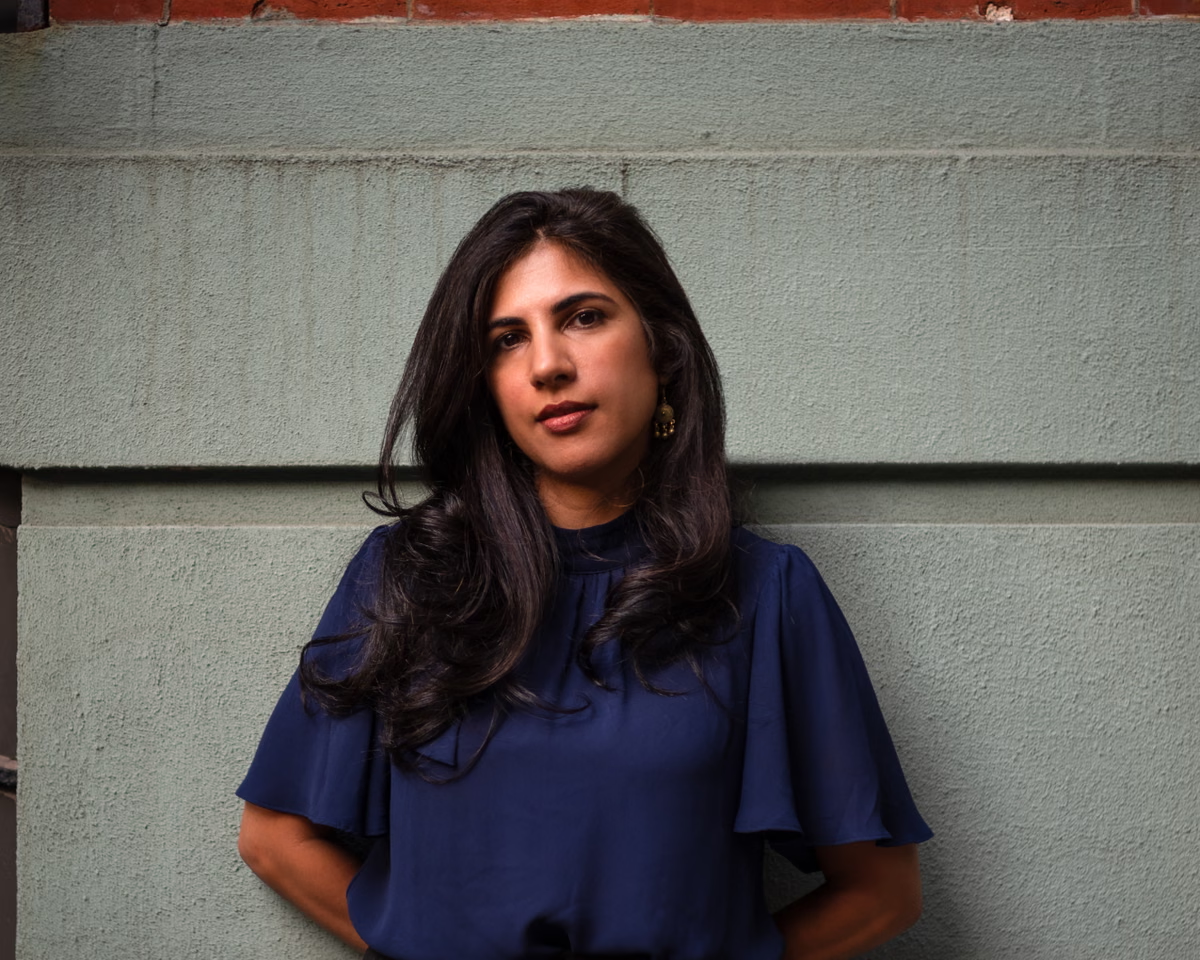







Growing up in California during the early 2000s, Rozina Ali’s childhood was defined by a sense of idyllic normalcy, filled with history books about the Kennedy family and television show DVDs. As a teenager, she held a deep belief in American exceptionalism, trusting that the government would uphold values of religious tolerance and pluralism. However, her perspective shifted dramatically in the hours following the September 11, 2001, terrorist attacks. While she initially insisted to her parents that the United States was not a place where they would face suspicion, they warned her that the country was at war and that Muslims would inevitably be targeted.
In her new bookSeasons of FuryAli, now a journalist for theNew York Times Magazinetraces the history of Islamophobia in the United States, arguing that the phenomenon predates the 9/11 attacks by decades. The book, which took ten years to research, examines the experiences of four families to illustrate how government policies and social paranoia have shaped the lives of Muslims in America. Among the cases profiled is that of Abdeen Jabara, an Arab American lawyer who, during the 1970s, exposed one of the most extensive government surveillance operations in the nation’s history.
Ali notes that the 1967 Israel-Arab war served as a critical turning point, galvanizing the Arab American community and leading to increased surveillance. She explains that the conflict helped to racialize Arabs in the United States, establishing a lens through which the government began viewing the region and its people. This trajectory continued through the 1980s and 1990s, as the U.S. government increasingly identified Islamic groups as primary threats following the collapse of the Soviet Union. Even when domestic attacks were perpetrated by non-Muslims, such as army veterans, media outlets and officials frequently defaulted to blaming Middle Eastern terrorists.
The post-9/11 era solidified these trends, creating a national consensus that justified the expansion of executive power under the guise of national security. Ali points out that the Bush administration’s “war on terror” lacked a clear definition of terrorism, which allowed for the broad targeting of Muslim communities. Tools and agencies created during this period, such as the Department of Homeland Security, have since been utilized to target other vulnerable groups, including Latino immigrants. This expansion of authority eventually reached the Supreme Court, where national security justifications were used to uphold policies like the travel ban.
Today, the climate for Muslims in the U.S. remains increasingly hostile. A May 2026 poll from the Pew Research Center indicates that a majority of Muslims report experiencing daily discrimination. Furthermore, the percentage of American adults who believe Islam is more likely than other religions to promote violence has more than doubled in the 25 years since 9/11. This pervasive atmosphere is reflected in recent political developments, such as the classification of the Council on American-Islamic Relations (CAIR) as a terrorist organization by officials in states like Texas and Florida.
As the 25th anniversary of the 9/11 attacks approaches, the social and political tension remains palpable. In New York City, for instance, an online petition has garnered tens of thousands of signatures urging Mayor Zohran Mamdani—who is himself Muslim—to “Stay Away” from commemorative events. Ali expresses astonishment at the current state of affairs, noting that while she originally intended to write a historical account, she now finds herself documenting a reality that feels more present and urgent than ever before. The report also notes that so when her parents sat Ali and her siblings down in the hours after the September 11, 2001 terror attacks, almost every word coming out of their mouths felt wrong. The report also notes that jabara would eventually become known as the first American citizen surveilled by the National Security Agency. The report also notes that co-host of Stateside With Kai and Carter, spoke with Ali about why she believes Islamophobia is more pervasive than ever – and what this means for our politics right now, carter Sherman. The report also notes that this interview has been edited and condensed for clarity. The report also notes that watch the Stateside podcast episode in full here. The report also notes that cS: We are talking just days ahead of the 25th anniversary of 9/11. The report also notes that what do you remember of that day, i’m wondering.