








Ten years ago, a persistent ache in my right elbow led me down a path of misdiagnosis, ranging from tennis elbow to thoracic outlet syndrome. By the time I sought help from an occupational therapist regarding my use of a bullet vibrator, I was already grappling with the physical toll of what I suspected was a repetitive strain injury. However, the reality was far more severe; over three years, my symptoms escalated to include shaky legs and weakened hands, eventually revealing a tumor on my spinal cord.
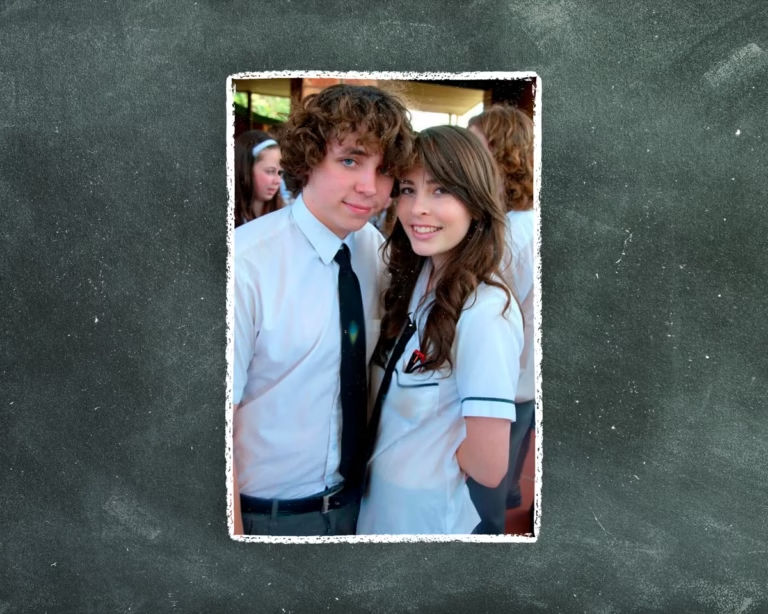
Facing a daunting surgery, I postponed the procedure for five weeks against medical advice to manage my personal affairs and emotional turmoil. During this period, I met Nicolas on a dating app. Despite the impending medical crisis, we formed a deep connection, and I shared the details of my diagnosis and my upcoming flight to New York City for surgery. Shortly after I returned to Seattle for a job interview, we officially became a couple.
The surgery successfully removed the tumor, but the recovery process was grueling. I spent three weeks in an inpatient rehabilitation unit, relearning basic motor skills by day while struggling with the emotional weight of my physical changes by night. I often felt profound regret that Nicolas and I had not been intimate before my body had been altered, fearing I had lost the chance to experience his touch or that I was now too broken to be desirable.
My desire to return to my pre-surgery sex life was driven by a need to prove that my identity remained intact despite my disability. Yet, the reality of spinal cord injury necessitated a new approach. Dr. Lisa Ruppert, a physiatrist and specialist in spinal cord injuries at Memorial Sloan Kettering, became a vital guide. She emphasized that for patients with spinal cord involvement, the focus must shift to identifying what remains functional. She explained that sexual arousal involves two distinct pathways: reflexogenic, triggered by direct touch stimulus to the genitals, and psychogenic, which is more complex.
Ruppert encouraged me to experiment with strategies like maintaining lighting for visual stimulation or adjusting my positioning to mitigate sensory overload. I shared these instructions with Nicolas, whose role in understanding my body became as significant as my medical chart. While our sensory explorations were rewarding, I initially approached them with the rigid mindset of a rehabilitation project, treating intimacy as a task to be mastered rather than an experience to be savored.
In an interview with Rachel Smith, a licensed marriage and family therapist specializing in sex therapy, I admitted that sex had become a project. Smith challenged this perspective, asking, “But what if pleasure became an exploration? Something to be discovered versus something to work on.” This resonated with my tendency to view my body through the lens of productivity and the pressures of millennial hustle culture. My narrow goal of restoring my body to its former function was, in hindsight, both unfair and limiting.
This struggle is common among those living with disabilities. As disability and gender studies scholar Sami Schalk, author of *Black Disability Politics*, notes, societal norms often dictate that the lives of disabled people should be centered exclusively on treatment, management, and cure. This capitalistic framework leaves little room for the pursuit of pleasure, a sentiment echoed by licensed mental health counselor Gabriela Fullon, who sees this pattern frequently among her clients, particularly those from immigrant backgrounds.
The U.S. healthcare system further complicates this by prioritizing reproductive function over holistic sexual health. Dr. Sonjia Kenya, a sexologist and professor at the University of Miami, points out that there is no standard sexual health curriculum in medical schools, leaving many physicians ill-equipped to address these concerns. While the system often supports male sexual functioning, it frequently neglects the diverse needs of women, and insurance coverage for sex therapy remains inconsistent.
Despite these systemic barriers, some providers are working to improve care. Ruppert trains medical residents on how to discuss sexual health with patients, and Kenya advocates for physicians to expand their referral networks. For patients, Kenya suggests that if a provider asks about sexual activity, one can simply state, “I do not enjoy sex,” to open a necessary dialogue.
Ultimately, I have learned that healing is not the same as punishing my body into repair. Drawing inspiration from Audre Lorde’s 1978 essay *Uses of the Erotic: The Erotic as Power*, I have come to see pleasure as an internal sense of satisfaction and a form of self-respect. Whether I am blasting music by Beyoncé or practicing choreography from Janet Jackson’s *Pleasure Principle* video, I am reminded of Schalk’s wisdom: “Pleasure is what brings us back to ourselves.” The report also notes that so I stopped playing tennis, the internet suggested I had tennis elbow. The report also notes that once the outer elbow pain moved inward, I changed my self-diagnosis to golfer’s elbow. The report also notes that competitive dragon-boating and bouldering, i stopped lifting weights. The report also notes that for good measure, I consulted an occupational therapist about my nightly bullet-vibrator routine after reading that golfer’s elbow is common among construction workers who operate heavy-duty vibrating machinery. The report also notes that he listened closely and said he’d note VRI on my patient chart. The report also notes that eager to end my diagnostic journey, i asked what VRI meant. The report also notes that tendinitis and thoracic outlet syndrome) fully explained my symptoms, none of the diagnoses I researched or received (a pinched ulnar nerve. The report also notes that my body would undergo complete, permanent paralysis from the neck down within a year, one surgeon estimated that without treatment.