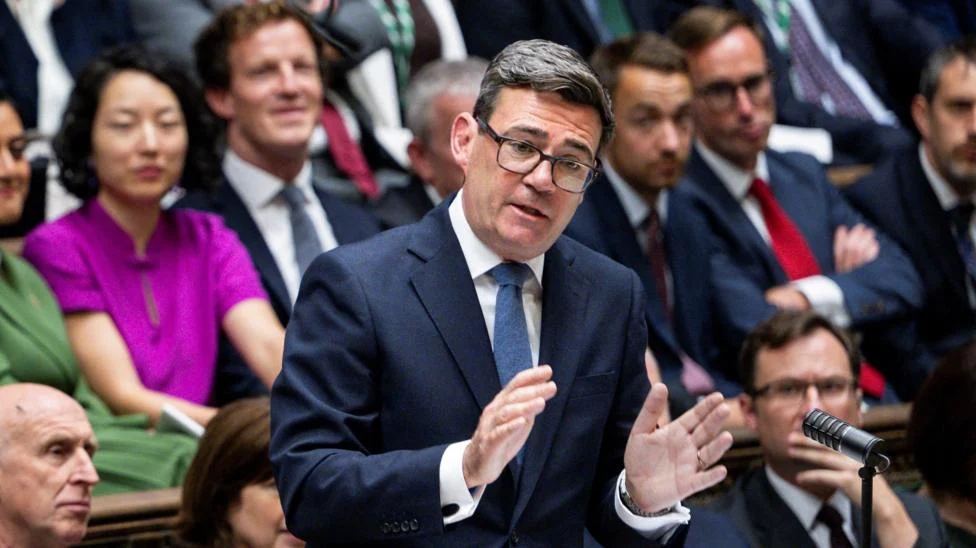






Prime Minister Andy Burnham faced his first Prime Minister’s Questions (PMQs) on Wednesday, encountering intense scrutiny from Conservative leader Kemi Badenoch regarding the state of the UK economy. The session followed a sharp rise in government borrowing costs, which reached an 18-year high, prompting Badenoch to demand clarity on how the new administration intends to fund its spending commitments and manage rising national debt.
Badenoch characterized the Prime Minister as a “spendthrift” who lacks a clear plan to pay for his policy promises. She pressed Burnham to confirm whether he is preparing to implement tax increases, asserting that the current market anxiety stems from his failure to detail how he will balance the books. “The markets are clearly worried that we now have a spendthrift prime minister who wants to say yes to everyone but cannot tell us where the money is coming from,” she stated, challenging him to be honest about his fiscal intentions.
In response, Burnham attributed the current financial instability to the legacy of the previous Conservative government. He argued that the “turbulence on global markets are because of that exposure that they left behind.” The Prime Minister, who succeeded Sir Keir Starmer in July, emphasized that his administration remains committed to fiscal responsibility and will adhere to established fiscal rules while simultaneously working to alleviate cost-of-living pressures for citizens.
The debate also touched upon comments from economist and cross-bench peer Lord Jim O’Neill. While Lord O’Neill had previously praised the Prime Minister’s first five weeks in office for boosting business and consumer confidence, he recently warned that the government’s tone in the Commons could unsettle investors. He also suggested that Labour might eventually need to address welfare spending and the state pension triple lock. Burnham acknowledged the peer’s expertise but noted that they do not always agree on policy matters.
Burnham countered the Conservative attacks by criticizing the recent shadow cabinet reshuffle conducted by Badenoch. He accused her of appointing individuals who were instrumental in the leadership team of former Prime Minister Liz Truss. “Can I also say to her and the whole of her new shadow cabinet, the majority of whom were part of a government that lasted for 49 days, a short-lived government that crashed confidence in the economy and hammered people’s mortgages,” he remarked.
The Prime Minister further highlighted that he had already taken steps to reduce taxes, specifically citing the reduction of VAT on energy bills and cuts to business rates for the hospitality sector. Regarding future fiscal planning, he confirmed that he and Chancellor John Healey have scheduled the Budget for October to mitigate market speculation. He declined to provide specific spending details during the session, stating, “I’m not going to do what any prime minister has done and write the budget here.”
Market data indicates that the yield on 10-year government bonds has reached its highest level since 2008, while 30-year bond yields are at their peak since 1998, significantly increasing the long-term cost of government borrowing. Badenoch maintained that the Prime Minister’s approach mirrors the errors of the past, claiming, “The reason why that budget failed was because spending was announced before the money to pay for it, which is exactly what he is doing right now.” The report also notes that and had announced a series of eye-catching policies, mainly aimed at tackling the cost of living, the prime minister used the summer recess to tour the UK. The report also notes that making a statement and answering questions from MPs, mPs returned to Parliament on Tuesday and Burnham spent more than three hours in the Commons. The report also notes that so will he be honest and tell us: is he preparing to raise taxes again, yes or no, yesterday he said change begins with honesty. The report also notes that but at the same time, we will help reduce cost-of-living pressure on our constituents, and that’s the approach that we will take, it will stick to the fiscal rules. The report also notes that it could mean that the government’s choices on what it wants to spend are constrained as the Budget approaches. The report also notes that sure enough, yesterday the cost of government borrowing rose to its highest in 18 years, he knows what he’s talking about and. The report also notes that she removed a shadow chancellor who said that the Truss mini budget was a mistake, and she replaced that shadow chancellor with one that helped to write the Truss mini budget, she took a decision at the weekend.