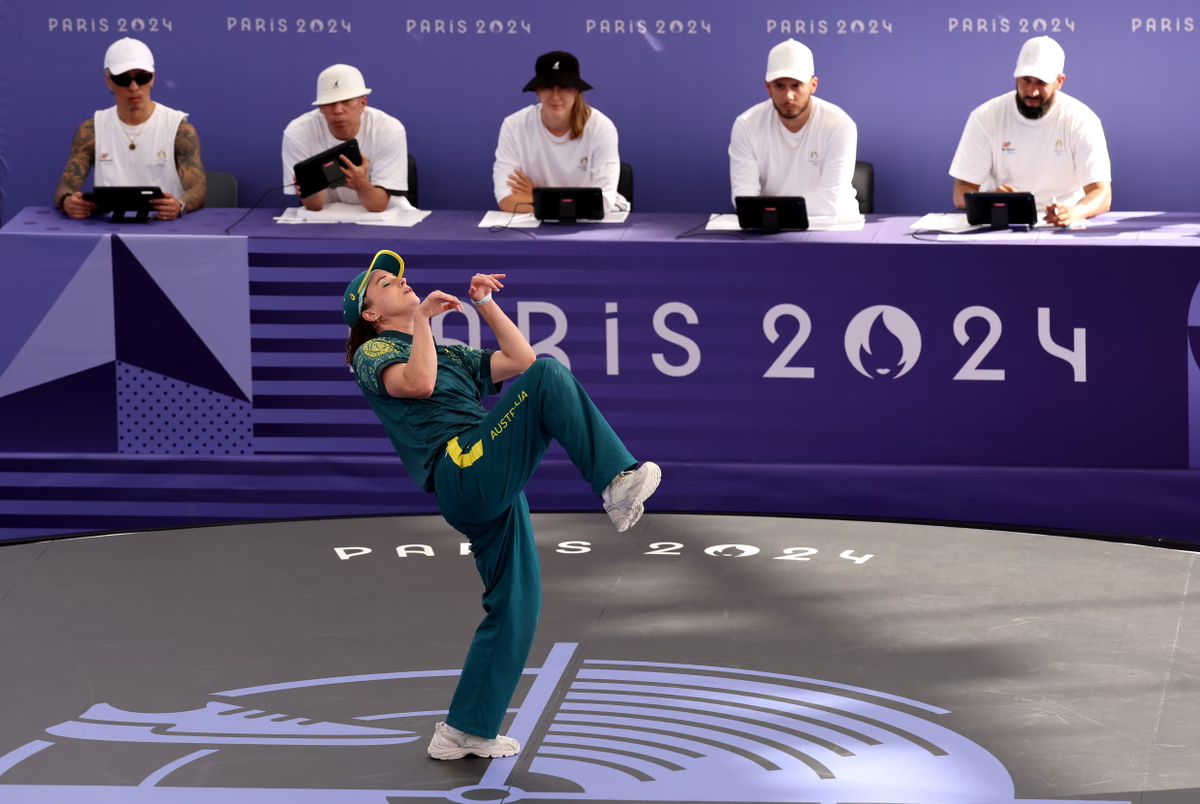




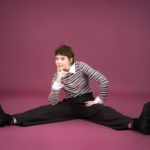

The new Netflix documentary, Untold Raygun: Breaking Badly, provides an inside look at the experience of Australian B-girl Rachael Gunn during the 2024 Paris Olympics. Early in the film, Gunn recounts a therapy session held shortly before the Games, where she expressed a deep-seated fear that the entire world might laugh at her. When her therapist asked if that outcome was truly reasonable, Gunn responded with hysterical laughter. While such a scenario is statistically unlikely for most, it became a reality for Gunn, whose unique performance—featuring moves like the kangaroo hop and the sprinkler—turned her into a global meme overnight.
Fellow Australian B-girl Flix notes in the documentary that Gunn became the most famous breaker on the planet almost instantly, despite failing to earn a single vote from the nine judges across her six rounds of competition. The film, which premieres globally on Tuesday, captures a sympathetic portrait of Gunn, who appears self-aware and is supported by her husband, Sammy Free, and her parents. However, the documentary largely avoids addressing the complex reality of what it means for breaking—an art form rooted in the Black and Brown youth culture of the South Bronx—to have its first Olympic appearance primarily associated with a white academic from Australia.
Critical perspective is provided by other B-girls, including Tinylocks, who emphasizes the hip-hop ethos of “no easy props.” This concept, often linked to American B-girl Asia One and her 1997 crew of the same name, centers on the necessity of earning respect through demonstrated skill. Tinylocks, who chose not to pursue the Oceania qualifying spot, notes that she views breaking as an art form. She recalls that while some of Gunn’s earlier performances in the small Australian scene showed promise, others were less impressive. Flix, who did compete in the Oceania qualifier, also shares her perspective on the challenges women face in the male-dominated breaking scene.
The documentary details how Gunn adjusted her strategy after performing poorly at several European events in the months leading up to the Olympics. Realizing she was trailing behind top-tier competitors, she and her husband attempted a different approach to her set composition. While this strategy might have been successful had her fundamental footwork been sharper and more precise, it ultimately resulted in the viral performance that defined her Olympic run. The film contrasts this with other athletes like pommel horse specialist Stephen Nedoroscik, who also became a meme in Paris but avoided the same level of mockery because his performance was backed by high-level athletic mastery.
Gunn acknowledges that public discourse often targets women in ways that feel disproportionate, noting that people frequently hold strong, sometimes critical, opinions about female athletes. While she did not commit any wrongdoing, her performance drew intense scrutiny. The documentary places her in the context of other unconventional Olympic competitors, such as British ski jumper Eddie the Eagle in 1988 or swimmer Eric Moussambani in 2000, who were also noted for their lack of traditional elite skill.
Despite the global attention, the documentary does not address the fact that breaking will not be featured at the 2028 Los Angeles Games, a decision unrelated to Gunn’s performance. Furthermore, it misses an opportunity to fully explore the impact of her notoriety on the future of the sport. The film concludes by focusing on Gunn’s personal resilience, with her stating, “I’m a dorky white woman who is an academic, and I’m OK with that.”
Looking ahead, the World DanceSport Federation (WDSF) submitted a proposal last week for breaking to be considered for the 2032 Brisbane Olympics. If the local organizing committee chooses to include the sport, it remains to be seen whether the community will embrace a different direction for the competition. For now, Untold Raygun serves primarily as a character study, prioritizing Gunn’s personal journey and her ability to maintain her sense of whimsy despite a very public bout of global humiliation. The report also notes that anyone who has ever gone to a therapist will be amused at this anecdote. The report also notes that the therapist would have been right, nine and a half times out 10. The report also notes that no, they’d say, the worst outcome you can imagine probably won’t come to pass. The report also notes that the kangaroo hops – in the cypher made her go viral almost as soon as she was done with her sets, her shenanigans – the sprinkler. The report also notes that (Perhaps if Gunn had been explicit about what she was planning to do in her sets, her therapist would have reacted differently.) Gunn’s performance launched a thousand memes, more than a couple of late-night TV segments, several conspiracy theories, and even a musical at the Edinburgh Fringe Festival. The report also notes that it’s mostly focused on Gunn herself with little time spent on the greater context of the art form and how it ended up in the Olympics. The report also notes that through them, we get a coming of almost middle-age story about an academic who meets a B-boy working at a call center, falls in love with him and the art form he’s passionate about, and somehow ends up centerstage at the Olympics.