
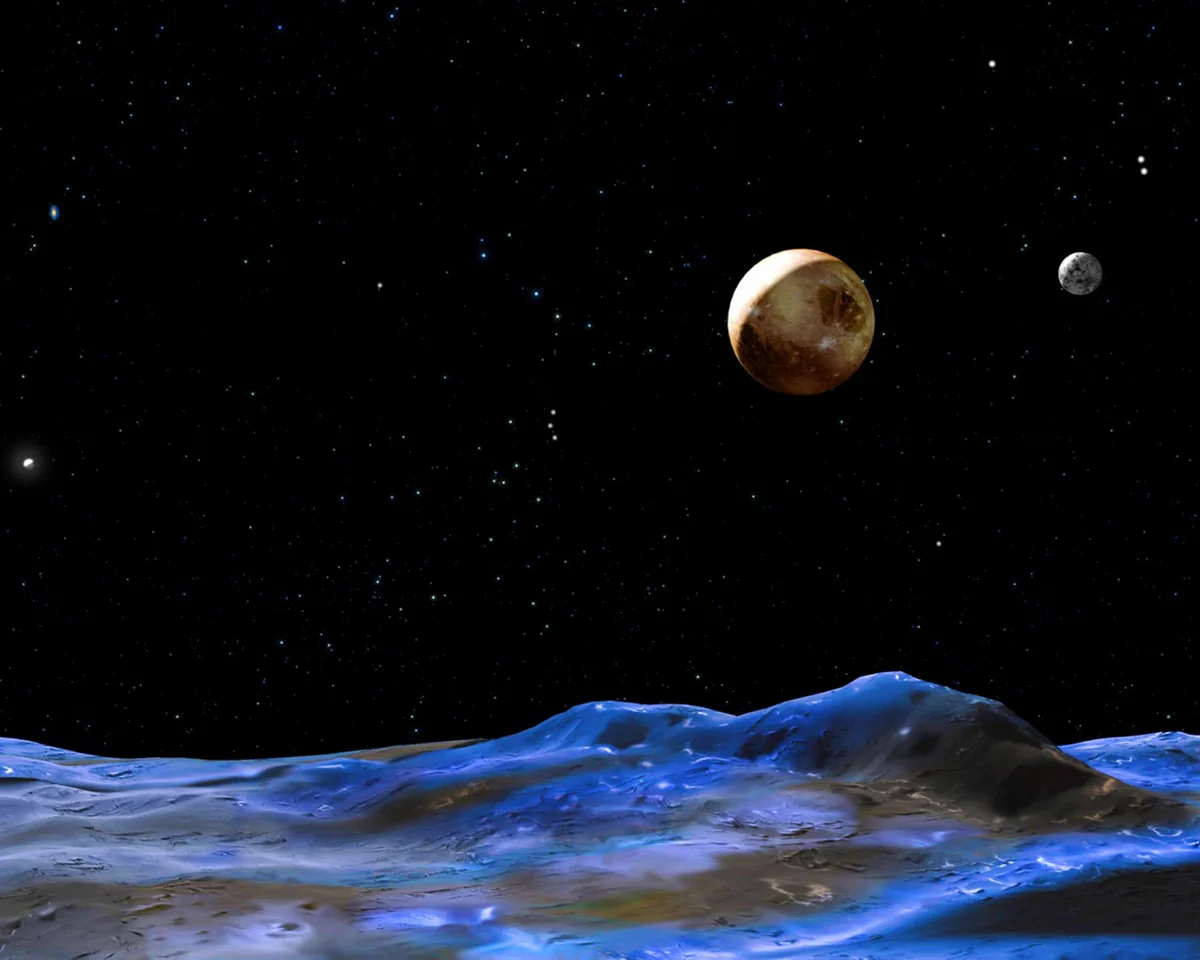









Twenty years have passed since the International Astronomical Union (IAU) voted in August 2006 to relegate Pluto from its status as a major planet to that of a dwarf planet. This decision reduced the count of recognized planets in our solar system from nine to eight, sparking a controversy that remains unresolved today.
Philip Metzger, director of the Stephen W. Hawking Centre for Microgravity Research and Education at the University of Central Florida, remains a vocal critic of the IAU’s criteria. He argues that the definition created by the union is fundamentally flawed, stating, “The definition of a planet they created, you can’t use it at all,” and adding that it renders the scientific definition of a planet “completely non-useful.”
For many, the attachment to Pluto is rooted in its status as an underdog. Kevin Schindler, a historian at the Lowell Observatory in Arizona—where Pluto was first discovered in 1930—notes that the planet is viewed as “the small kid on the block that is being picked on.” This sentiment is echoed by activists like Laurel Kornfeld, an actor and amateur astronomer who has campaigned for Pluto’s reinstatement since the day of the vote. She recalls her initial reaction as, “Wait a minute, this is wrong,” and continues to wear apparel supporting the “Pluto Resistance” movement.
The push to restore Pluto’s status appears largely concentrated in the United States, a phenomenon Metzger attributes to national pride, noting, “This was the one we discovered.” This sentiment has even reached political circles; in April, NASA administrator Jared Isaacman expressed his support for a re-evaluation, stating, “I am very much in the camp of Make Pluto a Planet Again.”
The 2006 IAU vote was triggered by the discovery of Eris, a distant object in the Kuiper Belt beyond Neptune. Eris, which possesses more mass than Pluto, prompted the IAU to establish a three-point definition for a planet: it must orbit the Sun, have sufficient mass to be round, and have “cleared its neighbourhood.” Critics argue that the third requirement is particularly problematic because it depends on an object’s location rather than its physical characteristics. Metzger points out that even small, non-round asteroids could technically clear an orbit if positioned near a star, suggesting that the criteria are not scientifically meaningful.
The debate has created a divide between two scientific schools of thought: the geophysical camp, which emphasizes a body’s physical properties, and the dynamicists, who prioritize an object’s orbital position. The 2015 New Horizons flyby provided the geophysical camp with significant data, revealing that Pluto features mountains, water ice hills, and evidence of recent geological activity, which supporters argue qualifies it as a planet.
Conversely, those who support the current classification, such as astronomer Mike Brown—often labeled “The Man Who Killed Pluto”—argue that a purely geophysical definition would lead to an unmanageable number of planets, potentially including Earth’s own moon. Brown maintains that he has no issue with a higher number of planets, but insists that if Pluto is included, the moon must also be classified as one. Some advocates, like researcher Byrne, are comfortable with this, suggesting that an object can simultaneously be a satellite and a planet.
Procedural grievances also persist, with some critics characterizing the 2006 vote as a “coup” and arguing that it was conducted improperly. Brown dismisses these claims, asserting that the only people complaining about the voting process are those who disagreed with the outcome. As the debate enters its third decade, Metzger suggests that a modern attempt to vote on the matter would likely be even less useful than the original, as positions on both sides have become deeply entrenched. The report also notes that t wenty years ago, Pluto got demoted. The report also notes that at the time, many scientists were unhappy with the decision. The report also notes that “I was like: wait a minute, this is wrong.” When we meet on Zoom she is wearing a T-shirt that says: “Pluto Resistance, 20 years: 2006-2026.”. The report also notes that ongoing debates, occasional protests and petitions – seems to be largely confined to the US, the campaign to reinstate Pluto – with its passionate advocates. The report also notes that “I’ll admit there was some of that – among the public, not the scientists.”. The report also notes that the campaign has taken on a populist tinge, with Trump’s Nasa administrator, Jared Isaacman, telling a congressional committee in April that he was in favour of a rethink, more recently. The report also notes that the event that sparked the IAU’s 2006 vote was the discovery of a distant celestial body that would come to be called Eris. The report also notes that including Haumea, Makemake and Sedna, other smaller bodies were discovered around the same time.