








A devastating flash flood struck Nepal on Wednesday, with preliminary scientific investigations pointing to a massive chunk of a glacier breaking off and temporarily obstructing a river. The resulting surge of water and debris caused widespread destruction, claiming hundreds of lives and leaving over a thousand people—including foreign nationals and pilgrims—missing. Rescue operations have intensified as the search for survivors continues.
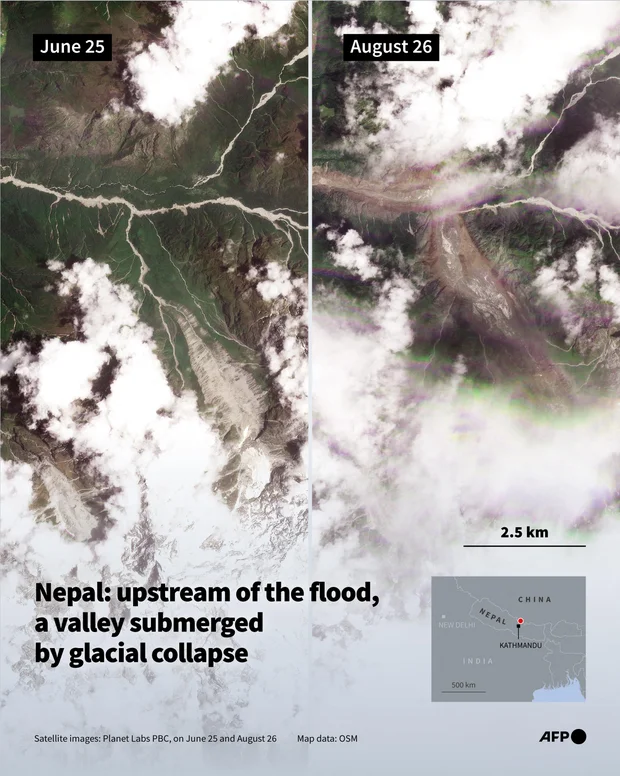
The U.S. Geological Survey identified a magnitude 5.2 glacier collapse that sent a torrent of debris downstream. This assessment relies on data from local seismic stations, long-period seismic waves, and satellite imagery. Jakob Steiner, a geoscientist at the University of Graz, described the event as a lower section of a glacier shearing off, noting that the visual evidence resembles a clean cut made by a massive blade. He likened the impact of the falling ice mass to an explosion, which triggered the subsequent chaos.
While experts caution against drawing a direct, immediate link between this specific disaster and global warming, they emphasize that human-driven climate change is significantly altering the Hindu Kush Himalaya region. Saswat Sanyal, a disaster risk reduction specialist at the International Centre for Integrated Mountain Development, noted that rising temperatures are accelerating glacial melt. The region, which stretches 2,175 miles from Afghanistan to Myanmar, contains the largest volume of ice outside the polar regions and serves as the primary water source for 12 major rivers across 16 nations.
The surge was sudden and overwhelming, with water levels in some rivers rising by as much as 9 meters (29.5 feet) in just 30 minutes. Sanyal described the event as a massive, abrupt surge that provided residents with virtually no time to escape. Preliminary evidence indicates that a significant volume of ice and rock plunged into the Lhende Khola, a tributary of the Bhote Koshi River, creating a cascading hazard of debris flow and river blockage.
The affected valley is no stranger to mountain hazards, having experienced similar glacial lake floods in 2025 and previous ice and rock avalanches. Steiner warned that the region has reached a point where certain areas are no longer safe for human habitation. He expressed frustration that despite previous warnings, coordinated action among stakeholders remains insufficient to prevent such recurring catastrophes.
Climate scientists highlight that the Hindu Kush Himalaya is warming at an alarming rate, impacting snow cover, permafrost, and mountain stability. Approximately 78% of the glacier area situated between 14,760 and 19,685 feet above sea level is highly vulnerable to these temperature increases. As glaciers retreat, mountain rock previously supported by ice becomes exposed to thawing, increasing the likelihood of material shifting down slopes.
Steiner characterized the disaster as the “new normal,” warning that conditions are likely to deteriorate. Global records show the last decade was the hottest on record, and 2024 was the warmest year ever measured. Projections suggest that even if global warming is capped at 1.5 degrees Celsius, up to 50% of glaciers outside the polar regions could be lost by 2100. Current policies, however, put the planet on a trajectory for 2.8 degrees Celsius of warming by the end of the century.
The consequences of this rapid melt extend far beyond the immediate mountain communities. With glaciers melting at double the rate seen since 2000, the resulting instability threatens the livelihoods of approximately 2 billion people—a quarter of the global population. Experts warn that the resulting displacement and environmental shifts will eventually have worldwide impacts, ranging from mass migration to rising sea levels.
Infrastructure in the region has also suffered significant damage, including critical hydropower facilities. Steiner noted that the affected valley contained roughly 10% of Nepal’s power generation capacity. As the nation grapples with the aftermath, the tragedy underscores the urgent need for better disaster preparedness and a more robust response to the escalating risks posed by a warming climate in the high Himalayas. The report also notes that they suggested, that may have led to the backed-up water surging downstream with enormous force a few hours later. The report also notes that if you look at the imagery it’s like someone cut with a huge knife through the whole lower part and it fell off. The report also notes that however, they said that as Earth’s temperature rises because of human activities such as burning oil, gas and coal, the chances of such disasters increase, especially in the Himalayan mountains, which are warming considerably faster than many other parts of the world. The report also notes that we have to be cautious and not draw a connection yet. The report also notes that and about 1.65 billion people further downstream, the climate research group said in a 2023 report, those rivers provide fresh water to some 240 million people living in the region. The report also notes that hundreds have lost their homes across the Himalayan region, and officials reported large-scale damage to critical infrastructure, including hydropower dams, roads, buildings and bridges in the region, in this week’s catastrophe.