
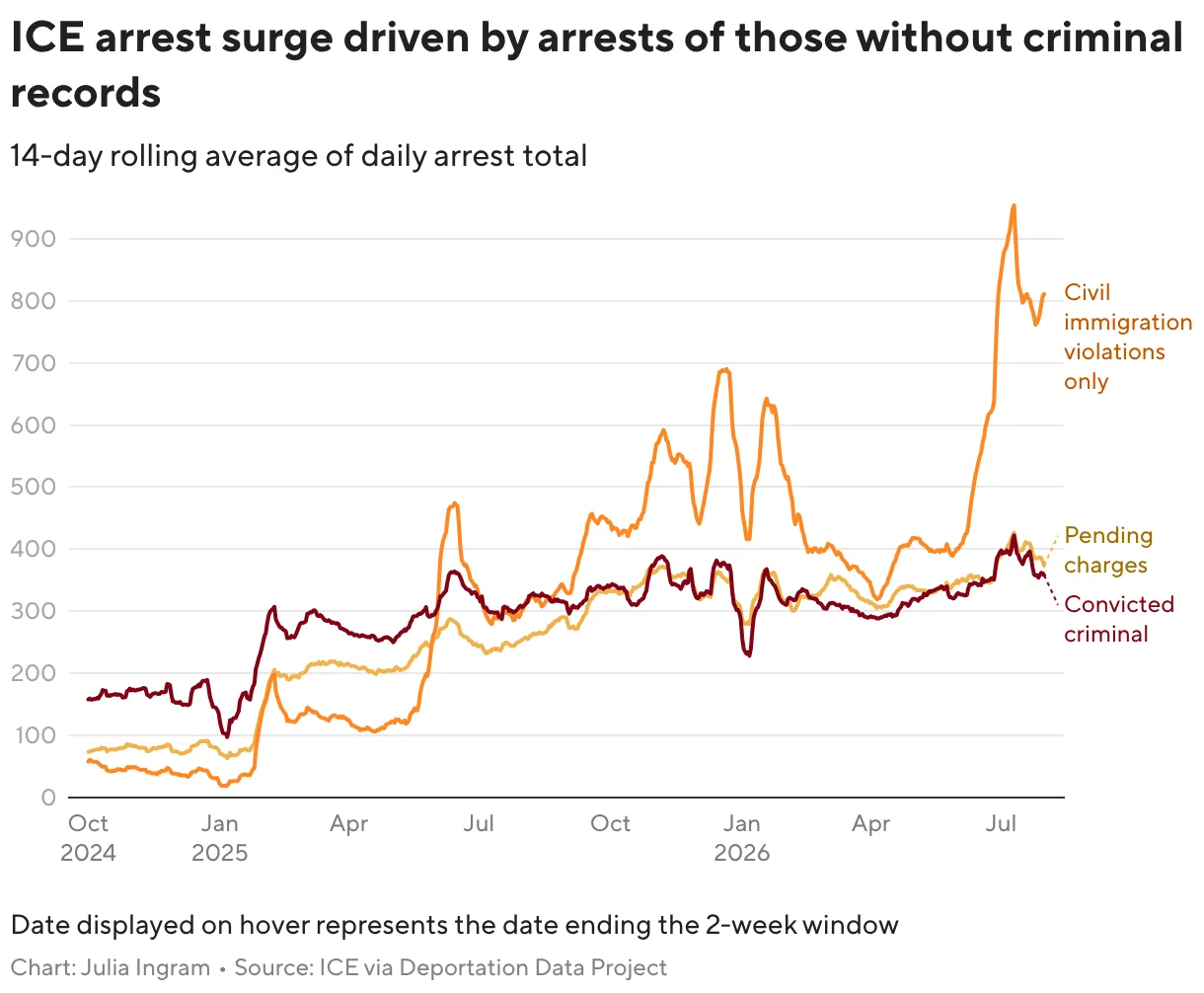









U.S. Immigration and Customs Enforcement (ICE) recorded a significant increase in enforcement activity this summer, with new federal data showing an average of more than 800 daily arrests of individuals without criminal records during July. This surge aligns with a broader White House initiative to push the agency toward a target of 2,000 daily apprehensions.
July marked the first month of President Trump’s second term where individuals facing only civil immigration violations—rather than those with pending criminal charges or convictions—constituted the majority of all arrests. Overall, the agency averaged more than 1,580 arrests per day throughout the month, representing a new peak for the current administration.
The current enforcement uptick follows a period of reduced activity earlier in the year, which was influenced by public backlash regarding Department of Homeland Security (DHS) operations in Minneapolis, as well as internal funding disputes and leadership changes. Despite these fluctuations, the recent rise in total arrests mirrors trends seen in previous urban crackdowns, characterized by a notable increase in community-based apprehensions of individuals lacking criminal histories.
While administration officials frequently emphasize that enforcement efforts target the “worst of the worst,” data indicates that individuals with violent criminal convictions, as defined by the Justice Department’s Bureau of Justice Statistics, represent only about 6% of those booked into ICE detention under the current administration. In July, that figure dropped to approximately 4%.
A DHS spokesperson defended the agency’s strategy, stating that ICE enforces the law as written and that immigration status remains the primary factor for targeting. The spokesperson argued that many individuals classified as “non-criminals” may include terrorists, human rights abusers, or gang members who lack a domestic criminal record. This data was obtained from ICE by the Deportation Data Project, a research initiative led by the University of California, Berkeley and UCLA, though it does not account for potential criminal history in other countries.
White House border czar Tom Homan and Homeland Security Secretary Markwayne Mullin have both argued that local sanctuary policies, which limit cooperation between local law enforcement and federal immigration authorities, necessitate a “flood the zone” strategy. They contend that these policies force federal agents to deploy more resources to specific cities to locate targets. Mullin recently urged state governors to increase cooperation with ICE, suggesting that such collaboration would reduce the need for federal agents to operate extensively within their jurisdictions.
However, analysis of June and July data suggests that community arrests are not confined to sanctuary jurisdictions. While street arrests in sanctuary-policy areas rose by 27% compared to the previous six months, other regions experienced a 50% increase. In Florida, a state requiring local collaboration with federal immigration authorities, street arrests nearly quadrupled during this period. Jacksonville saw monthly averages rise from 18 to 166, while Miami experienced an increase from 115 to 715.
Texas also saw community arrests triple in cities like El Paso and Austin. Meanwhile, some sanctuary-policy cities experienced similar surges; arrests in San Ysidro, California, were more than six times higher than in previous months, while figures in Denver, Colorado, and Newark, New Jersey, doubled.
The increase in apprehensions has been achieved without large-scale, publicized city crackdowns. Instead, agents have increasingly utilized traffic stops, airport operations, and immigration check-ins. These tactics have drawn scrutiny following the deaths of two immigrants during attempted traffic stops in Maine and Texas.
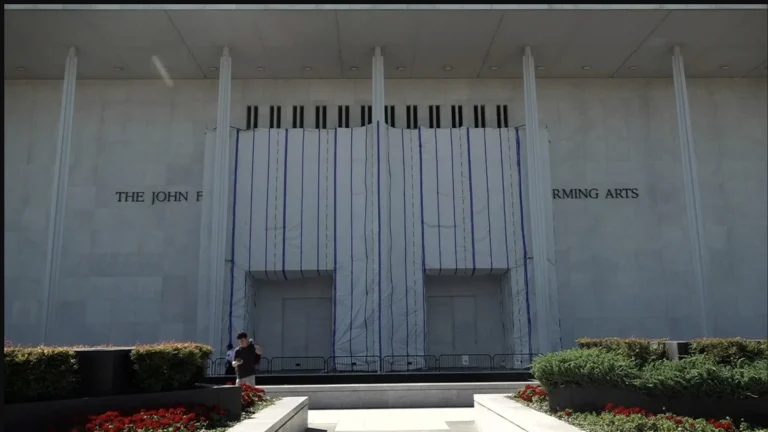
During June and July, nearly half of all ICE arrests—at least 45,300—occurred in communities rather than within jails or prisons. An additional 12,700 arrests were attributed to 287(g) agreements, which empower local law enforcement to perform immigration-related duties. ICE currently maintains these agreements with over 1,850 agencies, a figure that continues to grow as the DHS allocates $1.15 billion toward the program through September 2027. The report also notes that what makes someone a target for immigration enforcement is whether or not they are illegally in the U.S.— full stop,” a DHS spokesperson said in a statement to. The report also notes that let’s work to get the worst of the worst off the streets and then you won’t see me in your cities and states like you do as much,” Mullin said at a conference of state governors earlier this month, urgi, i’m just saying. The report also notes that asked DHS to provide that data. The report also notes that feds consider charging ICE officer accused of shooting immigrant in Minnesota. The report also notes that a massive data center hub is likely heating up a town outside London. The report also notes that dOJ warns Kennedy Center could be knocked down if renovations blocked.