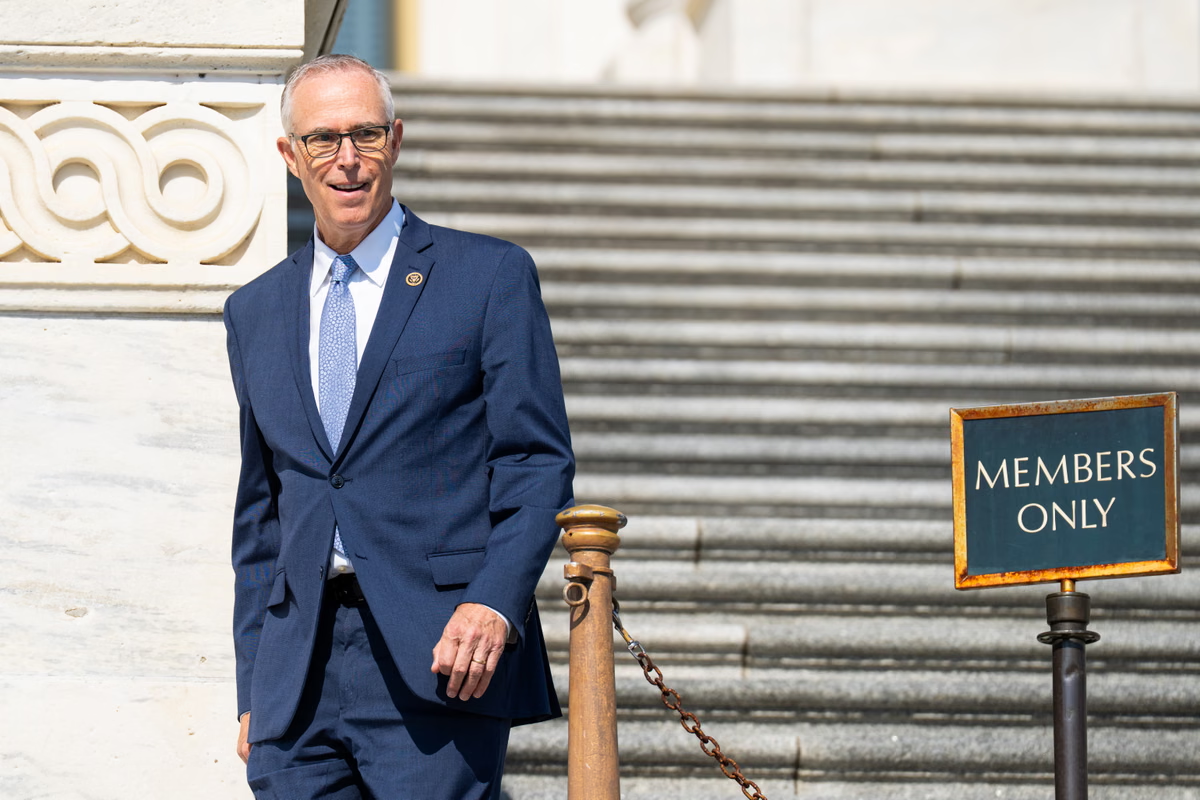







The January 6, 2021, attack on the U.S. Capitol remains etched in public memory as a violent insurrection fueled by supporters of Donald Trump. For Representative Jared Huffman, however, the day revealed a deeper, more troubling reality: a militant Christian nationalist movement operating in plain sight. As he recalls being locked down in his office during the riot, Huffman notes that the presence of crosses, shofars, and “Appeal to Heaven” flags, alongside rioters praying while police were being assaulted, signaled a shift in American political extremism.
Now 62, the California Democrat is sounding an alarm in his new bookNo Prophets: The Fight to Save Democracy from Christian Nationalism. Huffman contends that the United States suffers from a “Bible-sized blind spot,” allowing a theocratic insurgency to flourish. He argues that this movement has only gained strength following Donald Trump’s return to the White House, posing a significant threat to science, education, and the Enlightenment values established by Thomas Jefferson in 1776.
Huffman, who represents Marin County, holds a unique position in Congress as the only self-identified non-believer. Raised in Independence, Missouri, he began to question his faith during his sophomore year at UC Santa Barbara following his father’s death. He eventually embraced humanism, finding it a more affirmative label than atheism. For years, he kept his secular worldview private, a decision reinforced by his first day in Congress in 2013. When then-House Speaker John Boehner asked, “Alright, who’s going to hold the Bible?” for a photo-op, Huffman felt “sullied and hypocritical” as he participated in the tradition.
The shift toward public honesty came in 2017, following the death of his mother and the start of the Trump administration. Despite warnings from his wife, brother, and senior staff that admitting to being a non-believer would be a “career-wrecking idea,” Huffman went public. While he received support from figures like Nancy Pelosi, Jamie Raskin, and the House chaplain, he also faced significant prejudice. He notes that some Democratic colleagues, who are devout Christians, have treated his secularism as a personal insult, highlighting what he calls “Christian privilege.”
Huffman defines this privilege as a cultural taboo that shields domestic religious radicalism from the same level of scrutiny applied to foreign or minority faiths. He points to the January 6 select committee as a prime example. While the committee’s “Purple Team” meticulously documented the role of right-wing Christian extremists in the insurrection, the section was ultimately excised at the insistence of vice-chair Liz Cheney. Huffman credits Cheney for her courage in opposing Trump, but argues that her decision to remove the religious findings was a disservice to the country, suggesting that if the rioters had been carrying Qurans or wearing hijabs, their religious motivations would have been analyzed with “surgical precision.”
The book also examines the internal structure of modern Christian nationalism, which Huffman describes as a temporary coalition of three distinct, volatile subcultures. The most politically potent is the New Apostolic Reformation (NAR), a decentralized network of self-declared “apostles” and “prophets” who reject traditional denominational authority. On the Catholic side, he identifies the “Rad Trads,” a small but influential group that opposes the liberalizing reforms of Vatican II.
Huffman draws a direct line between these movements and the erosion of democratic norms. He cites the “dumbing of America” and the rejection of climate science as evidence of a broader assault on Enlightenment values. He points to Representative Mary Miller of Illinois, who once quoted Adolf Hitler and dismissed solar panels by claiming God “controls the sun.” Huffman warns that this represents a potential unraveling of the 250-year truce between fundamentalist Christianity and the Enlightenment, drawing a grim parallel to the collapse of the Weimar Republic in the 1930s.
Reflecting on his time in office, Huffman expresses frustration that the January 6 attack did not serve as a lasting wake-up call. He believes many of his colleagues failed to grasp the religious nature of the mob that sought to harm them. WithNo Prophetshe aims to force a confrontation with this movement, arguing that the failure to understand and hold Christian nationalism accountable is a dangerous oversight for the future of American democracy. The report also notes that “I truly believed January 6 would be the wake-up call our country needed to confront this movement to understand it and to hold it to account. The report also notes that “Unfortunately, the country went back to sleep and many of my own colleagues who the mob wanted to kill that day didn’t even seem to notice the religious elements of the group that was trying to kill them.”. The report also notes that the only current member of Congress to admit he does not believe in God, no one is better qualified to make this case than Huffman. The report also notes that he grew up in Independence, Missouri – the home of former president Harry Truman and historic headquarters of the Reorganized Church of Jesus Christ of Latter-Day Saints (now the Community of Christ ), an offshoot of Mormonism. The report also notes that a devout Christian, Huffman was ordained into its priesthood. The report also notes that “The bottom line is the supernatural tenets of my faith, the God belief, the notion of heaven and hell and miracles and so forth, no longer worked for me. The report also notes that that’s a hard thing when you lose your faith. The report also notes that “It took me years of reflecting and thinking about it to determine that the things I liked about my religious upbringing, the universal values that are very much part of the Christian gospel, are available in all sorts of faith perspectives, including non-belief.