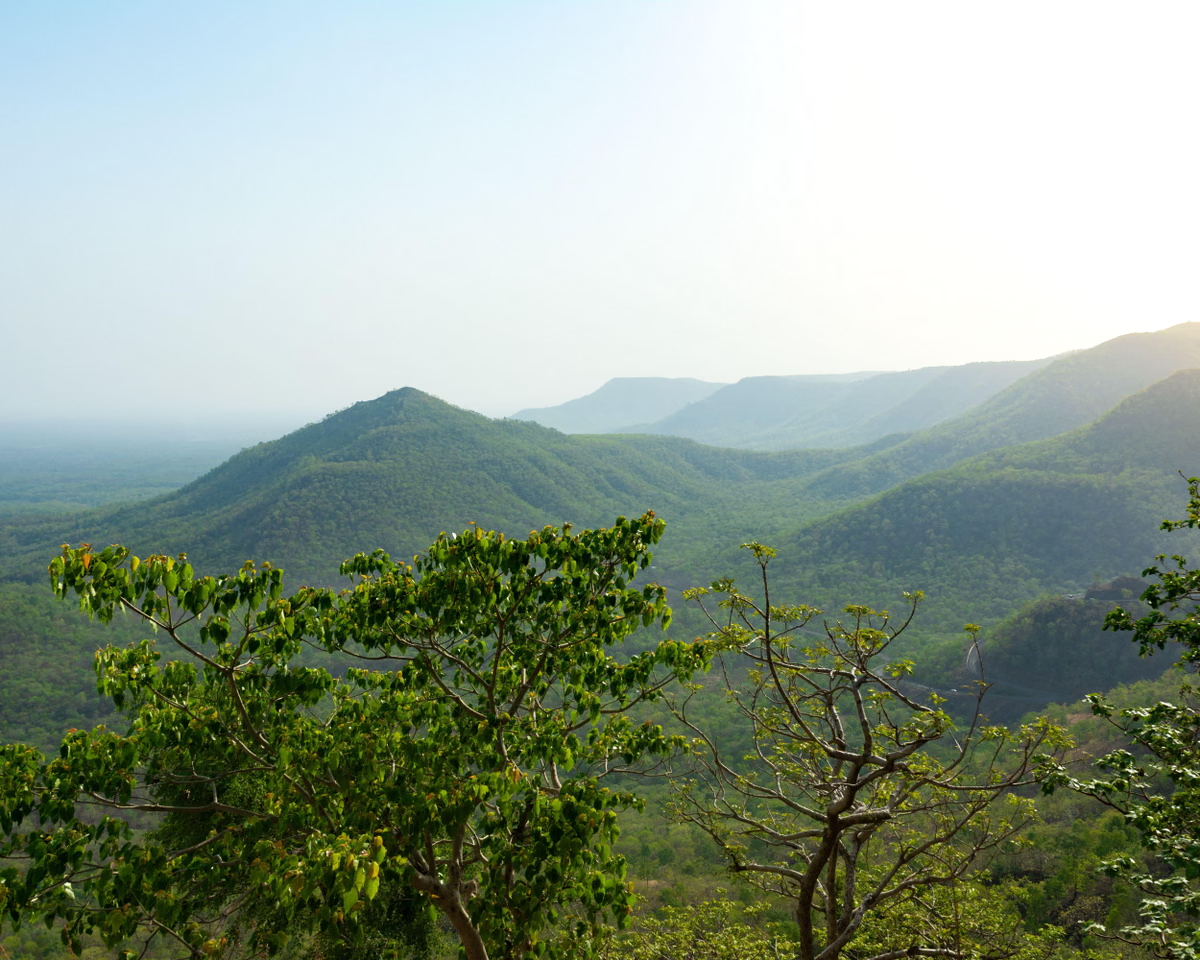









A decade after India launched its ambitious Green India Mission to expand forested areas, government auditors have revealed that the program has achieved only negligible results. The shortfall, amounting to 97.57% of the initial 2014 pledge, has sparked significant alarm regarding the country’s environmental trajectory, especially as the UK Met Office warns that 2027 could become the hottest year on record due to an intense El Niño event.
While the government’s 2023 comprehensive report claimed that forest cover has increased since 2021, independent assessments suggest a different reality. Critics argue that the official data relies on creative accounting, with former civil servants recently writing to the government to challenge the methodology as nonscientific and unreliable. The primary point of contention is the broadening of the definition of “forests” to include orchards, palm plantations, and bamboo groves, which critics argue lack the ecological value of diverse, natural forest patches.
Pooja Choksi, founder of Ficus Research Consulting, noted that the discrepancies stem from how the government categorizes land. She explained that while these plantations may have some biodiversity value, they do not offer the same benefits as the country’s diverse, indigenous forest ecosystems. The government maintains that its definition is internationally accepted and encompasses tree-covered land outside traditional forest boundaries.
The pressure on India’s natural landscape is compounded by the ongoing diversion of forest land for industrial development. Over the past five years, the government has approved projects covering an area roughly equivalent to the size of Hong Kong. Mining remains the largest driver of this land loss, accounting for 22% of all diverted forest areas, followed by road construction and irrigation projects.
Regional data highlights that Madhya Pradesh, which holds the country’s largest forest area, accounts for nearly a quarter of all forest land diverted nationwide since 2021. Arunachal Pradesh, located on the border with China, ranks third in these diversions. Research mapping 28 years of satellite data across central Indian coal mining regions found that the environmental damage extends far beyond tree loss, with water bodies shrinking, soil quality degrading, and natural ecosystems diminishing by 35%.
The Great Nicobar Project has become a focal point for these concerns. The central government describes the initiative as a strategic necessity for maritime and defense interests in the Indo-Pacific. However, the project is slated to divert 13,075 hectares of forest land. Geoscientist CP Rajendran has criticized the plan, calling it geologically impossible and ecologically destructive for the protected Indigenous tribes residing in the area.
In response to the loss of forest land, the government often relies on compensatory afforestation, pouring public funds into planting trees elsewhere. However, experts like Choksi warn that this strategy is often one-dimensional, focusing on “green cover” metrics while ignoring the specific ecological purpose and biodiversity requirements of different regions. Furthermore, the biennial forest report, which was expected in 2025, remains outstanding, leaving the true health of India’s forests difficult to assess.
Financial questions have also emerged regarding the Prime Minister’s Citizen Assistance and Relief in Emergency Situations Fund (PM Cares). Established during the pandemic, the fund held a balance of £647m (Rs 8,452 crore) at the close of the 2025 financial year. Bharatiya Janata party spokesperson Pradeep Bhandari defended the fund during a debate, stating that it is intended for long-term rehabilitation rather than immediate disaster relief.
Beyond environmental policy, other notable developments include the opening of RaGa, a new restaurant by renowned chef Gaggan Anand on Delhi’s Janpath Road, which began operations on August 26. Additionally, choreographer Usha Jey continues to gain attention for her fusion dance style, which she credits as a way to connect with her bharatanatyam roots, while ongoing discussions continue regarding the challenges of surviving extreme heat in urban centers like Mumbai. The report also notes that last week, however, we learned that the forest cover programme had barely taken root when the government’s auditors released their findings of the flagship Green India Mission. The report also notes that who described the progress as “negligible”, the shortfall of 97.57% from India’s initial pledge in 2014 was stark enough to alarm the government’s own auditor. The report also notes that you’ll get a far greener picture, yet if you ask the government about forest cover. The report also notes that on account of the strongest El Niño in more than a century, i’m writing this on the day the UK Met Office issued a calamitous warning – 2027 could be the hottest year yet. The report also notes that for India, a disrupted monsoon season puts agriculture and millions who depend on it at risk. The report also notes that which makes the question of what’s happening to India’s green cover feel far more urgent than an academic disagreement over numbers. The report also notes that datasets and government’s parliamentary disclosures, i went down the rabbit hole of reports.