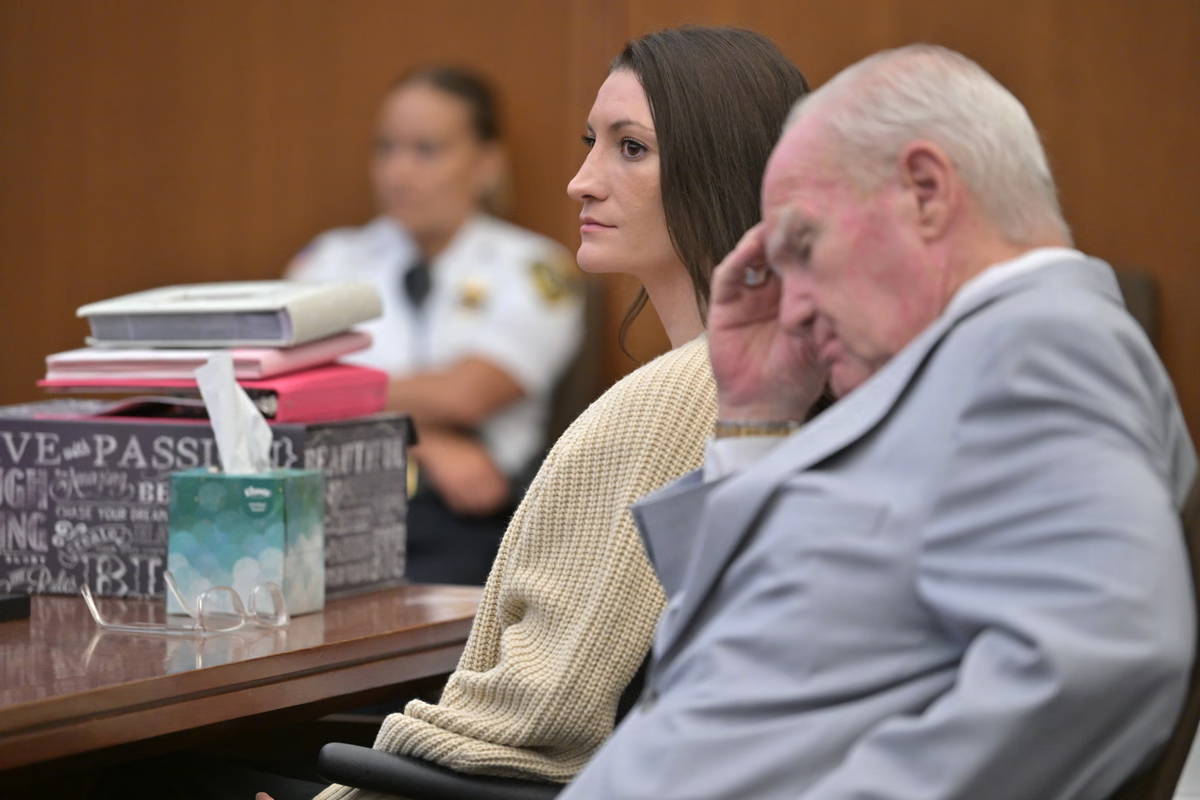









The trial of Lindsay Clancy, the Massachusetts mother facing charges for the January 2023 deaths of her three children, is expected to reach the jury next week. Jurors must determine whether Clancy is guilty of murder or if she was suffering from severe postpartum psychosis, which would render her not criminally responsible for her actions.
Defense attorney Kevin Reddington has argued that Clancy was not only experiencing postpartum psychosis but was also struggling with bipolar disorder and was overmedicated at the time. The defense rested its case on Friday following testimony from Dr. Phillip Resnick, a forensic psychiatrist who previously consulted on the Andrea Yates case. Resnick testified that he believed Clancy was “frankly psychotic” when the children died, noting that she experienced “command hallucinations” and a “delusion of influence” where she felt an external force had taken control of her body.
Forensic psychologist Paul Zeizel, another defense witness, testified that Clancy had informed her former husband, Patrick Clancy, that a male voice had ordered her to kill their children and herself. Zeizel stated that psychological testing showed no evidence of Clancy exaggerating her symptoms and concluded she was unable to conform her behavior to the law.
The prosecution maintains that Clancy acted with deliberation and rationality. To counter the defense, they recalled psychiatrist Dr. Avram Mack, who testified that Clancy’s presentation in the aftermath of the killings showed few abnormalities. Mack described her as generally friendly and cooperative, though she expressed misery and distress. He noted that while she was anxious about returning to work and using a nanny, she felt positive about her ability to care for the children herself.
During cross-examination, Reddington challenged Mack’s assessment, noting that the psychiatrist had not interviewed people from Clancy’s life and relied primarily on his own observations of her while she was medicated in a psychiatric facility. The burden remains on the prosecution to prove that Clancy did not suffer from a qualifying mental disease or that she retained the capacity to understand the criminality of her conduct.
The trial proceedings were interrupted on Wednesday and Thursday, with Judge William Sullivan dismissing the jury early. The judge characterized the delay as an “unforeseen circumstance,” instructing jurors “not to speculate about what it is; you’re not to hold it against either side. It’s just something that we have to deal with.”
Hospital chaplain Sheila Cavanaugh provided testimony regarding her interactions with Clancy at Brigham and Women’s Hospital shortly after the incident. Cavanaugh reported that Clancy appeared to have a “flat affect” and described hearing a persistent male voice that threatened her and her children if she did not comply with its commands. Cavanaugh recalled telling Clancy, “Lindsay, your children are safe. They’re safe in heaven with God,” to which Clancy responded, “I am so glad my children are safe.”
The case has drawn significant public attention, highlighting broader concerns regarding maternal mental healthcare. On Thursday, hundreds of supporters gathered outside the courthouse, many wearing pink and carrying signs such as “She Needed Help.” Attendee April Vincent expressed the frustration of many, stating, “Women are being dismissed, neglected and ignored when we speak up. We’re scared because nobody takes us seriously.”
If the jury finds Clancy not guilty by reason of insanity, she will not be released but will instead be committed to a state psychiatric hospital for ongoing treatment and periodic review. The report also notes that the outcome may come down to expert witness testimony – and there have been many – but the trial will be remembered for the spotlight it put on maternal health care in the United States. The report also notes that prosecutors pushed back on defense claims that Clancy was suffering from a postpartum mental illness that caused her to break from reality. The report also notes that five, Dawson, three, and Callan, eight months, after sending her husband out on errands, they contend Clancy acted deliberately and rationally when she took the lives of her children Cora. The report also notes that they would have to know their actions were wrong, mack said that the medical standard for assessing if someone can be held criminally responsible for their actions under Massachusetts law. The report also notes that and that he had reached that conclusion based on Clancy’s descriptions of her feelings and the progression of her illness, mack said Clancy suffered from a “major depressive episode” in 2022 and 2023. The report also notes that the subject matter has ignited a movement for those invested in maternal and postpartum healthcare in the US, given the widespread interest in the trial online and beyond.