
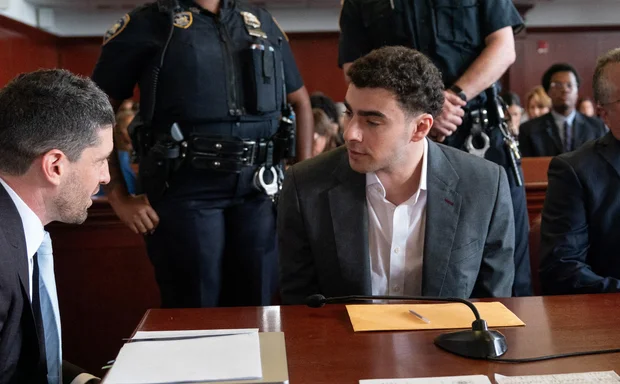







Luigi Mangione’s guilty plea on Friday regarding federal charges linked to the 2024 shooting of UnitedHealthcare CEO Brian Thompson has ignited a significant legal debate. With his state murder trial currently scheduled to begin in three weeks, questions are mounting over whether the federal resolution will impact the state’s ability to proceed with its own prosecution.
During Friday’s hearing, Mangione admitted to killing Thompson in December 2024. He entered guilty pleas to federal counts of interstate stalking resulting in death and stalking through the use of interstate facilities resulting in death. Mangione acknowledged in court that he understands both charges carry a maximum potential sentence of life in prison. The judge has set his federal sentencing for Dec. 18.
The legal landscape remains complex, as Mangione still faces state charges of second-degree murder, along with weapons and forgery counts. A previous first-degree murder charge was dismissed in September 2025. His defense team, led by attorney Karen Friedman Agnifilo, has consistently argued that the state proceedings constitute double jeopardy, a Fifth Amendment protection against being prosecuted twice for the same offense. They intend to pursue this argument more aggressively following the federal plea.
Agnifilo stated outside the courthouse that Mangione has faced unfair treatment since the beginning, noting he has successfully contested terrorism charges and the death penalty while simultaneously navigating two separate prosecutions. She argued that the state trial seeks to punish him twice for the same conduct. The defense has already filed a motion in state court seeking to dismiss the charges based on these double jeopardy protections.
The Manhattan District Attorney’s Office, led by Alvin Bragg, maintains that it will continue to pursue the state case. A spokesperson for the office emphasized that they have been preparing for the trial since December 2024 and remain committed to securing justice for the Thompson family. The office stated it is prepared to litigate the defense’s motions to ensure accountability for the incident.
The timing of the trials has been a point of contention throughout the case. legal reporter Katrina Kaufman noted that there has been ongoing friction between state and federal prosecutors regarding the order of the proceedings. While federal authorities initially sought to move first, the state judge previously insisted that New York had conducted the primary investigative work.
Legal experts suggest the outcome may hinge on specific New York state laws. Jessica Levinson, a professor at Loyola Law School, explained that New York provides broader protections than the federal Fifth Amendment. State law generally prohibits successive prosecutions for the same course of conduct. However, she noted that the prosecution will likely rely on a legal carve-out, arguing that the elements of federal stalking charges differ significantly from the elements required for a state murder conviction.
Levinson added that the defense’s strategy likely involves two goals: demonstrating an acceptance of responsibility to potentially mitigate sentencing, and attempting to secure a dismissal of the state murder charge. She noted, however, that convincing a judge to dismiss the state case remains a difficult legal hurdle.
Attorney and legal analyst Joe Tamburino agreed that the federal plea should not necessarily preclude a state trial. He argued that the two jurisdictions are addressing different types of harm. According to Tamburino, New York law focuses on intentional murder, whereas federal law targets stalking and interstate movement that results in a fatality. Because the charges involve distinct elements, he believes double jeopardy will not prevent the state from continuing its prosecution.
Ultimately, it will fall to New York State Supreme Court Justice Gregory Carro to determine if the state’s double jeopardy statute applies to Mangione’s specific circumstances. The court must also decide whether Mangione’s admission of guilt in federal court can be introduced as evidence during the state trial.
As the legal battle continues, the family of Brian Thompson remains focused on the upcoming proceedings. In a statement, they expressed that they remain mindful of the additional hearings to come in New York and Pennsylvania, emphasizing their commitment to seeing the justice that Thompson deserves.
The case, which originated from the shooting of Thompson on a Manhattan sidewalk as he walked to a company investors conference, has drawn national attention. With the state trial date approaching, the defense’s motion to dismiss remains a critical development that could reshape the final stages of the litigation.
Regardless of what is eventually decided in the courts, it seems likely the state trial will be delayed.
“He’s been treated differently from every other defendant charged with this offense in New York,” she said.
is the hope that in deciding to say, ‘I’m pleading guilty,’ that includes a prosecution in the legal sense.”
“Despite this being a single, isolated event, Mr.
Here are some of the biggest questions remaining in the wake of Mangione’s plea deal.
The fact that the case took place in New York does change the equation.
“One of them being accepting responsibility and hoping that serves as a mitigating factor when the judge does give a sentence.