









Today, millions of people across Europe will experience their first total solar eclipse in 27 years. Starting at 15:34 GMT, the moon will begin its transit across the sun, gradually interrupting daylight hours and eventually plunging regions along the path of totality into sudden darkness for approximately two minutes.
The celestial event follows a path from the Arctic, sweeping across northern Russia, Greenland, and Iceland before moving over Spain and a small portion of Portugal. This trajectory will bring near-total darkness to roughly 15 million people. The timing of the event varies significantly based on geographic location as the moon’s shadow traverses the Earth’s surface.
The progression of the eclipse is marked by several key milestones. At 15:34 GMT, the partial eclipse begins at the first location on Earth. By 16:58 GMT, the total solar eclipse commences at the initial point. The event reaches its maximum intensity at 17:46 GMT, with totality lasting about two minutes and 18 seconds near the center of the path.
Specific regional observations include Reykjavik, Iceland, where the eclipse reaches its maximum at approximately 17:48 GMT. In western Spain, totality is expected to begin at roughly 18:27 GMT, or 8:27pm local time, lasting for up to 110 seconds depending on the observer’s exact position. The global phase of the total eclipse concludes at 18:34 GMT, while the final partial eclipse phase ends at 19:58 GMT.
While the path of totality is narrow, a partial eclipse will be visible across much of Western Europe, parts of Northwest Africa, most of Canada, and sections of the northern United States. In total, nearly 980 million people—roughly one in eight individuals worldwide—may witness the sun being at least partially obscured, provided weather conditions allow for clear viewing.
European cities will see varying degrees of coverage. Paris is expected to see 92 percent coverage, London 91 percent, and Berlin 85 percent. However, for many cities further east, the sun will set before the eclipse reaches its maximum, meaning the deepest phase will not be visible. In Canada, St. John’s, Newfoundland, will experience 53 percent coverage, while Montreal and Toronto will see 18 percent and 8 percent respectively.
In the United States, parts of Alaska will experience the deepest coverage, with 37 percent in Fairbanks and 28 percent in Anchorage. Other regions will see significantly less: Bangor, Maine, at 24 percent, New York at 9 percent, and Detroit at 3 percent. In Spain, cities such as Leon, Valladolid, Zaragoza, Teruel, and Valencia fall within the path of totality, offering prime viewing. Madrid and Barcelona remain just outside this band but will still experience over 99 percent solar coverage.
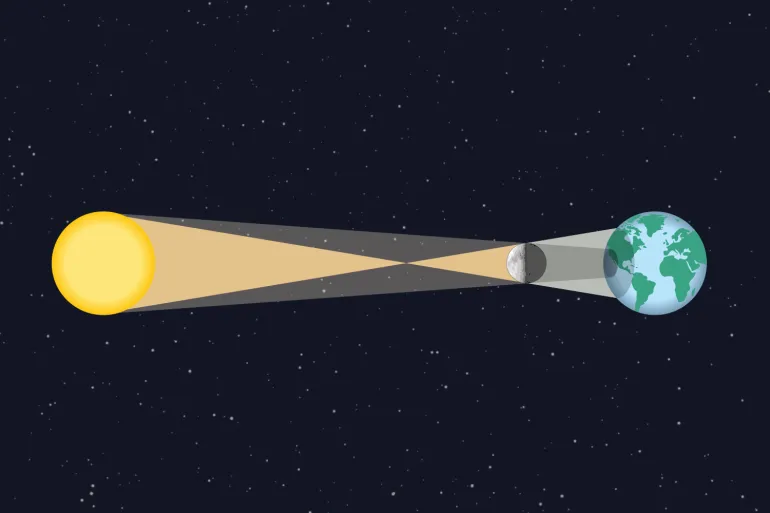
A solar eclipse occurs when the moon passes between the Earth and the sun, temporarily obstructing light. During totality, the moon completely covers the sun’s bright face, revealing the solar corona. NASA will provide a livestream of the event starting at 17:15 GMT for those unable to view it in person.
Safety remains paramount for observers. Looking directly at the sun can cause severe eye injury. Experts advise using certified eclipse glasses or safe handheld solar viewers. Before use, these should be checked for scratches or tears. Children must be supervised, and ordinary sunglasses—regardless of their darkness—are insufficient for protection.
Observers must never look at the sun through cameras, binoculars, or telescopes without a specialized solar filter, as concentrated sunlight can damage both the equipment and the human eye. Eclipse glasses should not be used with unfiltered optical devices. The only exception to these rules is the brief period of totality, when the moon completely blocks the sun; during these two minutes, it is safe to look without protection.
As soon as the sun begins to reappear, eye protection must be immediately reapplied. Photographers are warned that pointing a camera directly at the sun without a proper solar filter can damage the sensor. During the brief window of 100 percent coverage, the filter may be removed for photography.
This event serves as a significant astronomical milestone, with the next total solar eclipse scheduled to occur on August 2 of next year. Observers are encouraged to plan accordingly to ensure both a memorable experience and the preservation of their vision throughout the duration of the celestial transit.
During the couple of minutes when the sun is 100 percent covered, the filter comes off and you can shoot bare.
Where and how can you watch it safely?
In this visual explainer, Al Jazeera unpacks everything you need to know.
Here is how today’s eclipse will unfold
Here are some tips for what you should and shouldn’t do.
The filter should go back on the instant the first bead of sunlight returns.
It will cross southern Spain, North Africa, Saudi Arabia and Yemen.