
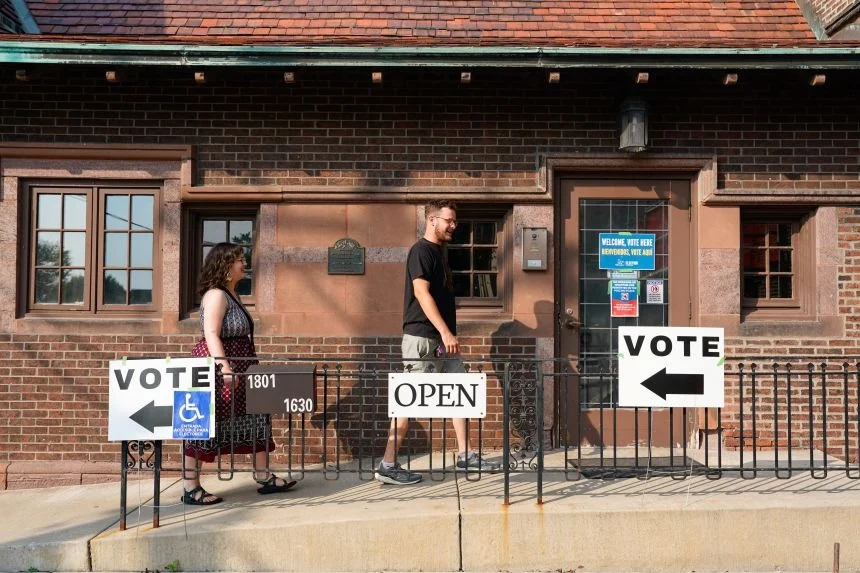








The Democratic establishment successfully fended off a progressive challenge in Wisconsin on Tuesday, as Milwaukee County Executive David Crowley secured a narrow victory in the gubernatorial primary. Decision Desk projected Crowley as the winner over democratic socialist Francesca Hong, marking a significant consolidation of party support in the final days of the campaign. Outgoing Governor Tony Evers played a pivotal role, hitting the campaign trail to rally voters behind Crowley. The result reflects concerns among the state’s primary electorate regarding Hong’s electability in a critical presidential battleground, particularly following her performance in recent media appearances, including a interview where she struggled to address a 2020 social media post advocating for the cancellation of Thanksgiving.
The race served as a broader test of the Democratic Party’s ideological direction, questioning whether the progressive momentum seen in deep-blue districts could translate to swing states. While polling in the race was limited, a late July survey from Marquette Law School had placed Hong at 46%, followed by former Lt. Gov. Mandela Barnes at 21% and Crowley at 11%. However, Crowley emerged as the primary alternative after Barnes withdrew from the contest. This outcome follows a trend of tight races for the party’s left wing, including Abdul El-Sayed’s narrow win in the Michigan Democratic Senate primary just one week prior.
In Minnesota, progressives achieved a notable victory as Lt. Gov. Peggy Flanagan defeated moderate Rep. Angie Craig in the Democratic primary for the seat being vacated by retiring Sen. Tina Smith. Flanagan, who secured endorsements from Sens. Bernie Sanders and Elizabeth Warren, centered her campaign on criticisms of Craig’s financial ties to the American Israel Public Affairs Committee and her support for the Laken Riley Act, which mandates the detention of certain individuals. Flanagan is now the heavy favorite for the general election, where she will face first-time candidate and former NFL broadcaster Michele Tafoya. Additionally, former state senator Matt Little won the Democratic primary for Minnesota’s 2nd District House seat.
The political landscape in Minnesota also saw tensions rise over immigration enforcement, which became a flashpoint following the January deaths of two U.S. citizens at the hands of federal agents during protests against mass deportation efforts. Meanwhile, in the Republican sphere, Darline Graham secured first place in South Carolina’s special primary for a full Senate term, bolstered by an endorsement from former President Donald Trump. Despite this, Graham fell short of an outright majority, capturing roughly one-third of the vote and heading into a runoff against Rep. Ralph Norman.
Graham’s path to the nomination remains uncertain, as she finished significantly below the 50%-plus-one threshold. Historical data suggests this is a precarious position; only one other Trump-backed statewide candidate has performed worse in a primary, notably South Carolina Lt. Gov. Pam Evette, who subsequently lost her June runoff by 37 points. Norman, who finished third in that same gubernatorial primary with 17%, is positioning himself as a conservative alternative, emphasizing his leadership in the House Freedom Caucus. When asked about his political history, Norman stated, “My record is an open book.” His primary hurdle may be his 2024 decision to support Nikki Haley over Trump, a move that could complicate his standing with the former president’s base.
The broader trend for Trump-endorsed candidates has been challenging, with Graham’s runoff entry and Mike Lindell’s loss in the Minnesota GOP gubernatorial primary to state House Speaker Lisa Demuth adding to a string of recent defeats. Since August 4, three Trump-backed candidates have lost their respective races, including Michigan congressional hopeful Amir Hassan and Tennessee Rep. Andy Ogles, who fell to Charlie Hatcher. These losses bring the total number of defeated Trump-backed candidates for Congress or statewide office to seven this season, with five of those losses occurring in statewide contests.
Elsewhere in Wisconsin, the 3rd District Democratic primary saw a victory for a candidate looking to flip the seat currently held by Republican Rep. Derrick Van Orden. The winner fended off progressive rival Emily Berge, the former Eau Claire city council president, in a race that Democrats view as a prime opportunity to gain ground. The district, known for its Driftless Area, remains a focal point for party strategists who are closely monitoring the impact of candidate electability on the upcoming general election cycle. The report also notes that in interviews in recent days, Democratic voters in the state said Hong’s stumbles in television interviews — including a interview in which she gave a meandering answer when asked about a 2020 tweet in which she advo. The report also notes that but whether it will take her any further in the August 25 runoff is a big open question. The report also notes that in fact, Graham is pretty far from 50%-plus-one, relative to other Trump-endorsed candidates. The report also notes that in interviews in recent days, Democratic voters in the state said Hong’s stumbles in television interviews — including a interview in which she gave a meandering answer when asked about a 2020 tweet in which she advocated for canceling Thanksgiving — as they explained their worries about the 37-year-old state lawmaker and former restaurant owner’s electability. The report also notes that and perhaps some voters were convinced those votes would be too risky, democratic leaders have worried greatly about nominating both El-Sayed and Hong. The report also notes that because the universe of voters isn’t as predictable, polling primary elections is also more difficult than general elections. The report also notes that urban voters (who favor more left-wing candidates) and under-sampling more rural, blue-collar ones, and there is some thought that these surveys might be over-sampling more-educated. The report also notes that plus, there just wasn’t much quality polling in either race.