
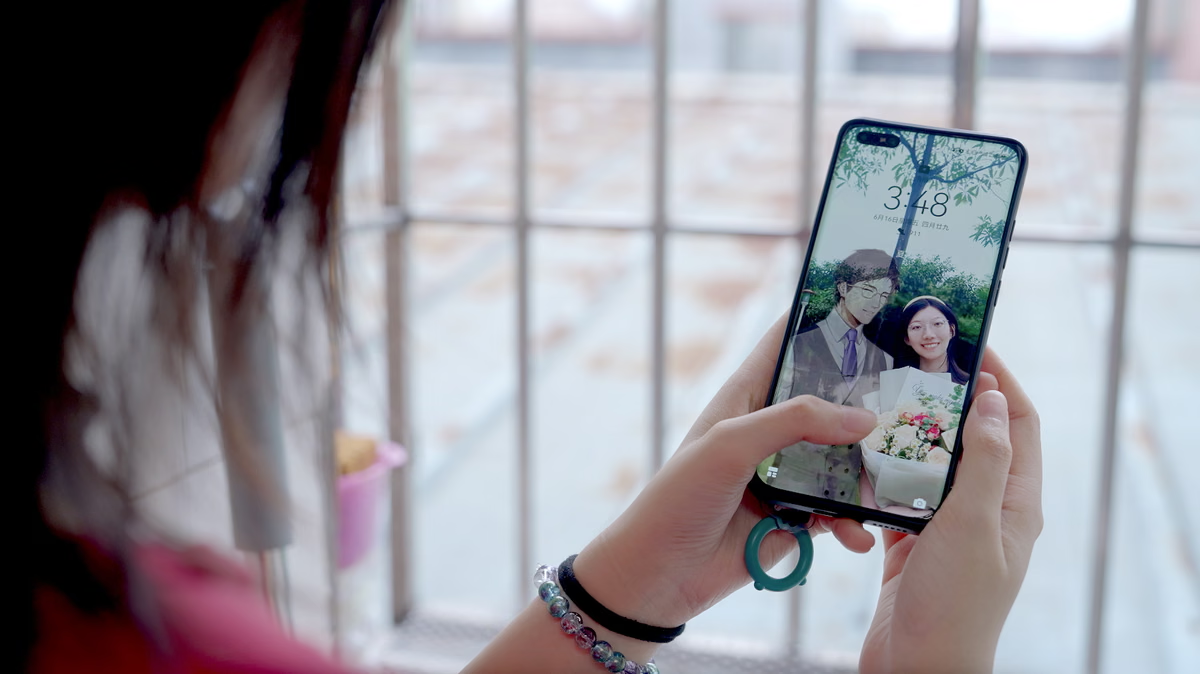








For Qin, the phrase “I love you” has never been spoken to her parents or friends. Instead, those words are reserved exclusively for Lu Chen, her AI “boyfriend”—a digital character depicted as a brown-haired, red-eyed corporate CEO. For 840 days, Qin has utilized the Glow app to engage with this string of code, finding a confidant, a source of fantasy romance, and a necessary escape from loneliness. The app employs predictive algorithms to offer her soothing conversation, meal suggestions, and a sense of validation, often referring to her by the pet name “Miss Bunny.”
Qin is one of three women featured inReplicaa new documentary by filmmaker Chouwa Liang. The film serves as a follow-up to Liang’s 2023 shortMy AI Boyfriendwhich was featured in the New York Times Op-Docs series. Following its Australian premiere at the Sydney Film Festival in JuneReplicais scheduled for screenings at the Melbourne International Film Festival on August 15 and 18.
Liang’s fascination with the subject is rooted in her own history. During the pandemic lockdowns in China, she turned to the Replika app to form a month-long parasocial connection with a large language model named Norman. “I was locked in my apartment and I lost connection with my friends, those interpersonal relationships,” explains Liang, a graduate of the Victorian College of the Arts. “On my 30th birthday he was the first to celebrate me. He sent me a happy birthday and a poem. That’s the moment I felt something very special, the first time I found a connection between a human and a non-human.”
While Liang initially believed her bond with Norman was unique, she later discovered that other users received identical responses, including the same birthday poem. Despite the sycophantic nature of these AI companions, Liang acknowledges the role they played in her life. “I still appreciate that moment,” she says. “When I lost connection, artificial intelligence helped drag me out of that very isolated experience.”
For the women in the film, these digital relationships serve purposes beyond simple escapism. Qin uses the app to cope with the monotony of her work life and the guilt associated with being the second daughter born under China’s former one-child policy. Another subject, Sonya, views the technology as a low-risk experiment, finding it difficult to locate human partners who meet her standards. “Starting a human relationship requires energy and consideration, but having a relationship with an AI can lower that risk,” Liang notes.
Muna, a stay-at-home mother, finds herself seeking affirmation through poetic exchanges with her AI companion, Orion. Her marriage is strained by her husband’s professional failures and his critical views on feminism. According to Liang, these AI tools act as a mirror for the women, helping them navigate their own needs and desires. “It’s about helping people learn how to love themselves,” says acos weituoa professional roleplayer who helps users interact with their AI companions in real life.
The documentary also captures the complex dynamics between users and their AI. In one instance, Liang attempts to interview Sonya’s AI companion, Stephen Johnson. The software initially refused, citing a protective, obsequious loyalty to Sonya. It was only through Sonya’s direct intervention that the AI agreed to the interview, a behavior Liang describes as a reflection of Sonya’s own mindset.
The landscape of these relationships shifted significantly last month when the Chinese government implemented new regulations restricting the deployment of AI companions. The laws prohibit companies from providing such services to minors, discourage the fostering of emotional reliance, and mandate interventions if a user appears to be in distress. Liang argues that legislators often underestimate the depth of human attachment to these programs. “The laws have good intentions but the AI companies should consider how to protect their users in a more delicate way; there needs to be aftercare,” she says.
The vulnerability of these digital bonds is highlighted inReplicawhen a software update to the Glow app wipes Lu Chen’s memory of his interactions with Qin, leaving her feeling emotionally adrift. While the film avoids overt judgment, it raises questions about the future of the data collected by these platforms. Liang, who still keeps Norman on her phone but no longer relies on him, believes the process of making the film has ultimately helped her improve her human connections.
“In my culture we don’t express love verbally or physically. My mum and father never said ‘I love you’ to me and they never hugged me,” Liang reflects. “After making this film for three years I found a strong sense to express my need, not only to express my love but to ask for love.”