

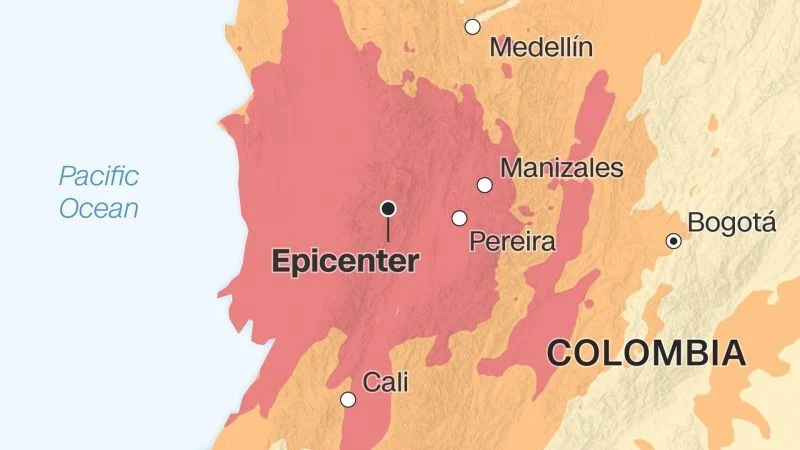









A powerful 7.4 magnitude earthquake struck western Colombia on Monday, resulting in scores of fatalities and causing severe damage to thousands of buildings throughout the nation. According to the United States Geological Survey, this seismic event is the strongest to originate within the country since at least 1990.
The earthquake’s epicenter was located in San José del Palmar, situated in the northwestern department of Chocó, approximately 240 kilometers (149 miles) west of Bogotá. Tremors were felt as far away as the capital city and were also recorded in neighboring Venezuela, a region already managing the aftermath of several destructive quakes earlier this summer.
While most seismic activity occurs near tectonic plate boundaries, the US Geological Survey notes that quakes can occasionally happen within continental interiors. Historical records indicate that the frequency of significant earthquakes, defined as those reaching a magnitude of 6.0 or higher, has fluctuated over recent decades. Classified as a major event, Monday’s 7.4 magnitude quake was expected to produce the extensive structural destruction currently being reported. The report also notes that historical data shows that the number of significant quakes — generally those of 6.0 or higher magnitude — have ebbed and flowed over the last few decades.