



Syria and Russia have concluded 18 months of intensive negotiations regarding the future of Moscow’s military presence in the country, a process that began following the collapse of the Bashar al-Assad regime in December 2024. The transition marks a significant departure from the previous era, during which Russia served as a primary ally to the Assad government throughout the 14-year civil war that originated with the 2011 Arab Spring protests.
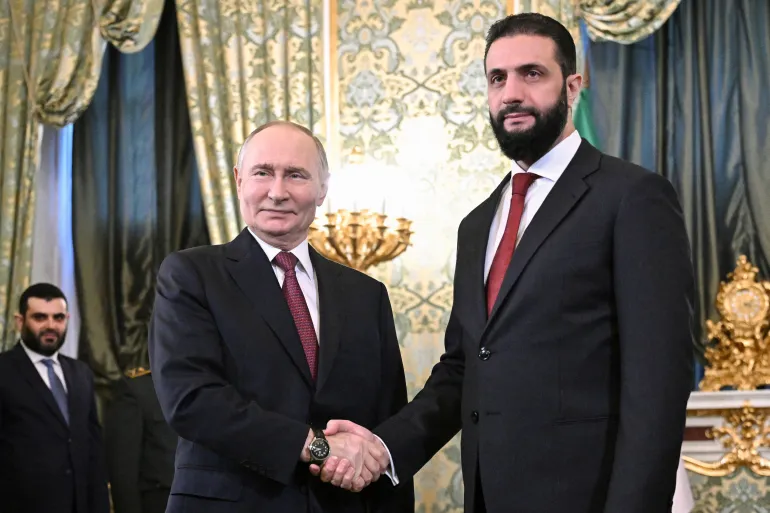
The current administration in Damascus, led by President Ahmed al-Sharaa, announced a memorandum of understanding on Sunday concerning the status of the Hmeimim airbase and the Tartus naval facility. Under the terms of this new agreement, Syria will assume control over civilian operations at Hmeimim and the commercial sectors of the Tartus port. The remaining military infrastructure is set to be converted into joint Russian-Syrian training and qualification centers, with the transition process expected to reach completion within three months.
This development represents a notable pivot from the role these bases previously played in supporting the Assad regime, a conflict that resulted in millions of displacements and hundreds of thousands of deaths. Analysts suggest the move is driven by pragmatic necessity: Damascus seeks to reclaim sovereignty over critical national infrastructure, while Moscow aims to maintain a strategic foothold in the region after investing heavily in the country for decades.
Alexey Muraviev, a senior research fellow in defence and strategic studies at Edith Cowan University, noted that the agreement underscores a mutual dependency. He stated, “The agreement between Russia and the Syrian government indicates that both countries need each other,” adding that the Syrian leadership is clearly not interested in terminating its long-standing relationship with Moscow.
The Russian military intervention in 2015 was instrumental in shifting the momentum of the civil war in favor of the Assad government, with Hmeimim serving as the hub for air operations and Tartus providing a vital Mediterranean naval base. However, Russia notably refrained from intervening during the final offensive that led to Assad’s overthrow in December 2024. Following the regime’s fall, most Russian troops departed, leaving only those stationed at the two primary bases.
The Syrian foreign ministry described the new arrangements as a “reorganising of the Russian presence” along the coast. Officials stated that this move is the most significant development since negotiations commenced a year and a half ago, effectively initiating a new phase in bilateral relations.
Ruslan Trad, a non-resident fellow at the Atlantic Council, observed that the current government has adopted a realist approach to foreign policy. Despite having fought Russian-backed forces for years, the al-Sharaa administration began discreet negotiations to retain a Russian presence shortly after taking power. “This confirms the classic realist maxim that in politics there are no permanent enemies, only permanent interests,” Trad explained.
The decision to maintain ties with Moscow is viewed as a calculated trade-off. Beyond military cooperation, Russia holds significant leverage through its control over Bashar al-Assad’s asylum, management of Syrian reconstruction contracts, and the provision of subsidized grain and oil. Furthermore, Russia remains a veto-wielding member of the UN Security Council, which has historically provided diplomatic cover for members of the current Syrian leadership.
Aron Lund, a fellow at Century International, highlighted the deep-rooted technical and administrative legacy of cooperation between the two nations. He noted that breaking these ties would be economically and logistically painful for Syria, which remains chronically cash-strapped and reliant on Russian technical support. President al-Sharaa has visited Vladimir Putin in Moscow twice since assuming office to secure this assistance.
Despite this renewed cooperation, analysts emphasize that Syria is not closing doors to other international actors. Muraviev suggested that the new government remains open to developing strategic links with Turkey, the United States, and potentially Israel. This flexible approach was evident even during the final months of the previous regime, as negotiations between Moscow and the opposition forces began before the total collapse of the Assad government.
Lund characterized the negotiations as “very discreet,” likely due to concerns that publicizing the details of the base agreements might prompt European or American demands for their closure. He added that the leadership in both capitals has demonstrated significant flexibility in navigating the post-Assad landscape.
For its part, Moscow views the preservation of these facilities as essential for its ability to project power into the eastern Mediterranean and Africa. By offering debt relief and economic cooperation, Russia continues to signal its support for Syria’s territorial integrity, while President al-Sharaa has publicly acknowledged Russia’s role in stabilizing the broader region.
However, analysts say it could represent something more pragmatic, with Damascus reclaiming greater sovereignty over strategically important facilities while Moscow preserves a foothold and avoids being pushed entirely o
The Russian military intervention in 2015 helped to turn the tide of the war in favour of the al-Assad-led government.
However, Russia did not interfere during the major advance towards Damascus that led to al-Assad’s overthrow in December 2024.
Assad fled to Russia where he and his family were granted asylum.
Moscow has yet to comment on the deal.
In the same vein in which al-Sharaa has gone in efforts to strike cordial relations with Western powers such as the US – which bestowed him with the status of Specially Designated Global Terrorist in May 2013 during the civil war – Trad said the post-al-Assad government has likely calculated that punishing Russia for its wartime role would cost more than it was worth.
“It’s transactional pragmatism on both sides,” he told Al Jazeera.
“They began to meet only some weeks after Assad’s ouster.
In practice, they were meeting and negotiating just weeks after Russian jets bombed al-Sharaa’s fighters.
“So yes, both sides still need each other, just on renegotiated terms that reflect Syria’s new leverage as sovereign gatekeeper rather than as Moscow’s client,” he added.
“But … an agreement means that the Syrian government has retained an interest, and withstood the pressure from other parties, because they clearly see the dividends of maintaining the relationship with Russia.”
“But they would probably want to keep a multi-vectoral engagement … and having Russia in the equation will help them to use it as perhaps even a bargaining chip in their power game with other major powers.”
“Al-Assad’s fall was a major blow to Russia, but that has already happened.
We shall see whether the new arrangement will constrain Russia even more, or, to the contrary, whether this deal will formalise and reactivate Russia’s military presence.”