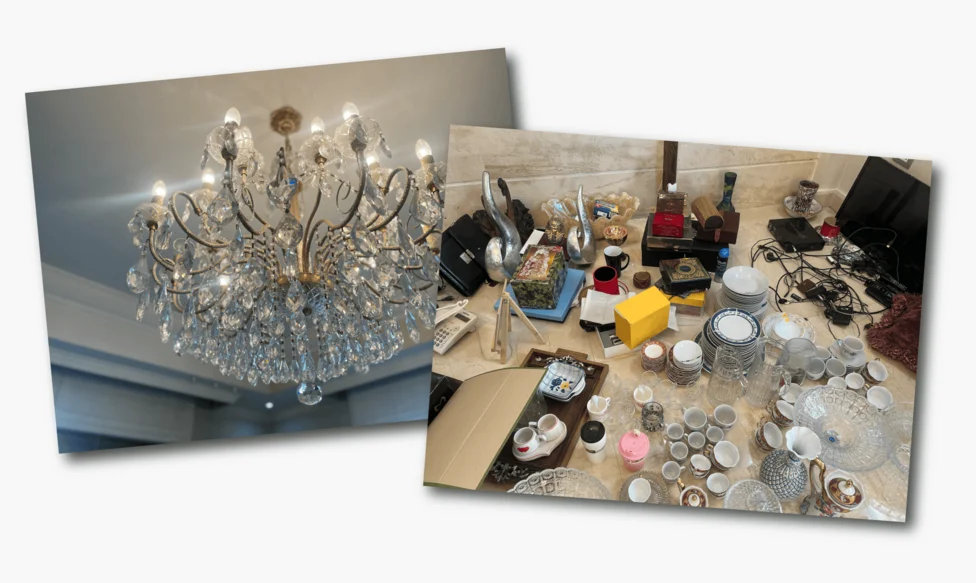




In an abandoned luxury apartment in the Syrian capital Damascus, armed men dressed in military fatigues sifted through designer clothes and documents. The residence, once a bastion of power for one of the regime’s most feared figures, stood as a silent witness to the sudden collapse of Bashar al-Assad’s government in December 2024. Scattered across the living room floor, under a sparkling crystal chandelier, were dozens of photos of the same slender man in different settings—sitting at his desk, even playing in the snow. And multiple prints of the same image, showing him smiling warmly as he shook the hand of ousted dictator Bashar al-Assad.
The man was not instantly recognisable, but gold medals and gilded certificates piled nearby were inscribed with the name Hussam Luka. Known as “The Spider,” Luka was one of Assad’s top henchmen, accused of orchestrating atrocities and systematic torture, and sanctioned by the UK, US and European Union. Like others in the regime, Luka seemingly vanished overnight when the government fell, leaving a trail of unanswered questions and demands for justice that many fear will never be realised. Inside his apartment, days after the fall, we watched rebels looking for clues as to where he might have fled.
In the corner of the living room, on a console table, was an unremarkable-looking notebook. Inside, in scribbled blue handwriting, we found dozens of names—from shopkeepers and doctors, to military officials and people with the Luka family name. Could these contacts help us learn more about The Spider and his crimes, or even help us to track him down? At one time, Luka’s own phone number was hard to avoid; in the early days of the Syrian civil war, it had been a fixture of the regime’s psychological warfare.
The conflict was sparked by Assad’s brutal crushing of a pro-democracy uprising in 2011—a war in which hundreds of thousands of people would go on to be killed. Luka was a local head of the Political Security Directorate, one of Assad’s main intelligence agencies, and operated in Homs. At the time, rebel-held areas in Homs were under siege by the government, and residents were struggling to survive. Several people, including former rebel fighter Motaz al-Zaydi, told us they had resorted to eating rats. Al-Zaydi remembers Luka’s name and phone number appearing on a wall in his neighbourhood, and said the message began to spread that those wanting to flee the fighting could phone the number for safe passage.
Some are believed to have been granted safe transit out of the city by Luka, but others who called the number were never seen or heard from again, according to several people we spoke to, including al-Zaydi. Many told us they referred to Luka as “The Spider” because of his vast web of allies and informants, including some embedded in rebel groups. “He was everywhere,” Homs residents told us. Al-Zaydi described Luka as an “evil genius” and “a fox of a man.”
But his most egregious action in the city, many argue, was his alleged involvement in the so-called Eid al-Adha bombing. It was the Muslim holiday of Eid al-Adha in September 2015, and Mohammed Towakatli’s seven-year-old, Wael, was gardening in the playground he had set up in the al-Waer neighbourhood. At 17:10, just after the power ration had kicked in, Mohammed remembers the strike hitting. As Mohammed walked around the park earlier this year, now planted with rows of saplings, he recalled the horror. “They were tiny children,” he said with tears in his eyes. “The ground here was painted red with blood.”
Twenty-eight people were killed, including 17 children and four women, according to the Syrian Network for Human Rights. Luka, according to a Syrian activist group and a pro-opposition newspaper at the time, was responsible for the attack. His actions in Homs earned him a promotion, and by the time of the regime’s collapse, he ran the General Security Directorate (GSD). The government security services could target anyone—from opposition fighters, journalists, doctors, or activists. Those arrested were detained in Syria’s political prisons, including Sednaya in Damascus—a facility so notorious it has been described as a human slaughterhouse.
As head of the GSD, Luka had strategic control over Syria’s detention policies, and his personnel would oversee the systematic interrogation and abuse of thousands. There are widespread calls across Syrian society on social media for former senior officials to be held accountable. Syria’s Attorney General, Hassan al-Turba, told the the government had launched a lawsuit against Luka. “A warrant has been circulated domestically and we are working on circulating it internationally,” he stated.
We later obtained a second number which we were told was also for Luka—this time registered in Syria and linked to social media and messaging apps which he appeared to be still using. We knew we could not approach him in person in Russia, where Assad’s henchmen are shielded from international journalists and police, so we decided to try putting our allegations to him over the phone once again. When asked if he would meet us outside Russia, he said: “It’s difficult.” He asked who was calling, and when told it was the, he immediately hung up.
We sent a message over WhatsApp, asking for his response to the many allegations against him, but he did not reply. Russia is highly unlikely to extradite officials from the regime that it long supported. For victims like Mohammed, the search for justice remains a painful, ongoing process. The notebook found in the Damascus apartment remains a vital piece of evidence, potentially linking the architect of so much suffering to a network of collaborators who may still be operating in the shadows of the post-Assad landscape.
The investigation into Luka highlights the broader challenge of holding regime officials accountable in a country where the state apparatus was built on fear and silence. While the physical evidence of his crimes—the detention centers, the bombed playgrounds, and the mass graves—remains, the men responsible for them have largely escaped into exile. The international community faces a complex legal battle to ensure that individuals like “The Spider” do not continue to enjoy impunity under the protection of foreign powers.
As the new Syrian administration attempts to stabilize the country and address the grievances of millions, the case of Hussam Luka serves as a litmus test for the future of justice in the region. Whether through domestic courts or international tribunals, the demand for accountability persists. For now, the phone number that once signaled both hope and terror for the people of Homs remains silent, a digital ghost of a man who once held the lives of thousands in his hands.
Hussam Luka’s apartment was luxurious and full of miscellaneous goods
As he continues to grieve for his son, Mohammed told the he wanted Luka, alongside other senior regime officials, to be returned to Syria and executed.
We had taken photos of every page of the book we discovered in Luka’s apartment and, back in London, began testing every one of its 155 numbers – aware that many people close to the regime would have fled or gone to ground.
Fifty-one numbers appeared to be operational.
We then called these again in order of their apparent importance to Luka, starting with military commanders and relatives.
Anyone who answered simply hung up when we explained who we were and what we wanted – or denied knowing Luka or his family, or even being the people listed in the book.
The phone book we found in the apartment – the has redacted the surnames and the first three digits of each phone number
A doctor in Aleppo reluctantly acknowledged he had treated Luka, but then ordered our journalist to leave and returned his consultation fee.
Our reporter then booked an appointment with another doctor in the phone book, this time based in Damascus.
This doctor revealed he had once accompanied Luka’s mother on a medical trip to Russia, but was reluctant to give us any more information, other than to vaguely direct us to a pharmacy belonging to one of Luka’s daughters.
Locals said she, too, had not been seen since December 2024.
For months we drew a blank in our hunt for Luka.
And then we had our first breakthrough.
He had been the guard for Luka’s apartment block, he told us, and eventually agreed to give us the number for someone he said had been Luka’s personal bodyguard – a man we are calling Mahmoud.
It took weeks to secure an interview with Mahmoud.
Meetings would be scheduled but he would not show up, or he would request a meeting in a private space such as a car or apartment, which our reporter judged too much of a risk.
They eventually met at a hotel one night, just before midnight.
Broad-shouldered and physically imposing, Mahmoud seemed to be considering every answer carefully before he spoke.
As word had spread in December 2024 that Assad’s rule was on the brink of collapse – with rebels advancing on the capital – Luka had said he would stay and defend Damascus, Mahmoud told us.
But by the early hours of the next morning, Luka had disappeared, taking a large sum of money with him from the office safe, Mahmoud said.
Mahmoud refused to share any contact details for Luka or his family, but did give us a number for Luka’s driver, who he believed had driven the former spy chief out of the capital that night.
This man proved even harder to reach.
When he answered the phone, his voice was nervous and unsteady.
He repeatedly insisted he was just a driver, and knew nothing of Luka’s activities.
Multiple meetings with us were never kept, and eventually he stopped replying.
We turned our attention to Luka’s possible escape routes, including neighbouring Lebanon – where the Iran-backed group Hezbollah had close links with the Assad regime.
We managed to find a man, now based in Lebanon, whose name was listed in Luka’s contacts book, but under a number that no longer worked.
We saw it, and realised it had a Russian country code.
Now, the Russian telephone number for him suggested we finally had proof that he was – as we had predicted – in Russia.
We wanted to verify that this number really was Luka’s.
The voice on the other end of the phone sounded confused, but answered the questions instantly and correctly.
He refused, however, to speak to us directly.
The same voice answered, and we introduced ourselves, explaining that we had questions about serious allegations relating to massacres and torture committed by the former regime official.
“I can’t take any risk talking on the phone in the position I’m in,” Luka said, his tone anxious.
Over a period of a day, the was able to locate him in two âsuburban areas on the outskirts of the Russian capital, Moscow.
The locations seemed far removed from the luxurious lifestyle Assad is reported to be leading in exile in Russia, and to the life Luka himself once led in Syria.
We rang the number and the same voice as before answered, the line crackly.