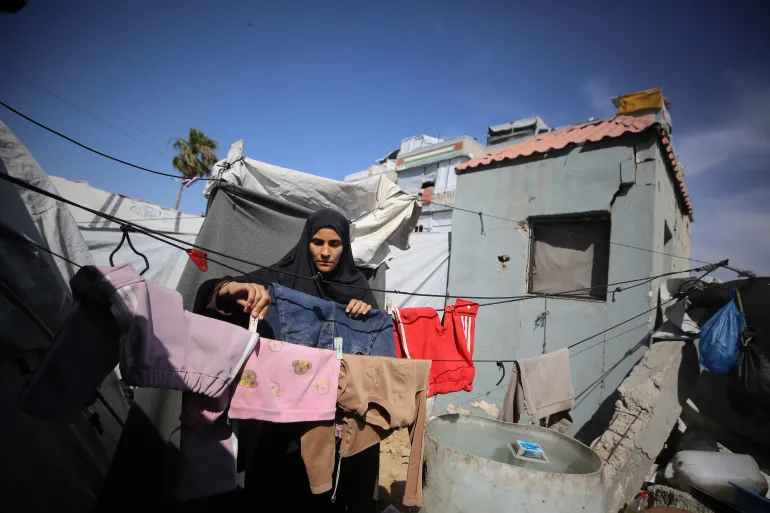






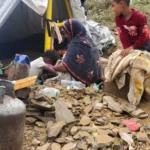
Gaza City, Gaza Strip – Under the scorching heat inside a displacement tent in northern Gaza, Mona al-Masri tries to plan for each day as it comes. Mona is a widow and the mother of four children, ranging in age from two to nine. Her husband, Mohammed, was killed in an Israeli strike in September 2024, leaving her to navigate the collapse of her family’s world entirely on her own.
Between fabric walls that provide little protection, Mona carries the crushing responsibilities of a family burdened by displacement brought on by Israel’s war on Gaza. The loss of her husband has stripped away the security that once defined their lives. Mona begins each morning in a desperate search for water and food, attempting to shield her children from a reality that bears no resemblance to the life they knew before the conflict began in 2023.
She explains that the most painful aspect of her situation is not merely the harshness of the living conditions, but the profound isolation of confronting every detail of survival alone. “There is no normal life inside the tent. Every day begins with the same questions: how will we secure our needs, and how will we get through another day surrounded by this exhaustion?” Mona says. “The war did not only take away our homes; it took away our sense of safety and stability and made even the simplest things require enormous effort.”
Mona is one of more than 50,000 widows currently in the Gaza Strip, according to data from the Ministry of Social Development. This staggering figure includes 28,224 women who became widows specifically as a result of the ongoing war, in addition to more than 22,500 widows who were already registered with the ministry prior to the 2023 escalation. Aziza al-Kahlout, a spokesperson for the Ministry of Social Development, warns that this number is expected to rise further as many women have yet to be officially registered.
Al-Kahlout describes the current situation as a humanitarian crisis, noting that the war has left these women to support their families without a provider amidst widespread destruction and the total collapse of basic living conditions. “This requires effective programmes for economic empowerment, job creation and strengthening self-reliance to help lift them out of poverty and deprivation,” she states. She emphasizes that the needs of these women extend far beyond simple financial aid, encompassing a critical requirement for healthcare, psychological support, and legal assistance regarding guardianship, custody, and inheritance rights.
“Protecting and empowering widows in the Gaza Strip has become a shared national and humanitarian responsibility that requires an urgent and sustainable response,” al-Kahlout adds. She advocates for a comprehensive support framework that includes regular financial assistance, emergency relief, vocational training, and support for small family businesses to help widows regain a measure of stability in an environment that currently offers none.
The loss of a husband during this war has not only deprived thousands of women of their partners but has also forced them into a state of permanent displacement and instability. Aseel Abu Shaweesh, a psychologist, explains that losing a spouse during active conflict is a traumatic experience with deep, lasting impacts on both the widows and their children. Many women are forced to suppress their own grief and emotional collapse to maintain a sense of normalcy for their children, a burden that leads to severe anxiety and psychological exhaustion.
“A widow in Gaza faces the pain of losing her husband, the responsibility of supporting her family, and caring for her children in an environment filled with fear and instability,” Abu Shaweesh notes. She highlights that the lack of private space to express grief or process trauma exacerbates the mental health crisis among these women. The constant pressure of survival leaves little room for healing, forcing many to prioritize immediate physical needs over their own mental well-being.
The impact on children is equally devastating, as they lose both their father and their foundational sense of safety. Abu Shaweesh observes that children in these families often exhibit signs of constant fear, sleep disturbances, and significant behavioral changes. She stresses that any long-term recovery strategy must integrate psychological and social support services alongside financial aid to help these families adapt to the new, harsh roles imposed upon them by the war.