
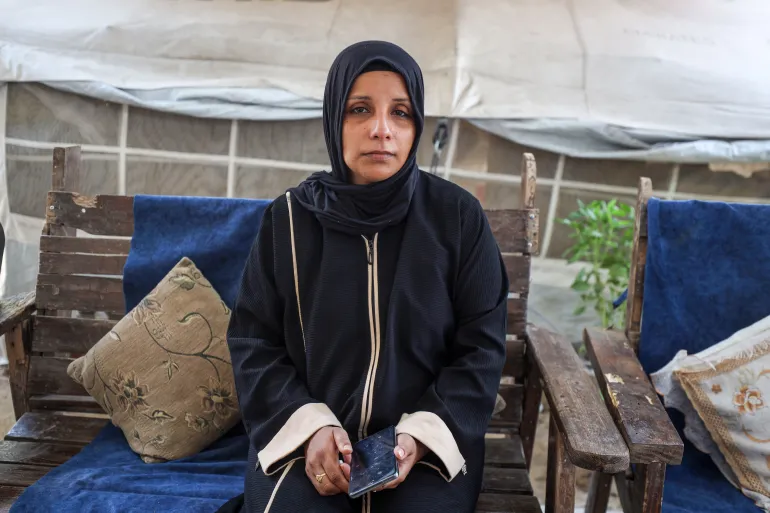





Gaza City, the Gaza Strip – Lara Abu Shreia could not sleep on Monday night. Every time she closed her eyes, she says, the faces of her loved ones appeared before her. So the 39-year-old turned to her phone, scrolling through photos as she prepared herself for a long-awaited farewell to her family.
In the largest mass funeral held in Gaza since Israel’s genocidal war against Palestinians began in 2023, thousands gathered in Gaza City’s Sabra neighbourhood on Tuesday to bid farewell to 112 members of the Abu Shreia and al-Hassaina families whose remains were recently unearthed from beneath the rubble nearly three years after an Israeli air attack. When the white bags containing the recovered remains arrived at the funeral site, Lara stood crying, surrounded by other mourning relatives.
“Today felt like the first day I lost them,” she says. “It was a renewed grief, saying goodbye to them this way.” For Lara, the funeral was not only about bidding farewell; it was about confronting the loss of almost her entire family. On November 22, 2023, a strike hit the family compound in Sabra, killing 14 of her closest relatives, including her mother, Nawal, her eight siblings, and several nieces and nephews. “My family disappeared almost in one moment,” she says.
At the time, Lara, her husband and their five children had been displaced to southern Gaza after a forced evacuation threat issued by Israel at the start of the war, which has killed more than 73,370 Palestinians. “While I was in the south, I was constantly anxious. I felt that something could happen to them,” she recounts. Whenever possible, she would communicate with one of her sisters, relying on brief phone calls to reassure herself that her family was safe.
Then, one night, Lara saw reports that strikes had hit Sabra. She tried calling her sister, but there was no answer. She repeatedly sent messages, hoping the silence was only because of the severe communication disruptions at the time. “I was worried, but I kept telling myself maybe the network was down,” she says. Her husband eventually received a call confirming the family’s building had been hit and that everyone was under the rubble.
With her world shattered, Lara tried to find anyone who could reach the house to rescue survivors. “Sometimes I think maybe someone was injured and waiting for help. Maybe someone could have been saved. Sometimes I think about them suffocating under the rubble. I almost lose my mind thinking about their last moments,” she says. For months, she remained unable to accept the reality. When she returned from the south in January 2025, she immediately went to the site of the strike, hoping against hope to find a survivor.
Weeks before the funeral, Palestinian Civil Defence teams began recovering remains from the destroyed homes in Sabra after long and complex operations. A total of 112 were found, out of 153 believed missing. According to Mahmoud Basal, spokesperson for Gaza’s Civil Defence, more than 8,000 bodies are estimated to remain beneath the rubble of destroyed buildings across the territory.
Basal described Tuesday’s ceremony as an unprecedented moment. “Today, 112 martyrs are being buried in one funeral for the first time in the history of the Palestinian cause,” he says. He notes that recovery operations remain extremely difficult due to the scale of destruction and a lack of necessary gear. “We need the capabilities and equipment to enter Gaza so Civil Defence teams can carry out this humanitarian mission,” he adds, warning that not every victim will be recovered because some bodies have evaporated or been scattered into small pieces.
For Lara, it was imperative to be at the site during recovery efforts, despite relatives trying to stop her. “I told them: ‘I want to see. Even if it is just a bone, I want to see something from them’,” she recalls. “I wanted to hug the bag. I wanted to hug whatever remained of them.”
Lara’s 50-year-old relative, Ali Abu Shreia, was also displaced in southern Gaza when the strikes hit. “The news began arriving: one house was hit, then another, then another,” he recalls. “I lost my two brothers – Ahmad, 51; and Moeen, 53 – and their entire families – wives and kids.”
Ali explains that the people inside the homes had moved from one place to another, eventually seeking shelter in the home of Mufeed al-Hassaina, a former Palestinian minister of public works and housing. “They thought they would be safe, but the war machine did not distinguish between civilians, homes, or families,” Ali says, describing the victims as ordinary people, including business owners and traders. “Seven families were completely erased from the civil registry.”
As the funeral concluded, the weight of the loss remained palpable. For the survivors, the recovery of these remains provided a final, albeit devastating, closure to a three-year nightmare. The mass burial serves as a grim testament to the scale of the destruction in Gaza, where the search for the missing continues amidst ongoing challenges and the persistent trauma of a war that has left few families untouched.
“Until now, I still cannot believe they are all gone.”
Back at the funeral, men, elderly relatives and children tried to hold back their tears as the solemn procession began to move.