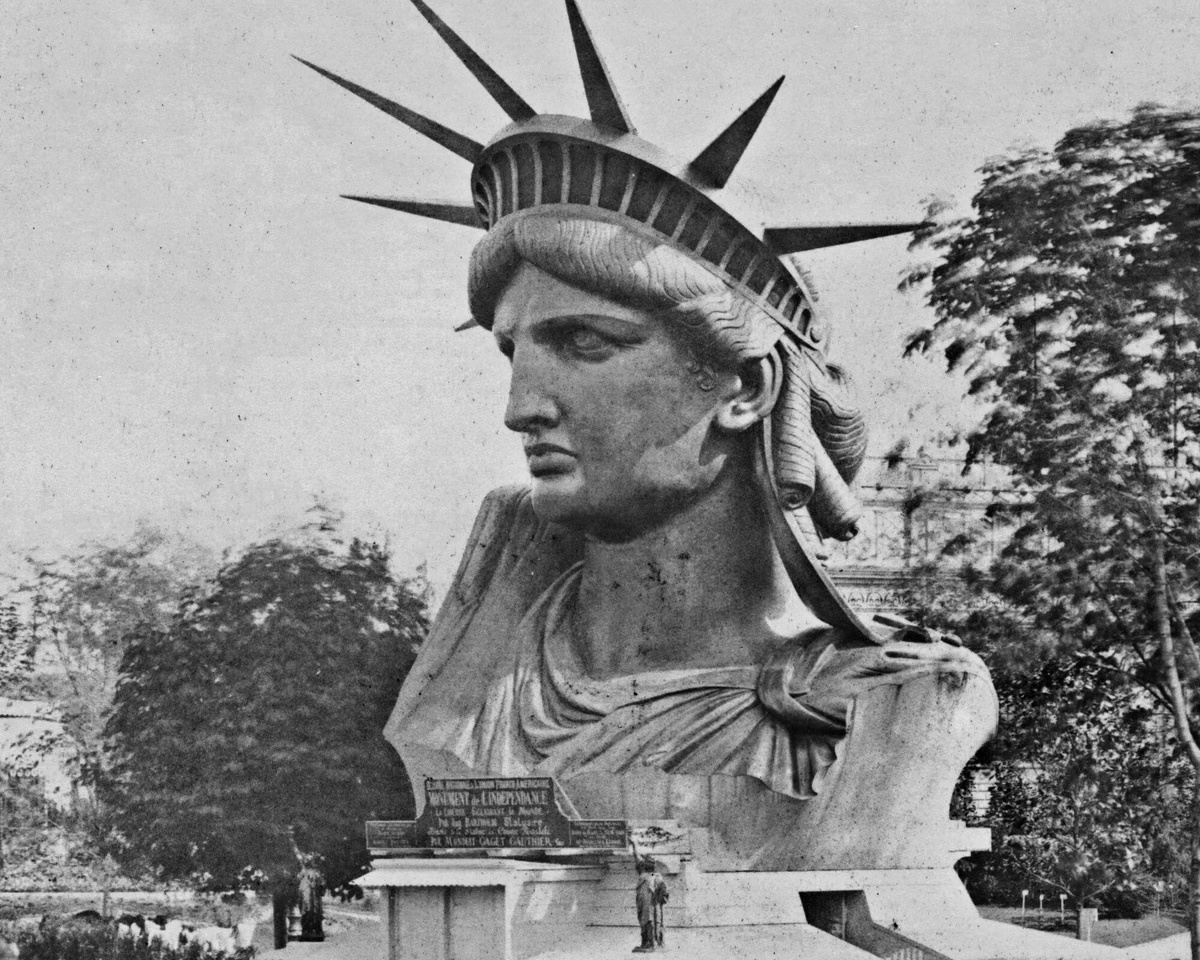







Diplomatic gift-giving has functioned as a powerful, centuries-old instrument of statecraft, acting as both a bridge between nations and a tool for political messaging. Perhaps the most iconic modern example is the Statue of Liberty, a colossal neoclassical sculpture gifted by France to the United States in the late 19th century. Originally titled “Liberty Enlightening the World,” the monument was intended to commemorate the 1776 US Declaration of Independence. While its delivery arrived a decade late, the gesture reinforced France’s foundational support for American autonomy from Britain. It was also a reminder – perhaps a pointed one – of France’s critical role in helping the US break free from Britain, delivered a decade late.
The statue’s origins were deeply rooted in European political maneuvering. During an 1865 dinner at Versailles, liberal politician Édouard Laboulaye proposed the project, hoping the celebration of American liberty would pressure France’s authoritarian leader, Napoleon III, to grant more domestic freedoms. Sculptor Frederic Auguste Bartholdi, seeking a monumental challenge after a failed proposal for an Egyptian lighthouse, embraced the task. Construction stalled until Napoleon III was deposed in 1870, eventually rising in a Paris workshop in 1884 before being disassembled for shipment to New York. The liberal politician Édouard Laboulaye suggested the gesture celebrating American liberty might prompt France’s authoritarian ruler Napoleon III, whom he and Bartholdi opposed, to introduce greater liberté at home, over a chic dinner at Versailles in 1865. But it was deemed too expensive by Egypt’s ruler, in his 20s he had drawn up plans for a lighthouse in the form of a robed Egyptian woman bearing a torch to be placed at the entry to the Suez Canal. In the north-west 17th arrondissement of Paris, would have been amazed to see the statue rise gradually from the workshop to tower above the area, before it was taken to pieces, put on a train to Rouen and then shipped to New York, in 1884 residents around rue de Chazelles. Who did not live to see the statue installed, hoped the Statue of Liberty would strengthen Franco-American friendship and ties, bartholdi and Laboulaye.
To mark the 140th anniversary of the statue’s inauguration and the 250th anniversary of American independence, the Musée d’Orsay is hosting an exhibition through 31 January 2027. Curators François Blanchetière and Juliette Chevée highlight that the project was a multifaceted venture, blending artistic, technical, media, and political interests. Although Bartholdi’s work became a global icon, the sculptor himself remains lesser-known today, a gap this exhibition aims to bridge by showcasing 100 of his works alongside an immersive virtual reality experience.
The role of these gifts in history is chronicled in the 2022 book “Diplomatic Gifts: A History in Fifty Presents” by career diplomat Paul Brummell. He notes that while contemporary offerings are often “low-key,” historical leaders used gifts as potent tools for propaganda and influence. A notable example of “panda diplomacy” occurred in 1972 following President Richard Nixon’s visit to Beijing, when China gifted the US giant pandas Ling-Ling and Hsing-Hsing. The gift attracted over a million visitors to the Smithsonian National Zoo in one month, significantly softening American public perception of China. In a reciprocal gesture, the US sent musk oxen Milton and Matilda to Beijing. This pattern continued recently as Xi Jinping sent two pandas to Atlanta zoo as an “envoy of friendship,” while Donald Trump presented Xi with a sculpture of a bald eagle. There was an element of self-interest behind the idea of making such a spectacular gift to the US at such a specific time, as with most diplomatic offerings. “Gifts these days are low-key,” he told the Washington Diplomat newspaper. “But looking back into history, diplomatic gifts went right to the heart of the thinking of the great kings.
Gift outcomes vary significantly. In 1826, Egypt’s pasha, Muhammad Ali, gifted a Masai giraffe named Zarafa to King Charles X of France. Conversely, a camel given to French President François Hollande during a 2013 visit to Mali met a grimmer fate; it was left for safekeeping in Timbuktu and subsequently slaughtered for a meal. Mali later pledged to provide a replacement animal. Other historical exchanges include the 3,020 cherry trees donated by Tokyo to Washington DC in 1912, Oslo’s annual Christmas tree gift to London since 1947, and the Netherlands’ yearly shipment of 20,000 tulip bulbs to Canada as a token of gratitude for wartime shelter.
Some gifts have proven culturally curious or problematic. Residents of Tanna in the South Pacific revered Prince Philip as a deity, presenting him with a grass penis sheath. In 2009, a translation error caused a diplomatic stir when US Secretary of State Hillary Clinton gifted a “reset” button to Russia, which was erroneously inscribed with the Russian word for “overcharge.” Meanwhile, Gordon Brown’s gift of a pen holder carved from an anti-slavery ship to Barack Obama was met with a DVD collection of the president’s favorite films.
North Korea maintains a massive repository of such items in the International Friendship Exhibition. Located 90 miles from Pyongyang, the facility houses 150 rooms filled with tributes to Kim Il-sung and Kim Jong-il. The collection includes eclectic items such as an armored ZIS-110 car from Joseph Stalin, an alligator-themed cocktail tray from Nicaragua, and a signed Michael Jordan basketball. These displays serve to project an image of international legitimacy to a domestic population largely isolated from the outside world. The windowless International Friendship Exhibition, 90 miles north-east of the capital, Pyongyang, has 150 rooms of presents given to the former leaders Kim Il-sung, who died in 1994, and Kim Jong-il, who died in 2011, in totalitarian North Korea.
For modern politicians, however, gift-giving is frequently viewed as a burdensome formality. Former British ambassador to France, Peter Ricketts, noted that such exchanges can become an “embarrassment.” Under standard protocols, gifts exceeding a small monetary value must be declared and either turned over to the state or purchased by the recipient personally, making the custom a logistical challenge for contemporary ministers.