









Attorney General Todd Blanche has long insisted that the government is not withholding or redacting documents from the so-called Epstein files on the basis of national security or foreign policy. When the release process began last winter, Blanche asserted that there was no tranche of super-secret material being hidden from the public, emphasizing that the Department of Justice was not withholding any information based on national defense concerns. Each CD was likely capable of holding hundreds of megabytes of material.
Despite these assurances, newly examined documents suggest that classified information was indeed present within the files. What exactly was classified and why remains a mystery.
Internal records indicate that Blanche’s own Office of the Deputy Attorney General (ODAG) received classified material related to the Epstein case as recently as March 25, 2025. Every page receives its own number.
Among the records is a timeline from the FBI’s New York office detailing efforts to transfer files to Washington, which specifically notes the delivery of 16 items to ODAG, including two CDs containing classified materials and a document labeled as the Epstein Transparency Project Classified Material.
An email sent that same day from the unit chief of the National Security Classification Operations Unit further confirms that three documents identified within the batch remained classified. While the exact nature and content of these materials remain undisclosed, the presence of these references complicates the Justice Department’s previous statements. The department has stated it collected approximately 6 million pages of material, ultimately releasing more than 3 million after conducting reviews for duplication, relevance, and attorney-client privilege. The identity of the email’s recipient is also redacted. Other documents — including court records and investigative files they’ve previously released — bring the total to over 3 million, according to the DOJ. Potentially collected as part of an earlier subpoena, this indicates that those documents had previously been used in federal legal cases.
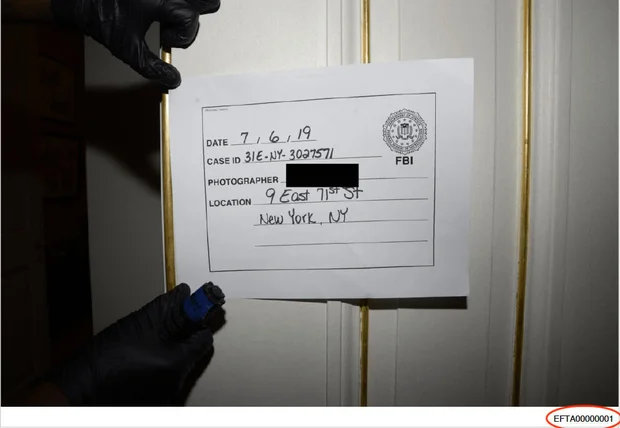
Beyond the specific references to classified items, a structural analysis of the files reveals significant gaps in the numerical coding system. These records are organized using Bates numbers—standard legal identifiers—alongside a primary EFTA (Epstein Files Transparency Act) numbering system. By comparing these sequences, researchers have identified thousands of instances where the primary EFTA count advances by one, but the secondary Bates numbers jump by two or more, signaling that pages were removed from the original collection. Here’s how it works: Documents from the Epstein files are labeled with a string of numbers beginning with the letters EFTA stamped on the bottom right-hand corner; EFTA stands for Epstein Files Transparency Act. Those are called Bates numbers — a common way of organizing massive document batches in legal cases. The sequence goes from 1 to 2,858,498, which is the tally of approximately how many pages of documents were released, in the Epstein files. For instance, Bates coding on some of the documents is from the Ghislaine Maxwell criminal case and was used to organize files given to Maxwell’s legal team ahead of her 2021 trial as part of the discovery process. According to like every federal prosecutor, she, She is very familiar with Bates numbers. “It’s the reason you have Bates numbers, so you notice something like that,” she said. Months and years, so knowing what was removed from context is simply not possible, the emails are not sequential in date and jump by days. Including communication with young women who would later accuse him of abuse; email exchanges with his business associates; messages to or from his assistant, Lesley Groff; or emails sent or received by Ghislaine Maxwell, most of the documents in this section are emails to or from Jeffrey Epstein. Containing all the back-and-forth) has already been reviewed and redacted as appropriate for production, the interstitial back-and-forth can be marked as duplicates, if the document is an email chain and the most-inclusive email (i.e. This was only partially accomplished because duplicate emails still exist throughout the files, if that was the case.
These gaps are particularly prominent in documents originating from Epstein’s financial records, such as bank statements from JPMorgan and Deutsche Bank. In one documented instance, a series of roughly 4,500 images of checks from Epstein’s accounts contained gaps where 66 individual images were missing. Barbara McQuade, a former U.S. Attorney for the Eastern District of Michigan, noted that financial records were not a permissible category for removal, adding that the entire purpose of the Bates numbering system is to track such documents. Although in several cases both are missing, oftentimes the missing image is only the front or the back of the check.
Another set of discrepancies appears in a preliminary processing sequence labeled with an R1 prefix, which spans approximately 995,000 pages. Within this sequence, gaps ranging from single pages to hundreds of pages suggest the organized removal of materials, predominantly emails. Although the Department of Justice has not addressed recent inquiries regarding these gaps, the agency has historically claimed that every document withheld was done so in accordance with standard legal procedures. Instructions given to DOJ attorneys working on processing the redactions state.
The recurring inconsistencies have prompted scrutiny from lawmakers and legal experts.
Attorney Stanley Brand, a distinguished fellow and veteran litigator, suggested that the administrative process has undermined public trust in the final release, noting that such transparency issues fuel long-standing suspicions regarding government handling of high-profile records.
Similar concerns were echoed by other observers who pointed to past government errors, such as a previously corrected claim regarding a missing minute of prison security footage from the night Epstein died, or the temporary removal and subsequent restoration of a photograph showing Commerce Secretary Howard Lutnick at Epstein’s island.
As Congressional challenges and private lawsuits continue to mount, demands for the release of the withheld portions of the files remain active. Critics argue that regardless of whether the gaps were intentional, the resulting lack of clarity reflects poorly on the Department of Justice, fueling skepticism about what information the government may still be choosing to keep behind closed doors. Congressional challenges and a lawsuit are casting doubts on the DOJ’s claims and demanding the release of more documents that were held back.