








Tehran has launched an intensive diplomatic campaign across the Middle East and toward Moscow in response to hints from US President Donald Trump that Washington might restart full-scale military operations against Iran. The escalation follows a series of military actions along critical maritime trade corridors and growing rhetoric from both sides. Because war again will cost him more”, he argued that Trump “really does not want to go to war. However, the US president’s next move is unpredictable, observers say.
Reporting from US news website Axios revealed that a American official confirmed US Central Command (CENTCOM) is preparing for potential major military actions in Iran, pending final orders from Washington. This comes after Trump publicly stated on Thursday that the US might be forced to “destroy” what remains of Iran, adding that the public would “know soon enough” whether he decides to act. On Thursday, Trump told reporters at the Oval Office that he may have to “destroy the rest” of Iran.
In response to the mounting pressure, Iran delivered a new nuclear and peace proposal to the United States on Thursday through Qatari intermediaries. A senior Iranian official confirmed to Reuters that discussions regarding the proposal can only take place once Washington satisfies seven specific demands set by Tehran. Meeting these conditions remains Iran’s prerequisite for reopening the Strait of Hormuz and re-engaging in peace negotiations regarding its nuclear program. Conversely, the US maintains that an agreement on Iran’s nuclear capabilities must be locked in before any broader ceasefire can be finalized. During that visit, Rezaei said: “On the issue of diplomacy, we have announced seven conditions to the Americans. The unfreezing of Iranian assets and the end to the US naval blockade of its ports in and around the Strait of Hormuz, among other things, the demands include the lifting of sanctions on Iran. We will neither open the Strait of Hormuz nor have negotiations.”, as long as they do not execute our seven conditions. According to former Iranian diplomat Hadi Afghahi, Tehran can ease the path to a settlement if the US also shows flexibility. According to the leaders reviewed international diplomatic efforts, including the Doha-led mediation efforts to support negotiations in recent weeks, in a bid to reach “a comprehensive agreement that puts an end to the crisis”, the Diwan, In a statement.
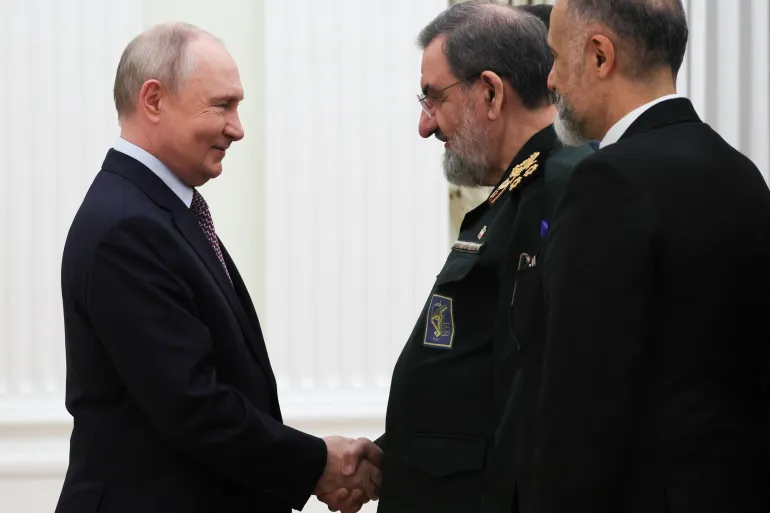
As part of its strategy, Tehran has actively strengthened its alliance with Moscow. Top Iranian security official Mohsen Rezaei traveled to Moscow on Thursday for direct discussions with Russian President Vladimir Putin at the Kremlin, delivering a personal message from Supreme Leader Mojtaba Khamenei. Iranian embassy reports quoted Rezaei as describing the meeting as “an extremely important exchange,” though specific details were withheld.
Images released by the Kremlin confirmed the presence of key Russian figures at the meeting, including military intelligence chief Igor Kostyukov and foreign affairs adviser Yuri Ushakov. Rezaei noted via Iranian state television that talks with Putin focused heavily on constructing gas pipelines running from Russia to Iran. The proposed infrastructure is intended to alleviate domestic gas shortages caused by US-Israeli strikes on Iranian natural gas refineries earlier this year during a 40-day intensive bombing campaign, while also aiding Russia in selling energy to neighboring markets. According to iran, It will retaliate if the US resumes larger strikes. Including the energy and treasury secretaries, afghahi cautioned that Trump “is still surrounded by a group of hawks”.
The bilateral meeting reinforces an expanding partnership that has developed since Russia’s full-scale invasion of Ukraine in 2022 and throughout the US-Israeli war on Iran—a conflict that left both Moscow and Tehran as the most heavily sanctioned entities globally. While Putin previously offered in early October to mediate an end to the war, defense cooperation between the two nations has continued to deepen. Reports by The Financial Times, citing examined Russian defense manufacturer schedules from 2024 and 2025, indicate Russia agreed to supply Iran with 90 helicopter-mounted precision-guided missile launchers, utilizing internal defense coding designated for Iranian contracts despite its own military needs in Ukraine. Which it has examined, showing an order for helicopter-mounted launchers being assigned a code used to refer to Iran in Russian, the newspaper cited a Russian defence manufacturer’s production schedule for 2024 and 2025.
Carnegie Endowment for International Peace scholar Nicole Grajewski noted that the arrangement demonstrates Moscow’s commitment to supplying Tehran regardless of its active wartime needs or Western opposition. Moscow has also assisted Iran with developing supersonic cruise missiles, supplied Verba shoulder-launched anti-aircraft systems, and shared intelligence assets. Despite these deep ties, Russia’s Foreign Ministry issued a advisory on Thursday warning its citizens against traveling to Iran due to the persistent risks of renewed military escalation.
Alongside its outreach to Moscow, Tehran has targeted Gulf nations to manage regional tensions. On Thursday, Iranian Foreign Minister Abbas Araghchi conducted diplomatic calls with several counterparts across the region. On his Telegram channel, Araghchi highlighted discussions with UAE Foreign Minister Sheikh Abdullah bin Zayed Al Nahyan regarding stability initiatives and regional developments. In the Gulf region, as well as to India and China, it has granted exemptions to shipping restrictions to Iraq and Qatar.
Araghchi also spoke with Saudi Foreign Minister Faisal bin Farhan Al Saud about enhancing security in the region, while holding similar conversations with the foreign ministers of Turkiye and Kuwait. In a discussion with Qatari Prime Minister and Minister of Foreign Affairs Sheikh Mohammed bin Abdulrahman bin Jassim Al Thani, the Qatari leader emphasized the necessity of guaranteeing freedom of navigation in international waters. Meanwhile, Oman’s foreign ministry confirmed that safe passage through the Strait of Hormuz formed the central topic of discussion during a call between Araghchi and Omani officials.
These diplomatic maneuvers coincide with heightened security risks in regional shipping lanes. Iran maintains firm control over maritime traffic passing through the Strait of Hormuz, where multiple vessels have recently sustained damage. The Islamic Revolutionary Guard Corps (IRGC) Navy reported that at least seven oil tankers caught fire this week after hitting naval mines while navigating unauthorized routes near Oman. On Friday, the IRGC confirmed two additional tankers were disabled by mine explosions after attempting to cross the waterway with assistance from the US military. How is Iran negotiating with regional leaders.
Tensions in the waterway previously escalated when Iran shot down two US reconnaissance drones near Qeshm Island. The US subsequently carried out defensive strikes against Iranian assets on Qeshm Island and Bandar Lengeh along the Strait of Hormuz in the run-up to the US midterm elections, where the ruling Republican party faced significant public backlash over the ongoing war and economic strains.
Iranian defense officials have issued stern warnings against further military action. On Thursday, a spokesperson for the Supreme Advisor to the Commander of the IRGC Aerospace Force stated that any nation or military force assisting American strikes on Iran would become a legitimate target for Iranian armed forces. Furthermore, state media outlet Tasnim News reiterated that Iranian missile bases possess adequate range to strike Israeli targets and US bases throughout the region, warning that Tehran’s retaliatory action against renewed aggression will not be geographically constrained.