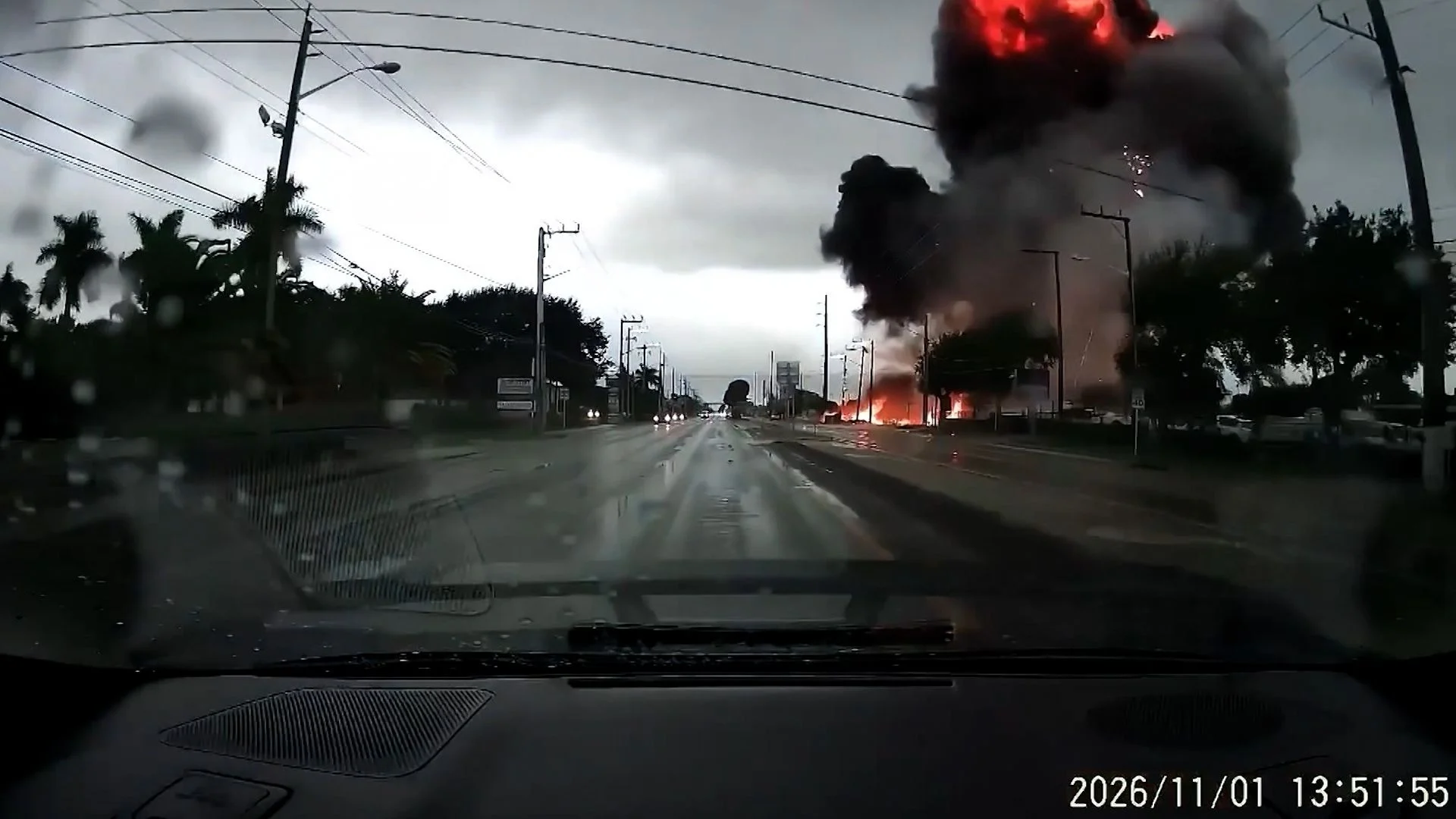










A private Learjet 60 traveling from Austin, Texas, to the Bahamas on Sunday suffered a catastrophic loss of control, nosediving into a roadway in Palm Beach County, Florida. The impact caused the aircraft to burst into flames, leaving a massive crater near passing vehicles and killing all nine people on board. Florida Governor Ron DeSantis described the scene as a “cataclysmic plane crash,” stating, “It looked like a missile going down.” While authorities have not officially identified all of the victims, 20-year-old Nathalia Filgueiras was identified by her mother as one of the pilots involved. A private jet plummeting 450 feet per second nosedived into a Florida roadway, bursting into flames and killing all nine people on board, in the blink of an eye. Air traffic radio captured the pilot’s voice as the plane plunged straight toward the ground, while the cause of the tragedy remains unknown. And the plane passed through a stronger storm cell a few minutes before it started plummeting, there were scattered storms in the area of the crash. ET: The plane takes off from Austin-Bergstrom International Airport in Texas. A major thoroughfare between Cresthaven Boulevard and 10th Avenue North, the Palm Beach County Sheriff’s Office said, the plane hit the ground shortly before 1 p.m. on Military Trail. Video from affiliate WPBF showed, the roadway was left shattered and burning wreckage dotted the crater. “There is a lot of debris that was strewn as a result of this crash,” DeSantis said. The scene is just miles from the airport in West Palm Beach that was recently renamed for President Donald Trump and his Mar-a-Lago resort. According to about 600 people are in need of shelter because the damage on the ground is blocking the entrance to a mobile home park,, Joel Flores, Palm Beach County commissioner for District 3, who was the first county official at the scene.
Chronology of the Final Moments
- 12:48:00 p.m. ET: The pilot reports precipitation and requests to climb to 37,000 feet; air traffic control approves the request.
- 12:48:28 p.m. ET: The pilot declares a “mayday” as the aircraft begins an rapid descent of 8,000 to 10,000 feet per minute.
- 12:48:36 p.m. ET: The plane plummets at 20,000 feet per minute (333 feet per second), with the pilot noting this exceeds aircraft limits.
- 12:48:54 p.m. ET: The pilot reports, “We’re going to crash into the ground!” to air traffic control.
- 12:49:01 p.m. ET: The pilot reports the aircraft falling at a rate of 22,000 feet per minute (367 feet per second).
- 12:49:17 p.m. ET: In the final transmission, the pilot states, “We’re out of time.”
- Sources: Data derived from LiveATC.net audio and FlightRadar24.
Investigation efforts are currently focused on the weather conditions surrounding the flight. According to the FAA, all clouds at heights where temperatures dip below freezing have the potential to create icing conditions. Thunderstorms generate powerful updrafts, or columns of rising air that cool rapidly, even in warm weather. And temperatures in these updrafts can drop to as low as -100 degrees Fahrenheit at the altitudes where planes fly. The system cannot keep up with the icing, planes are equipped with strong anti-ice systems. But in some cases. Ice can “make managing the airplane’s flightpath and airspeed more difficult and can prevent the airplane from maintaining level flight,” the NTSB said. Ice on wings and other surfaces can pose a major threat to private jets. The NTSB published a safety alert emphasizing the risks of in-flight icing conditions, which can cause pilots to lose control, in January 2024.
Prior to the fatal descent, the pilot had calmly reported ice accumulating on the aircraft at an outside temperature of -47 degrees Celsius (-52 degrees Fahrenheit), along with moderate turbulence that caused altitude deviations of up to 700 feet. The colder the air gets, the higher the altitude.
Aviation experts emphasize that icing is a critical hazard, as it can simultaneously increase aircraft weight while reducing lift and thrust. Icing can slow an aircraft or force it downward, in other words. It can happen at any time of the year, while icing happens more frequently in the winter.
As the situation escalated, the pilot’s voice shifted from professional to increasingly panicked, eventually shouting “Mayday, mayday!” and declaring an “overspeed condition.
Flight tracking data from ADS-B Exchange indicates the jet dropped 27,000 feet in a single minute before signals were lost.
This event marks the deadliest crash involving a Learjet 60, according to records from the Flight Safety Foundation, surpassing a 2008 incident in Columbia, South Carolina, that resulted in four fatalities. aviation analyst and former Department of Transportation inspector general Mary Schiavo emphasized that the descent was clearly uncontrolled. Investigators from the National Transportation Safety Board (NTSB) are expected to issue a preliminary report within 30 days. The aircraft, registered to a Delaware-based LLC and listed for charter, will be the subject of rigorous forensic analysis, with dashcam footage from the roadway expected to serve as a vital piece of evidence for determining the precise sequence of the structural or mechanical failure. The National Transportation Safety Board will hold a news conference Monday afternoon.