







China is intensifying its diplomatic outreach across the Middle East as it seeks to address the ongoing conflict between the United States and Iran. Following a period of relative inactivity, Beijing has launched a fresh push to engage with regional stakeholders, citing frustration with the current lack of progress toward a peaceful resolution.
Foreign Minister Wang Yi met with Ali Bagheri Kani, the deputy secretary of Iran’s Supreme National Security Council, in Beijing on Monday.
During their discussions, Wang emphasized that negotiation and open dialogue remain “the only viable path forward,” warning that regional tensions continue to “drag on and risk further spillover. He further affirmed China’s commitment to Iran’s national sovereignty and security.
Beijing has maintained a close relationship with Tehran as its largest trading partner and primary consumer of Iranian crude oil. Despite this connection, diplomatic efforts to facilitate a ceasefire have stalled for several months, prompting China to adopt a more visible role in the process. Observers suggest that Beijing’s heightened activity signals growing impatience with the status quo. However, Beijing’s diplomacy efforts have recently been stalled, she noted. “I think China is very frustrated, and it wants to be seen to enter [the process],” Yu said.
To formalize this renewed strategy, the Chinese Ministry of Foreign Affairs announced that special envoy Zhai Jun is scheduled to conduct official visits to Iran, Oman, and Saudi Arabia later this month.
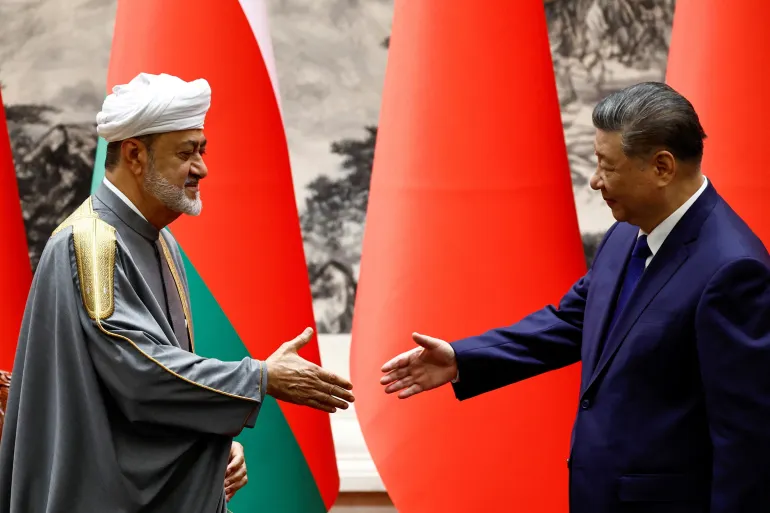
Simultaneously, President Xi Jinping hosted Oman’s Sultan Haitham bin Tariq for a landmark state visit, the first such visit by an Omani leader since diplomatic ties were established in 1978.
Xi characterized the relationship between the two nations as entering a “new historical starting point,” stressing that the Middle East and Gulf regions should not serve as an arena for geopolitical competition or great-power rivalry.
The partnership holds significant economic importance for China, which relies heavily on energy imports. Given that the US-Iran war has restricted traffic through the Strait of Hormuz—a strategic waterway that previously handled one-fifth of global energy exports—Oman’s geographic position is critical to China’s supply chain stability. “It’s been a few weeks or even months [in which] China really hasn’t done much diplomatically towards … ending the war,” Yu said. “Oman is particularly important because many of its ports are outside the strait,” she said.
During Sultan Haitham’s visit, the two countries signed 14 cooperation agreements spanning artificial intelligence, green energy, and logistics, alongside a new currency swap pact. In a joint declaration, both leaders called for the restoration of safe navigation through Hormuz and urged Washington and Tehran to resume direct talks to de-escalate the conflict.