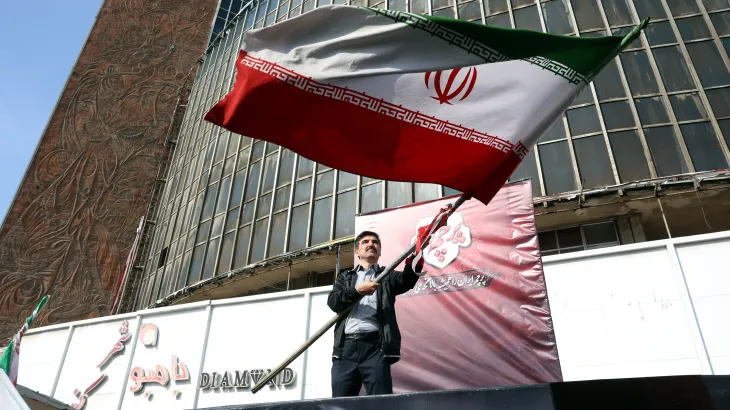








Diplomatic channels between Iran and the United States have reopened through mediation in Qatar, even as both nations maintain a stance of military readiness. Iranian officials have suggested a potential path to ease tensions, provided that specific demands regarding sanctions and regional blockades are addressed by Washington. “It is unclear how willing Washington is to accept these demands.
Foreign Minister Abbas Araghchi affirmed on Saturday that Iran is prepared for any scenario.
He noted that the country has undergone significant upgrades to its military capabilities, addressed previous vulnerabilities, and tested advanced weaponry to ensure forces remain at peak readiness. These statements occur alongside ongoing diplomatic activity, though President Donald Trump characterized the current talks as merely proceeding well, noting a lack of reliability in Iranian counterparts.
The US president, who directed joint military operations with Israel against Iran on February 28, has frequently discussed the possibility of further strikes on Iranian civilian infrastructure. Recently, Trump indicated that such operations might be considered following the US midterm elections on November 3. During a recent event at his Mar-a-Lago Club, he claimed that the US could neutralize remaining nuclear-related sites in a matter of minutes. They have doubled down on a willingness to expand attacks or even launch preemptive strikes if they deem war is inevitable, at the same time. Who ordered attacks alongside Israel against Iran on February 28, has repeatedly raised prospects of once more hitting the country’s civilian infrastructure, the Republican leader. “We still have to take care of, I would say, one or two sites, but we can do that in 10 minutes,” Trump told reporters at a Halloween party at his Mar-a-Lago Club in Florida about further bombing Iran’s nuclear facilities. According to iranian authorities have previously, If Iran’s civilian infrastructure is attacked again, seabed cables and infrastructure across the region could also become targets.
A notable outcome of the recent talks in Tehran and Doha appears to be a reduction in the timeline proposed for partially reopening the Strait of Hormuz. Araghchi stated that Iran has shortened its previous seven-day offer to two days, contingent on US cooperation. Tehran is specifically seeking an end to the naval blockade that has stifled its oil exports and trade, along with the issuance of oil sanction waivers and the unfreezing of Iranian assets held abroad.
Expert analysis suggests that while these talks represent a cautious opening, major hurdles remain. Negar Mortazavi, a senior fellow at the Center for International Policy, emphasized the difficulty of sequencing demands. The US continues to insist on progress regarding Iran’s nuclear program before offering concessions, creating a stalemate where each side expects the other to act first. “Therefore the central difficulty is sequencing and leverage.
This sentiment is echoed by analysts like Hamidreza Azizi, who noted that while Araghchi’s offer of a two-day window shows diplomatic flexibility, military posturing persists. The goal for Tehran, according to observers, is to impose enough uncertainty and potential cost on Washington to discourage further direct attacks, particularly after recent experiences where ceasefires did not hold. Iran appears increasingly determined to prevent a repetition of previous scenarios in which negotiations or temporary ceasefires were followed by renewed military conflict,” he wrote on social media. “From Tehran’s perspective, the objective is to make another attack so costly and unpredictable that Washington would have to reconsider the option altogether.”. It is clear that not recognising rights emphasised by Iran will lead to the failure of the negotiations,” he wrote on X.
Supreme Leader Mojtaba Khamenei has directed military commanders to prioritize maximum deterrence. During recent meetings, the leadership emphasized that any response to threats would be carried out without geographical restrictions, potentially targeting US and Israeli assets across the region. Military branches, including the Islamic Revolutionary Guard Corps, have publicly reaffirmed their capability to deploy drones and missiles if the conflict intensifies.
As diplomatic efforts continue, state media has showcased underground missile and drone storage facilities. Concurrently, internal defense preparations are underway, with the National Organization for Passive Defense identifying 14 critical sectors reliant on electricity. Officials are exploring strategies such as network islanding to shield the power grid from potential bombing campaigns. According to gholamreza Jalali, commander of the National Organization for Passive Defense,, During a speech on Sunday that they have identified 14 sectors most dependent on electricity that would need support if the war restarts. “Adopting preventive measures in the area of passive defence for the electricity grid is a fundamental principle that all authorities must follow up in their capacities,” he said, adding that officials were considering “.
Despite the high-level mediation, regional maritime security remains volatile. The Persian Gulf Strait Authority continues to enforce control over the waterway. Recent reports from the United Kingdom Maritime Trade Operations confirm that a vessel carrying liquefied petroleum gas was struck by three Iranian projectiles on Saturday near Lavan Island. A vessel carrying liquefied petroleum gas (LPG) was struck by three Iranian projectiles on Saturday about 40 nautical miles (74km) south of Iran’s Lavan Island, according to the United Kingdom Maritime Trade Operations.
Security chief Mohsen Rezaei indicated that he received a letter from US official JD Vance, noting a change in tone that he described as positive, though a response remains pending. Analysts linked to the negotiation process suggest that without tangible progress on economic and trade conditions, these diplomatic overtures are unlikely to reach a higher level.
Economic data underscores the pressure on Tehran. A US Treasury report highlighted that no new oil has been loaded onto tankers at Iranian terminals since August 25. With inflation nearing 90 percent as of September and a weakening currency, the economy is under significant strain from international measures, although experts caution that it does not appear to be on the verge of total collapse. According to at least four tankers were identified as being hit on Friday and Saturday, although not all attacks are, By vessels and monitors. While Iran’s year-on-year inflation neared 90 percent in September and the national currency continued to dwindle, it also showed overseas crude deliveries were down.