
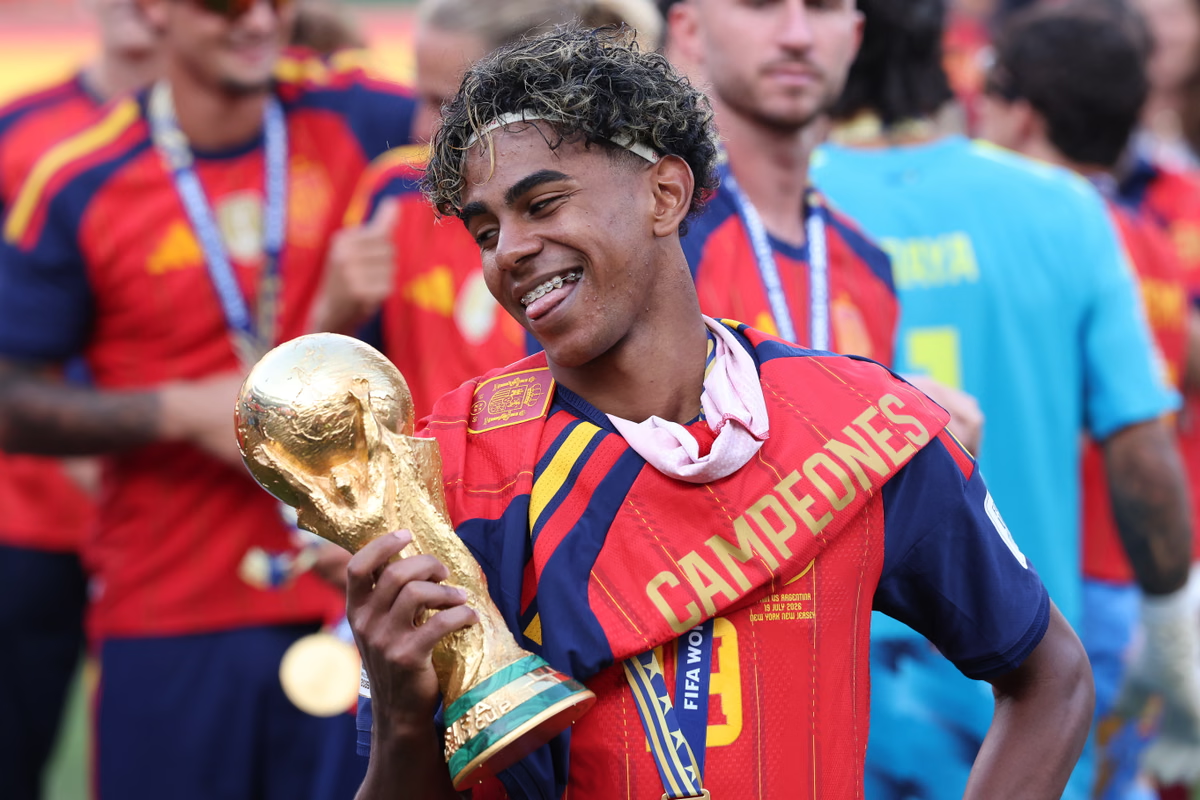









For Lamine Yamal, the intensity of a World Cup final felt strangely like the neighborhood streets of Mataró where his journey began. Even as a global icon, the 19-year-old retains a childlike desire to stay on the pitch, admitting that he never felt the urge for the final whistle to blow during his team’s championship run. Having turned 17 just before the Euro 2024 final and 19 on the eve of his World Cup semi-final, his rapid ascent has been nothing short of extraordinary. Wasn’t El Parque de Rocafonda either; it wasn’t the Mataró neighbourhood where it all began, but it might have been. “We’re in a World Cup final and I wanted to carry on,” he says, and there’s the smile again, the braces, this wasn’t Plaça Joan XXIII. No fear, just fun: 19 July, New Jersey and he knew: this 19-year-old who had happily been asleep on the bus to the biggest match of his life. There’s a Spain keyring hanging from the door and a second star on his shirt. Crates loaded for London, in the corridor. Named after the family friends who helped them, “ touched by God’s wand ” in the words of the coach whose office is next door, there’s something about Lamine Yamal, son of Mounir and Sheila.
Reflecting on the World Cup final victory, Lamine described a sense of inevitable triumph the moment Enzo Fernández was sent off. With the score at 0-0 in the final minutes of stoppage time, he and his teammates knew their numerical advantage made a goal nearly certain. When the opportunity finally arrived in the 106th minute, the realization of becoming a champion began to take shape. Still 0-0, but now, he says: “We knew it was impossible they would score, and with the ball against 10, very difficult for us not to, it was the third minute of second-half stoppage time. But on 106 minutes the ball came to his feet, the surprise was that they hadn’t already.
Lamine views modern football as increasingly mechanized, often describing opposing full-backs as robots following pre-programmed instructions. He believes his own unpredictability stems from a human element that computers cannot replicate. By manipulating the pace of his dribbling, he creates psychological traps for defenders, forcing opponents like Alexis Mac Allister to commit, thereby opening lanes for his teammates like Pedro Porro.
His connection with legend Lionel Messi remains a poignant chapter in his story. After the final, Lamine embraced the 39-year-old icon, thanking him for his contributions to the sport. The imagery of a young Lamine being bathed by Messi as a baby—an image long kept private at Lamine’s request to avoid unfair comparisons—has become a symbol of a passing torch. He remains adamant that he does not play for the cameras, but rather out of genuine internal motivation.
The pressure of expectation is a constant companion, yet Lamine navigates it with remarkable maturity. He acknowledges that his performance standards are skewed; where a nine-out-of-10 effort from him is often scrutinized as a seven, he accepts this as the cost of his status. He openly admits to being a player of Ballon d’Or caliber, noting that while the public might want to distribute awards to others, he remains focused on winning until the debate becomes impossible to ignore.
His family’s reaction to his success is a mix of immense pride and naive optimism. Because he won the Euros and the World Cup in such quick succession, he joked that his relatives might struggle to grasp the concept of defeat. He has spent time grounding them, warning that there will eventually be games that do not end in victory, though he aims to maintain his current trajectory.
Despite the fame, he cherishes moments of anonymity, recalling a recent trip to Nashville during the World Cup where he enjoyed a simple, quiet visit to a Walmart. These small experiences help him maintain his roots. He credits Barcelona with providing his tactical intelligence and control, but insists that the “special spark” he possesses comes from his own background and personality.
Lamine speaks candidly about the challenges of his fame, including the “inner abyss” he once navigated. He draws strength from the struggles his mother endured to ensure he could pursue football. Rather than being crushed by the weight of responsibility, he chooses to embrace it, often treating the intense scrutiny as part of the game itself.
Ultimately, Lamine believes he has surpassed the confusion of his early career. At 16, he was a student balancing school exams with international duty, often unaware of the gravity of his situation. Now, having secured three league titles alongside his international honors, he possesses a clearer understanding of what these trophies represent. As he continues his career, he remains a player who is determined to keep the magic alive in an era defined by data and rigid systems. Surrounded by tactics boards and stats sheets, and now he sits in a first-floor office in Las Rozas.