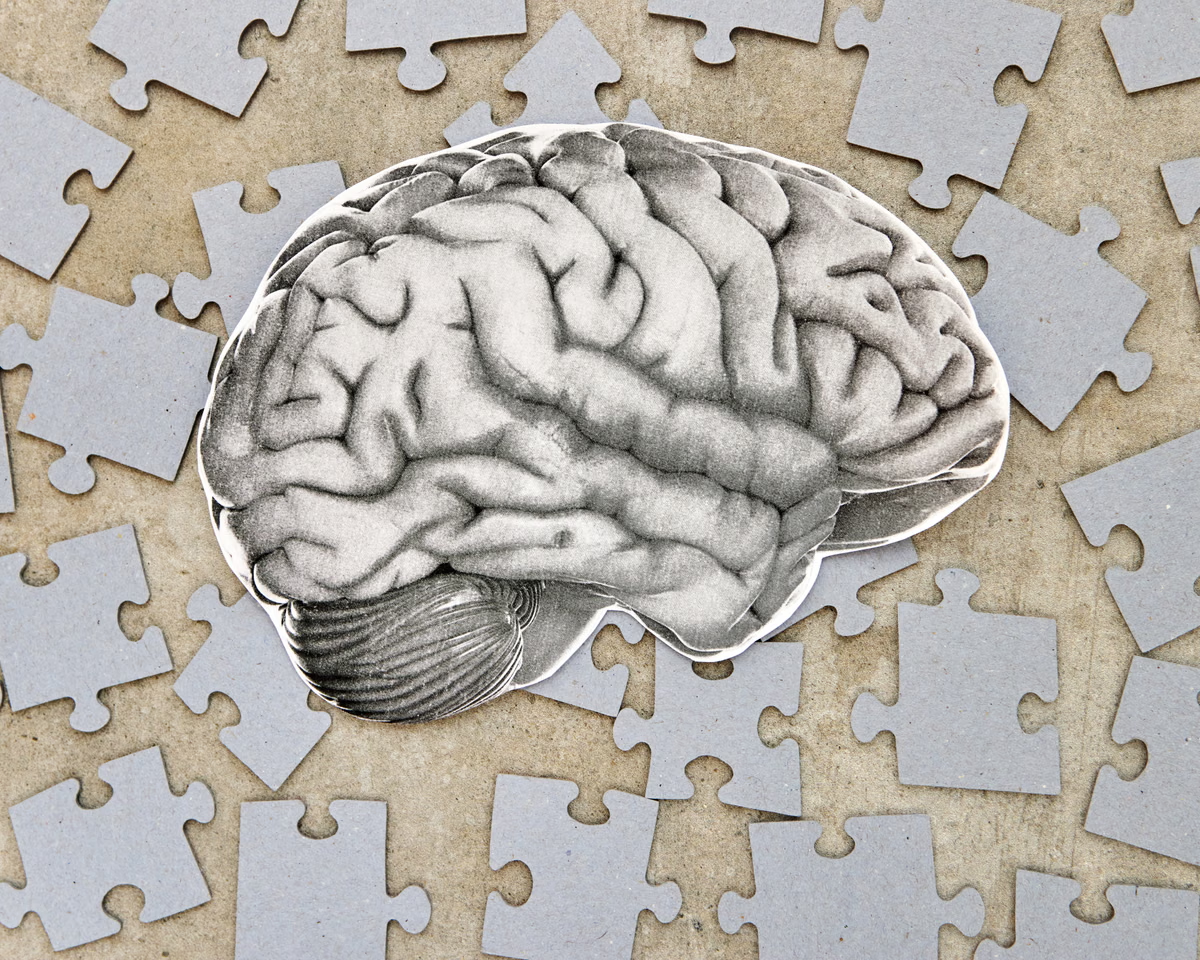









Dr. Norman Swan argues that our perspective on cognitive function is fundamentally flawed. In his latest book, The Brain Cliff, he suggests that “changing the way you think about the brain cliff can literally change the way you think and remember and think.” The common tendency to measure current cognitive performance against our abilities in our 20s is a false comparison that leads to an unnecessary assumption of deficit. Instead, Swan advocates for viewing the process as cognitive change rather than inevitable decline.
While fluid intelligence—the speed and problem-solving ability often associated with our 20s—does peak early, it is less critical for most people than crystallised intelligence. This form of wisdom, built upon knowledge and experience, can actually continue to improve as we age. The key to preserving this function lies in a biological phenomenon known as scaffolding. As we age, the brain constructs networks of nerves that act like internal infrastructure, pushing back the onset of cognitive decline. This process eventually extends into the prefrontal cortex, the area responsible for decision-making, emotional control, and memory synthesis.
To support this scaffolding, Swan suggests we should begin proactive brain maintenance in our 40s and 50s. He highlights the habits of “cognitive super-agers,” a diverse group he interviewed, ranging from a 95-year-old illiterate shoemaker to a 94-year-old worker at a McDonald’s in Kyushu, Japan. Despite their differences, these individuals share a common approach to life: they prioritize problem-solving, avoid rumination, and excel at “getting over it.” By refusing to dwell on circular, unproductive thoughts, they protect the prefrontal cortex from the stress and damage that can accelerate cognitive decline.
Lifestyle choices play a significant role in this process. Exercise is essential because it enhances brain plasticity, which in turn fosters scaffolding. Diet also matters; an anti-inflammatory approach—rich in leafy greens, berries, fermented foods like yoghurt, and low in red meat—supports the microbiome and aids the absorption of bioactive compounds. Furthermore, Swan notes that mind wandering and “mental time travel”—the ability to reflect on the past, engage with the present, and imagine the future—are vital activities that allow the brain’s default mode network to forge new connections.
Research indicates that genetics play a surprisingly small role in the trajectory of cognitive ageing. Even in the case of a 100-year-old neuropsychiatrist from New Jersey, family history was less significant than his active engagement in new skills, such as pencil drawing, and his commitment to maintaining social connections. This underscores that environmental factors and daily habits are the primary drivers of brain health.
For his own part, Dr. Swan has made deliberate changes to his routine. He has reduced his alcohol consumption, focused on managing coronary risk factors like blood pressure and cholesterol, and ensured that moderate to vigorous exercise is a non-negotiable part of his day. He also emphasizes the importance of mental habits, specifically working to avoid rumination and stress.
Perhaps most controversially, Swan advises against traditional retirement. He argues that the evidence is clear: cognitive decline often accelerates once someone stops working. He clarifies that retirement does not necessarily mean leaving the workforce, but rather avoiding a transition to inactivity. If one leaves a career to pursue volunteering, complex new hobbies, or learning new skills, they are still “at work.” Conversely, retiring to the couch to watch television is detrimental to brain health. As Swan puts it, he has no intention of retiring, joking that his employer, the ABC, will have to sack him instead. The report also notes that especially when we’re in midlife (40s and 50s), that’s not actually what’s happened. The report also notes that not deteriorated, our brains have changed. The report also notes that secondly, as the years pass, our thoughts move address. The report also notes that the further away we push the brain cliff, the more successfully we scaffold. The report also notes that the third idea is that we should do as much as possible to encourage the scaffolding and as little as possible to get in its way. The report also notes that they’re remarkably similar and they’re all protecting their scaffolding in several ways, but underneath. The report also notes that the prefrontal cortex becomes more and more important and anything that distracts or damages it potentially brings the brain cliff closer, as we move through life. The report also notes that what should you be doing at that age and is it ever too late to start.