




The Department of Justice is facing a growing crisis of credibility as federal judges across the country express alarm over the conduct of government lawyers. While the department maintains that its investigative and prosecutorial decisions are based strictly on the law and the facts, jurists are increasingly skeptical, frequently questioning whether the government is entitled to the traditional “presumption of regularity” typically afforded to federal agencies.
This judicial pushback follows a series of high-profile legal setbacks, including instances where government attorneys have acknowledged violating dozens of court orders in immigration cases. Legal experts suggest that the disconnect between the administration’s aggressive policy goals and the realities of courtroom procedure is eroding public faith in the department. Stephen Yale-Loehr, a retired immigration-law professor at Cornell, noted that the pressure originating from the top—whether from President Donald Trump or senior Justice Department officials—is creating a climate where the government’s legal standing is being undermined.
The skepticism is manifesting in tangible ways, with some judges now requiring sworn statements to accompany court filings to ensure accuracy. Josh Blackman, a professor at the South Texas College of Law, observed that many judges are no longer willing to give the department the benefit of the doubt. “We’ve seen a lot of judges saying that the federal government is not entitled to a presumption of regularity,” Blackman said, adding that he expects this trend of judicial scrutiny to continue.
In Georgia, U.S. District Judge William Ray, a Trump appointee, recently blocked a Justice Department subpoena he labeled “unreasonable” and “staggering.” The government had sought personal information regarding thousands of poll workers and volunteers involved in the 2020 election. Judge Ray emphasized that the statute of limitations for potential criminal charges had long passed, stating, “The DOJ cannot evade the statute of limitations based merely on a theory that someone, somewhere, somehow did something that was illegal.” He further warned that the use of grand jury power to acquire private information should concern all citizens, regardless of their political leanings.
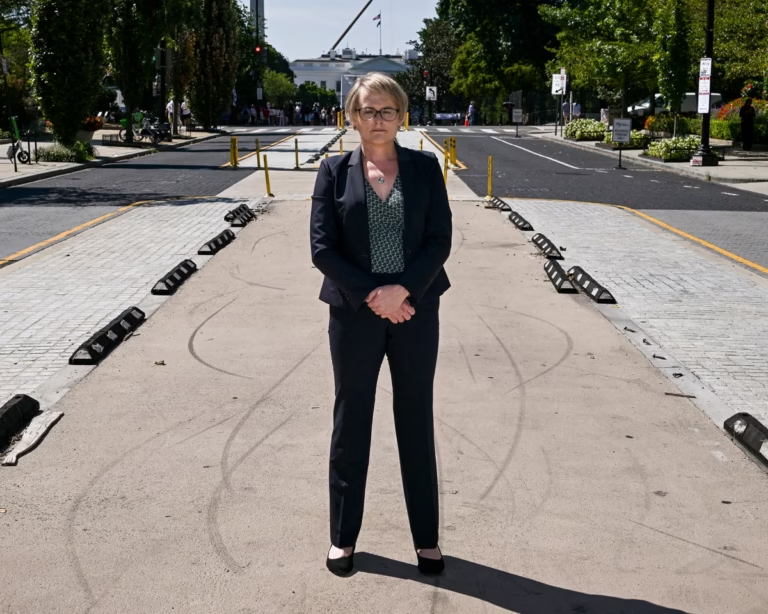
The government has also faced embarrassment in cases where it pursued charges that ultimately collapsed. For instance, prosecutors dropped vandalism charges related to damage at the National Mall’s Reflecting Pool after the Department of the Interior determined the damage was actually caused by a botched installation, not criminal activity. Similarly, judges have dismissed cases against former FBI Director James Comey and others, often ruling that the government’s legal theories failed to hold up under scrutiny.
In Washington, D.C., U.S. Magistrate Judge Zia Faruqui described the government’s handling of criminal cases as “unprecedented.” Analyzing data from 2014 to the present, Faruqui noted that the government dismissed 20 out of more than 4,000 cases filed by complaint. Columbia Law School professor Suzanne Goldberg suggested that the sheer volume of filings might explain some errors, but warned that the high rate of dropped charges could indicate the department is pursuing cases without sufficient evidence to satisfy political objectives.
Immigration litigation has become a particular flashpoint for these tensions. During arguments regarding birthright citizenship, Solicitor General John Sauer admitted that the government lacked concrete data on the scale of “birth tourism,” conceding that “no one knows for sure” how many people might be affected by the proposed restrictions. Meanwhile, in a case involving the deportation of Kilmar Abrego Garcia, U.S. District Judge James Boasberg found that the government disregarded an order blocking a deportation flight. Although the D.C. Circuit Court of Appeals later halted a contempt inquiry into the matter, the incident highlighted the ongoing friction between the judiciary and the administration.
In Minnesota, the conflict reached a breaking point between U.S. Chief District Judge Patrick Schiltz and U.S. Attorney Daniel Rosen. After reviewing a sample of immigration cases, Judge Schiltz identified 97 violations of court orders across 66 cases. “If anything is ‘beyond the pale,’ it is ICE’s continued violation of the orders of this Court,” Schiltz wrote. While the Justice Department continues to characterize these errors as inadvertent, the accumulating evidence of procedural failures suggests a deepening divide between the executive branch’s legal strategy and the oversight of the federal bench. The report also notes that wASHINGTON – President Donald Trump can – and does – turn to social media to spur criminal investigations of perceived rivals and his immigration crackdown. The report also notes that drawing broad conclusions from decisions in specific cases is difficult. The report also notes that a Justice Department spokesperson said multiple District Court judges opposed administration policies “before eventually relenting,” as in cases about ending temporary protections for immigrants from deportation. The report also notes that attorney for DC, charged Olympian David Hearn in July and accused him of “damaging a national resource, a national treasure.”. The report also notes that but Pirro’s office dropped the charges and acknowledged he Department of the Interior found “the damage was the result of a botched installation and not vandalism,” according to a July 31 filing in DC Superior Court. The report also notes that simply securing indictments has been difficult. The report also notes that who had investigated him, and New York Attorney General Letitia James, who won a $500 million civil judgment against him, trump pressed publicly for charges against former FBI Director James Comey.