




The Republic of Türkiye inherited one of the world’s richest architectural landscapes, spanning Byzantine churches, Ottoman mosques, and ancient ruins. However, it also inherited the legacy of wars, displacement, fires, earthquakes, and decades of economic hardship, which left many of these structures in states of neglect or decay. For much of the 20th century, the preservation of this vast cultural wealth struggled against the pressures of modernization.
From the 1950s onwards, rapid urbanisation transformed cities such as Istanbul. Informal housing, expanding road networks, and industrial development often took precedence over the protection of historical fabric. President Recep Tayyip Erdogan, born in Istanbul in 1954, witnessed these changes firsthand before becoming the city’s metropolitan mayor in 1994. This formative experience shaped his later administrative priorities.
After founding the AK Party on August 14, 2001, and coming to power the following year, his governments increasingly placed the restoration and adaptive reuse of historical sites at the centre of Türkiye’s cultural heritage policy. President Erdogan has repeatedly linked that vision to his own relationship with Istanbul. Speaking in 2025, he described serving the city first as mayor and later as prime minister and president, highlighting the reopening of Hagia Sophia Grand Mosque and the restoration of Rami Barracks among the projects through which he hoped to leave a lasting legacy.
As the AK Party marks its 25th anniversary, restoration, archaeology and adaptive reuse have become defining features of its approach to cultural heritage. Officials say that approach has also evolved significantly over the past two decades. Serdar Cam, deputy minister of Culture and Tourism, explains that the strategy has shifted from one focused solely on physical repair towards a holistic model that combines scientific documentation, the protection of original values, sustainability, a balance between conservation and use, and bringing cultural assets together with society.
Cam says the shift has meant preserving a building’s original function where possible and giving it an appropriate new use that ensures its survival. Conservation, he adds, now extends beyond restoring physical structures to include documentation, maintenance, visitor management, and digital archiving. This comprehensive approach is intended to ensure that historical sites remain vibrant parts of the urban and social landscape rather than static, isolated monuments.
The most prominent example in Cam’s account is Hagia Sophia Grand Mosque. Since reopening for worship on July 24, 2020, it has remained accessible to both worshippers and visitors while conservation and structural reinforcement work continues under the supervision of a scientific committee. This project reflects the government’s dual focus on maintaining religious significance while ensuring the long-term structural integrity of the UNESCO World Heritage site.
Cam says the restoration effort extends well beyond individual monuments. Rather than focusing on a handful of landmark sites, the government has pursued a broad-based programme of urban regeneration. In Istanbul alone, he points to projects including Rami Barracks, the Maiden’s Tower, Galata Tower and the former Defter-i Hakani Nezareti (Ministry of the Imperial Land Registry) building, alongside restoration work at the Sehzadebasi Tombs and Hatice Turhan Valide Sultan Tomb.
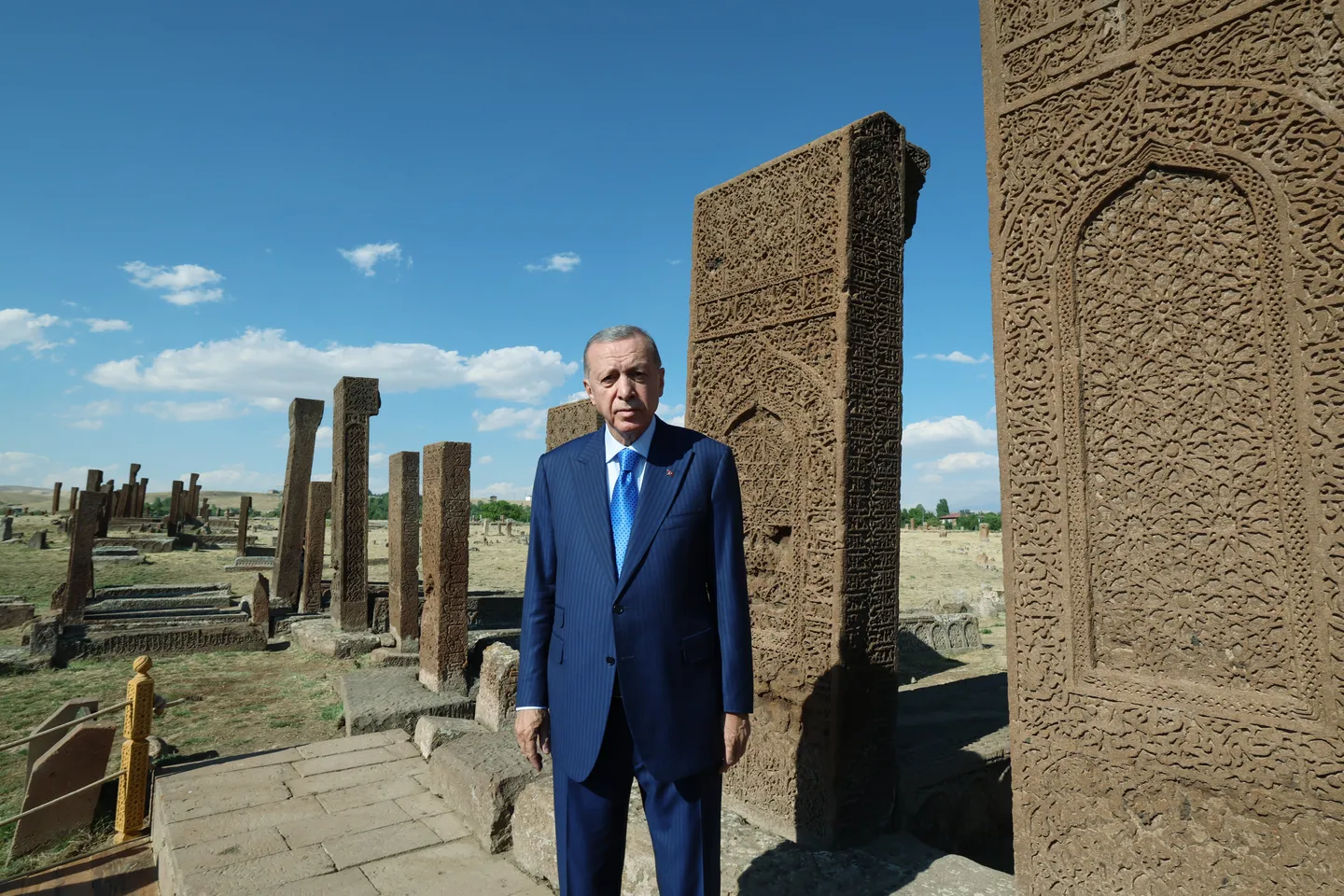
These sites preserve the memory of key figures from the Ottoman dynasty, serving as what officials call “places of memory” and “shared memory.” Beyond the city, the programme has included conservation work at the ancient city of Ani, Edirne’s Hidirlik Bastion, the Girls’ Monastery in Trabzon and Alanya Castle, while also expanding to industrial heritage through projects such as the former Adana Mensucat factory.
Speaking at the reopening of Yildiz Palace in July 2024, President Erdogan said around 6,000 foundation-owned cultural properties had been restored or repaired since 2002, while more than 120 restoration projects had also been completed abroad through TIKA, the Turkish Cooperation and Coordination Agency. After a six-year restoration, Erdogan said the objective was not only to restore its walls, gardens and interiors, but also to return one of Istanbul’s “places of memory” to public life by reopening long-inaccessible buildings as a museum for future generations.
“Each of these projects is also an instrument of diplomacy and prestige that introduces Türkiye’s cultural richness to the world,” Cam says, echoing a view frequently expressed by Culture and Tourism Minister Mehmet Nuri Ersoy. He points to Mor Ephrem Syriac Orthodox Church, inaugurated in Istanbul in 2023, as an example of that approach. President Erdogan attended the laying of its foundation stone in 2019 and later described the project as part of broader reforms concerning religious freedom and community foundations.
He noted that 1,084 properties, including 113 belonging to the Syriac community, had been registered in the names of minority community foundations, while 20 minority places of worship had been restored and reopened. This policy is presented as an effort to integrate the diverse cultural heritage of the region into the national narrative, fostering a more inclusive understanding of the country’s history.
Under the “Legacy to the Future” initiative, the ministry is expanding visitor infrastructure at archaeological sites through projects including a new visitor reception centre and theatre restoration at Ephesus, and conservation and environmental works at Pergamon’s acropolis. “Ancient places that reach the present through meticulous restoration are schools that carry the wisdom of the past into today,” Huseyin Ozer, a primary school teacher, tells. Together, these projects reflect a conservation strategy that spans centuries, aiming to balance the preservation of the past with the functional needs of a modern, growing nation.
Speaking at an international archaeology symposium in Ankara in August 2025, President Recep Tayyip Erdogan described Anatolia as a place where beliefs, cultures, languages and civilisations had intertwined over millenni
“It is of utmost importance to unearth, document, attentively protect and leave this treasure to next generations,” he said.
His administration, he said, has sought to build on that legacy by expanding resources devoted to archaeology.
Speaking at an international archaeology symposium in Ankara in August 2025, President Recep Tayyip Erdogan described Anatolia as a place where beliefs, cultures, languages and civilisations had intertwined over millennia, shaping humanity’s shared memory.
The results are perhaps most visible beneath modern-day Istanbul.
“The archaeological excavations carried out at Yenikapi, Sirkeci, Cagaloglu, Uskudar and Kadikoy areas in Istanbul produced finds of exceptional importance not only for Istanbul’s history, but for world history,” Hayri Fehmi Yilmaz, an art historian, tells.
At Yenikapi, the site of a major archaeological excavation uncovered during construction of Istanbul’s Marmaray rail project, he says excavations pushed back the city’s known history to the Neolithic era and revealed rare evidence of everyday life from the Byzantine and Ottoman periods.
Thousands of artefacts recovered from the site have since been conserved and added to museum collections across Türkiye.
According to Cam, archaeological work grew from 227 sites in 58 provinces in 2024 to 255 sites across 65 provinces in 2025, employing more than 2,000 archaeologists and art historians, along with more than 3,000 other workers.
Cam says the same conservation philosophy has been applied across projects of very different periods and purposes.
President Erdogan inaugurated Rami Library in January 2023 and said in 2025 that it had welcomed seven million visitors in its first two and a half years.
The project has also received international recognition.
In August 2026, Rami Library won the grand-scale category at the IFLA Green Library Awards after its transformation from a former military barracks into what organisers described as a climate-resilient urban commons.
Architect Sinan Genim believes the period has also seen stronger institutional support for heritage conservation.
“Important restoration work has been carried out across Türkiye, while projects such as Tas Tepeler have changed accepted ideas about archaeology and human history,” Genim tells.
Susin says the church has been warmly received not only by Syriacs in Türkiye and abroad, but also by other Christian and Muslim communities.
For educators, those investments also help bring history closer to younger generations.