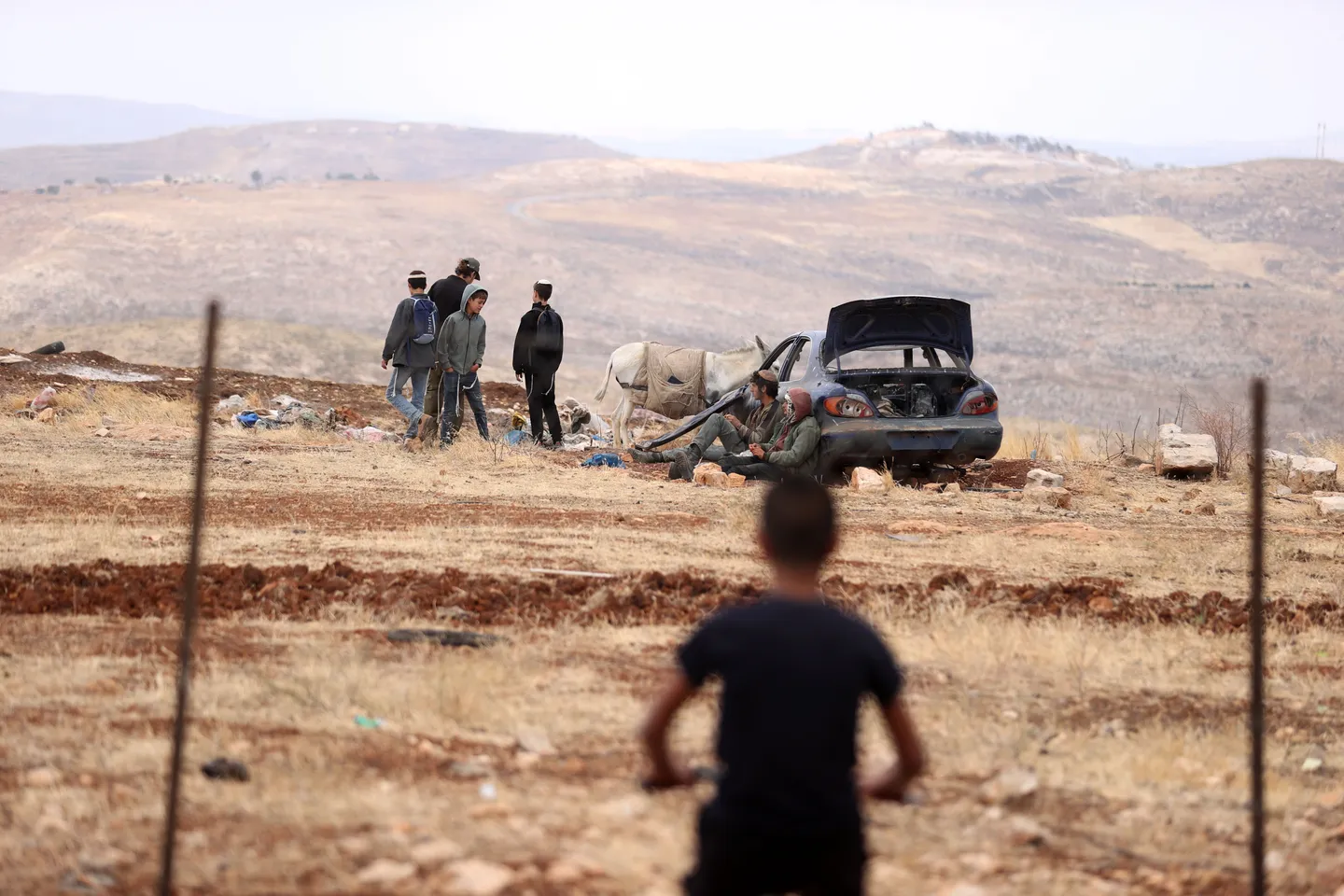






Every morning, Khaled Abeyat walks through his olive grove in Ein al-Duyuk, west of Jericho, inspecting the damage left behind by frequent incursions. Some of the trees have broken trunks, while others have been uprooted and left scattered across the ground, their roots exposed to the harsh sun. The 49-year-old farmer says the systematic destruction has severely impacted his livelihood and his fundamental sense of security.
Across the occupied West Bank, Palestinians have reported a sharp increase in settler attacks, including physical assaults, property destruction, and intimidation. For Palestinians living near settlements, attacks can take place on roads, farms and outside their homes, creating an environment of constant fear. Khaled says he now feels deeply tense whenever he sees settlers near his property, knowing the vulnerability of his position.
Khaled recounts that he was working on his land when a group of settlers entered his property and began damaging his olive trees. When he tried to stop them, they grabbed him. “They tied my hands and legs and dragged me across the ground,” he says. The rough terrain tore his skin, and the settlers threatened to kill him if he did not leave his ancestral land immediately.
Israeli soldiers were nearby during the incident, according to Khaled. “They were around the area,” he says. “But they were there to protect the settlers.” The attack resulted in severe injuries, particularly to his right hand. Khaled says the settlers struck it repeatedly and stepped on it while he was restrained. “Someone walked on my hand while it was forcefully held on the ground,” he says. “Last week, they walked on my broken hand and told me to leave,” he tells. “The bone was crushed. Until now, I cannot perform my work as I used to.” The injury has also affected his income, leaving him unable to maintain his grove effectively.
At night, Khaled sleeps outside among his olive trees to guard his property. He says settlers have threatened to burn his house and continue their campaign of harassment. “There are people who came at night carrying flashlights,” he says. The darkness that once brought silence now brings the sound of approaching footsteps. Despite the danger, he remains defiant. “I will not leave my land, no matter what happens,” Khaled says. “This land was inherited from my father. He told me never to abandon it.”
Khaled’s experience reflects what Palestinian officials describe as a broader, systemic shift in the occupied West Bank. Around 750,000 illegal settlers currently live in 156 settlements and 360 settlement outposts across the territory. Speaking in Ramallah on Monday, Palestinian Foreign Minister Varsen Aghabekian Shahin said settler violence is part of a coordinated strategy. She described violence and settlement expansion as “two complementary pillars of Israel’s illegal colonial project.”
Shahin rejected attempts to portray settler attacks as isolated acts by a small number of extremists, saying they are state-sanctioned. “Colonist violence has become a means of seizing Palestinian land, while colonist terrorism has evolved into a tool of displacement,” she stated. She added that 45 mosques in the occupied West Bank were targeted, including five that were burned and five that were demolished or partially destroyed. According to the official data, 45,195 trees were uprooted or damaged by Israeli forces or settlers over the same period. During the same period, the Israeli military carried out 341 demolitions, destroying 740 structures.
Shahin said the sharp rise in settler violence has made it increasingly difficult for Palestinians to remain on their land, pointing to the loss of livelihoods and security, the psychological toll on children and families, and the growing instability facing Palestinian communities. “I am not only worried about my son,” he says. “My children have the right to learn, but I cannot guarantee their safety.”
Five months ago, Mohammed Taweel was driving his pregnant wife from Far’ata, a Palestinian village near Nablus, toward a hospital. “This is the child that we have always dreamed of having,” Mohammed tells. But before they reached the hospital, five armed settlers stopped their vehicle. Mohammed tried explaining that his wife needed urgent medical care, but his pleas were ignored.
He says settlers smashed the car windows with the backs of their weapons and stones, sending shattered glass into the vehicle. “My wife kept crying and screaming during the entire time we were stopped,” he says. “She told me: ‘It looks like we will die before we see our son.’” For more than 40 minutes, Mohammed pleaded with them to let his family continue. He contacted Palestinian officials but remained stranded as the settlers blocked the road.
“I was standing there watching my wife in front of me, pregnant, unable to help her,” he says. Eventually, he took an almost deserted side road and reached the hospital after nightfall. By then, it was too late to prevent complications. “The fluid around the baby had broken inside the car,” Mohammed says. The prolonged delay deprived the baby of oxygen, leaving him with brain damage and a mental disability.
“My son did not choose any of this,” he says. “He will carry the consequences of that night for the rest of his life.” For Mohammed, the attack permanently changed how he viewed daily life. “It was about feeling that your life and your family’s life can be controlled by someone who decides whether you live or die,” he says. He notes that attacks have become increasingly unpredictable, leaving families across the West Bank in a state of perpetual anxiety regarding their future.
Presenting official figures on Monday, Palestinian Foreign Minister Shahin said that 11,074 violations by Israeli forces and settlers were documented across the occupied Palestinian territory in the first half of 2026, o
The figures show that at least 86 Palestinians were killed in the occupied West Bank during that period, including 21 killed directly by settlers.
They also recorded the displacement of 26 Bedouin communities and the establishment of 42 new settlement outposts, most of them pastoral.
The couple were preparing to welcome their first child.
Presenting official figures on Monday, Palestinian Foreign Minister Shahin said that 11,074 violations by Israeli forces and settlers were documented across the occupied Palestinian territory in the first half of 2026, of which 3,488 were attributed to settlers.
In Osarin, south of Nablus, the 46-year-old construction worker remembers the day his 12-year-old son Jad left for school but returned only minutes later.
His school uniform was torn, and cuts marked his mouth and nose.
“He came back after only 15 minutes,” Saeed tells.
Saeed says settlers stopped Jad on the road, searched him, beat him and that one of them attempted to touch him inappropriately.
Afterwards, Jad stopped talking about school.
“He decided to leave education even though he was one of the best students,” Saeed says.
According to the UN Office for the Coordination of Humanitarian Affairs (OCHA), more than 4,000 settler-related incidents were recorded between 2023 and 2025, among the highest levels since the agency began monitoring.
National Security Minister Itamar Ben-Gvir has repeatedly encouraged settlement expansion, telling settlers to “go to the hilltops and occupy them.
Shahin said the figures also recorded the seizure of 4,379 dunums of Palestinian land during the first half of 2026, while Israeli authorities advanced 113 settlement master plans—71 in the occupied West Bank and 42 in occupied East Jerusalem.
Saeed’s concern extends beyond Jad.