

“If I die, remember me like this. You won’t be sad,” Halil Kantarci wrote on social media on the evening of July 15, 2016. At the time, the 36-year-old was standing on the balcony of his mother’s apartment in Istanbul, where he could clearly see soldiers and tanks amassing on the Istanbul Strait (Bogazici) Bridge—a site now renamed the July 15 Martyrs Bridge. By then he had made up his mind: he could not stay silent. Kantarci would soon learn that FETO terrorists plotting a coup against the government had raided the Cengelkoy Police Station, and he felt compelled to act.
Kantarci kissed his children goodbye, asked his wife for her blessings and left to join thousands of other citizens mounting a resistance against the putschists. As the coup attempt unfolded, President Recep Tayyip Erdogan addressed the nation: “I call on our people to gather in the public squares of every province and at the airports. Let us come together as a nation in the squares and at the airports.” Hours later, Kantarci was shot dead by putschists in Cengelkoy, and his final social media post proved hauntingly prophetic. He became a symbol of the sacrifice of those 253 people who were martyred while defending democracy and liberty.
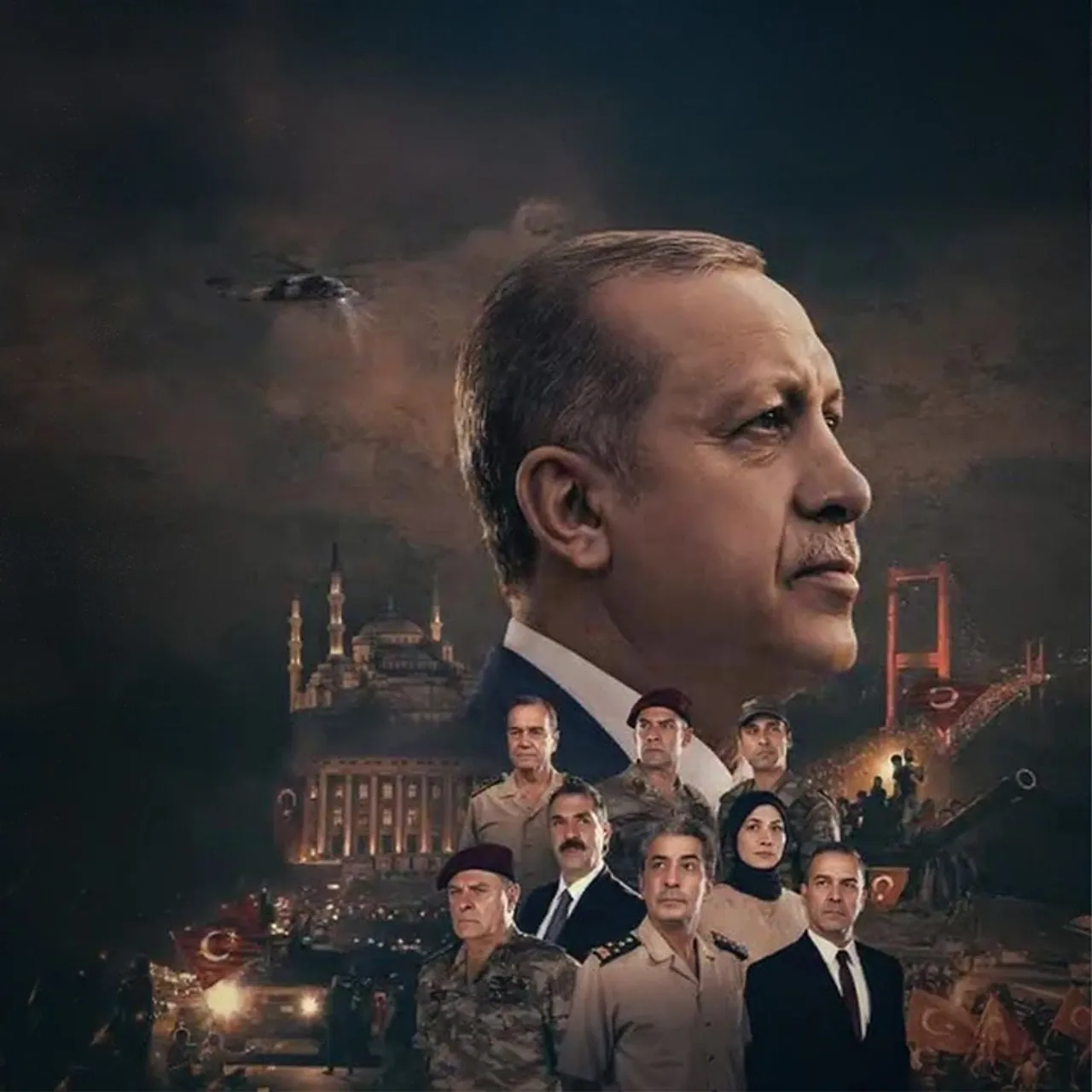
A decade later, the uniforms are costumes, the weapons are props, and the terror of that night is being carefully reconstructed for Asirlik Gece—a 15-part docudrama produced by TRT and now streaming on TRT 1 and Tabii. The series is adapted from Huseyin Aydin’s book, Asirlik Gece: Belgeler ve Deliller Isiginda 15 Temmuz Darbe Girisimi (A Century-Long Night: The July 15 Coup Attempt in Light of Documents and Evidence). It is a docudrama—a hybrid form that interweaves dramatic reconstruction with archival footage, official documents, and testimony from those who witnessed the coup attempt, both on the streets and from inside some of Türkiye’s most critical institutions.
The docudrama traces the FETO terror group’s decades-long infiltration of schools, the military, and state institutions before following 15 intersecting stories from the coup attempt. General coordinator Muhammed Erkam Bulbul, 41, tells, “Securing the President’s interview and bringing together the witnesses of that night was one of our greatest achievements on the production side.” This history unfolds alongside key events of July 15, including the warning received by the National Intelligence Organisation and the attempt to occupy the General Staff headquarters. The wider story includes attacks on religious officials and places of worship: at the Police Special Operations complex in Golbasi, imam Mustafa Yaman was killed while helping after the first air strike, and a muezzin was injured.
The production scale is immense. “We can call it the biggest television series ever produced in Türkiye. In effect, we have filmed the equivalent of almost 15 feature-length films,” the production team notes. The project was developed through the testimonies of real witnesses—the people at the centre of these events. Military, police, political, media, and civilian accounts are placed beside one another to provide a comprehensive view of the resistance. “July 15 was terrifying for all of us, but it also showed how, in difficult moments, we came together as a country and a nation and said ‘stop’ to the coup plotters in a loud voice for our freedom and democracy,” says director Emre Konuk.
The scenes are being recreated not in studios but on the streets where the people confronted the putschists. Actor Kemal Ucar portrays Halil Kantarci confronting the putschists shortly before he is fatally shot, but the production emphasizes that this is not a conventional crime drama or political thriller. It is a historical record intended to educate. “Young people in particular do not know very much about an event that took place ten years ago,” producer Saglam explains. The series reconstructs efforts to seize the General Staff and strategic sites in Ankara and Istanbul, the heart of the resistance.
More than 90 interviews form its documentary spine. Interviewees include President Erdogan, current MIT officials, and survivors of the violence. Conscript Muhammet Recep Ulu recounts what he witnessed at Akinci Air Base, while dramatised scenes capture the chaos of the night. Together, their testimony reveals not only events on the streets but also the decisions, confrontations, and the sheer scale of the betrayal. The series also explores the psychology behind the organisation, portraying how religion was used to demand absolute obedience from members, leading to the catastrophic events of that night.
The series is the first docudrama to feature an interview with President Recep Tayyip Erdogan recorded specifically for such a project. It captures the tension of the night, from the initial reports of the coup to the final defeat of the plotters. The production team spent months verifying archival footage and court records to ensure the accuracy of every scene. “The project was developed through the testimonies of real witnesses—the people at the centre of these events,” the producers reiterate. This commitment to accuracy ensures that the docudrama serves as a definitive account of the night for future generations.
For those who lived through them, the title can feel almost literal: a single night whose weight and consequences have lasted for a century. Filming in Cengelkoy continues until the first light of morning, mirroring the hours of violence and the eventual triumph of the people. The production team highlights that the series is not just about the tragedy of the 253 martyrs, but about the collective resilience of the Turkish nation. It serves as a stark reminder of the cost of democracy and the importance of vigilance in protecting national sovereignty against internal threats.
The series also covers the media response, including the heroic efforts of journalists who continued to broadcast despite the threats. Two employees were killed and four were wounded, but the broadcasts continued, ensuring the nation remained informed. This narrative thread is woven into the larger tapestry of the series, highlighting how every sector of society played a role in the resistance. The docudrama provides a platform for these voices to be heard, ensuring that the sacrifices made on July 15 are never forgotten by the public or by history.
As the series progresses, it delves into the legal aftermath, showing how the evidence gathered in the book was used to prosecute the plotters. The transition from the chaotic night to the orderly courtroom proceedings is handled with care, reflecting the nation’s commitment to justice. By combining the emotional weight of the individual stories with the cold, hard facts of the legal documents, Asirlik Gece offers a balanced and powerful perspective on one of the most significant events in modern Turkish history. It is a testament to the endurance of the human spirit and the power of a united nation.
“This is the story of the Turkish nation’s stand against the coup attempt and its victory,” the creators conclude. The docudrama stands as a monument to those who stood in front of tanks and gave their lives for the future of their country. By documenting these events with such precision and care, the series ensures that the legacy of July 15 remains a cornerstone of the national consciousness. It is a vital piece of television that bridges the gap between the past and the present, ensuring that the lessons of that night continue to resonate for years to come.
Soldiers in combat uniforms rush towards a crowd as frightened civilians spill into the streets.
Shouts reverberate through the darkness, and panic appears to spread by the second.
Tanks blocked bridges, fighter jets bombed parliament, and a commando unit was dispatched to target President Erdogan in Marmaris.
Screenwriter Fatih Mutlu transformed the book’s extensive documentary material into a narrative that could be recreated on screen.
Interviewees include President Erdogan; current MIT Director Ibrahim Kalin, then presidential spokesperson; Foreign Minister Hakan Fidan, who headed MIT in 2016; officials, security personnel, veterans, victims’ relatives and civilians who took to the streets.
Turgut Aslan, then head of the Turkish National Police’s Counter-Terrorism Department, revisits the attack that left him gravely wounded, with an actor recreating his experience.
By the final days of filming, the cameras had entered 342 locations.
The screenplay took six months to prepare, while the shoot lasted approximately three months.
Directors Cihan Saglam, 40, and Ahmet Toklu divided the production between two units, with a filming crew of around 160 people working through an unusually compressed schedule.
The passing decade created another challenge: many sites no longer looked as they did in 2016.
Production designers had to reverse later alterations and rebuild the visual texture of the night.
Bulbul says the series employed a principal cast of 192 to 193 actors and nearly 14,000 supporting performers and extras; another production representative places the wider cast at around 250 when all speaking and supporting roles are included.
The cast includes Erkan Petekkaya as Salih Zeki Colak, Ruzgar Aksoy as Omer Halisdemir, Yavuz Bingol as Adil Oksuz, Murat Aygen as Hakan Fidan, Burak Sergen as Zekai Aksakalli, Gulsim Ali as Hatice Kubra Ciftci, Seckin Ozdemir as Tolga Kilincarslan, Emir Benderlioglu as Muhsin Kose, Kemal Ucar as Halil Kantarci and Cem Kurtoglu as Hulusi Akar.
The score is by composer Can Atilla.
“That was already the most difficult part of the work.” For a production reconstructing an event still carried in living memory, spectacle could not be allowed to displace evidence.
Accuracy extended to clothing, colour and time of day.
A production representative gives the example of Hatice Kubra Ciftci, who confronted the FETO-linked coup troops on the bridge wearing a black-and-white shirt, a black headscarf and black trousers.
Gulsim Ali was dressed in matching clothes and filmed in the same place during the corresponding time frame.
“Whoever experienced an event that night, we included everything down to the colour of what they wore and their shoes,” Bulbul says.
The first reactions have reflected an appetite for precisely these lesser-known details.
“Because we are telling a true story, we explore many things people did not know.
That leaves them eagerly awaiting the next episode.”
Taha Koyuncu was just 23 on the night of July 15 and had only recently completed his military service, during which he served in a tank unit.
We also carried out deep preliminary work so that the real events of that night could reach the audience in the most affecting cinematic way.”
His team sought a different balance, investing in performance, production design and real locations so the dramatised scenes would carry the emotional and visual force of cinema without losing their factual foundation.
One international reference remained in his mind during development: HBO’s Chernobyl.
He was drawn to the way that series combined the circumstances surrounding a disaster with the intimate struggle of people trying to survive it.
Across the 15 episodes, the scale of the attempted takeover is repeatedly brought back to individual decisions.
Omer Halisdemir received an order he knew could cost him his life.
Acting on the instructions of Special Forces Commander Lt.
Zekai Aksakalli, he shot coup-plotting Brigadier General Semih Terzi as Terzi attempted to seize the Special Forces Command in Ankara.
Hundreds of kilometres away, on the bridge now named after the July 15 martyrs, Erol Olcok—a close friend and campaign manager of President Erdogan who had helped shape the AK Party’s political campaigns—and his 16-year-old son, Abdullah Tayyip, joined the civilian resistance.
Another episode follows Halil Kantarcı, who was 36 when he went out that night.
“If we can speak these sentences freely today, it is thanks to the people who truly sacrificed themselves for this country.”
“Perhaps he never expected that a weapon would be pointed at him.
But when he saw it, he did not run, because in his world there were things more important than himself.”
Re-entering Kantarci’s last moments, he says, brought grief but also an unexpected sense of completion.
“In the seconds when we filmed his final moments, my sorrow gave way to the feeling of a person who had fulfilled his duty.
Perhaps I internalised it too deeply.
I only hope I have fulfilled my own duty in a worthy way.”
The sala prayers recited from mosques became one of the defining symbols of the night, carrying a call for unity from minaret to minaret as people were urged into the streets.
One episode returns to Polatli Carsi Mosque in Ankara’s Polatli district, where coup troops tried to stop the call by threatening mosque officials and breaking sound equipment.
The struggle over sound was also a struggle over information.
At TURKSAT’s ground facilities in Golbasi, coup aircraft dropped four bombs in an attempt to halt television transmissions.
The sequence makes clear why both public and private channels had become strategic targets: whoever controlled the signal could shape what the country understood to be happening.
That multiplication of perspectives is central to the format.
The chain of command appears through interviews and actors, allowing testimony to interrupt, clarify and deepen the dramatised scenes rather than simply follow them.
Some scenes were so painful, he adds, that the crew could scarcely believe the events had actually happened.
That is why he sees the series primarily as an archive for a generation that did not witness the night.