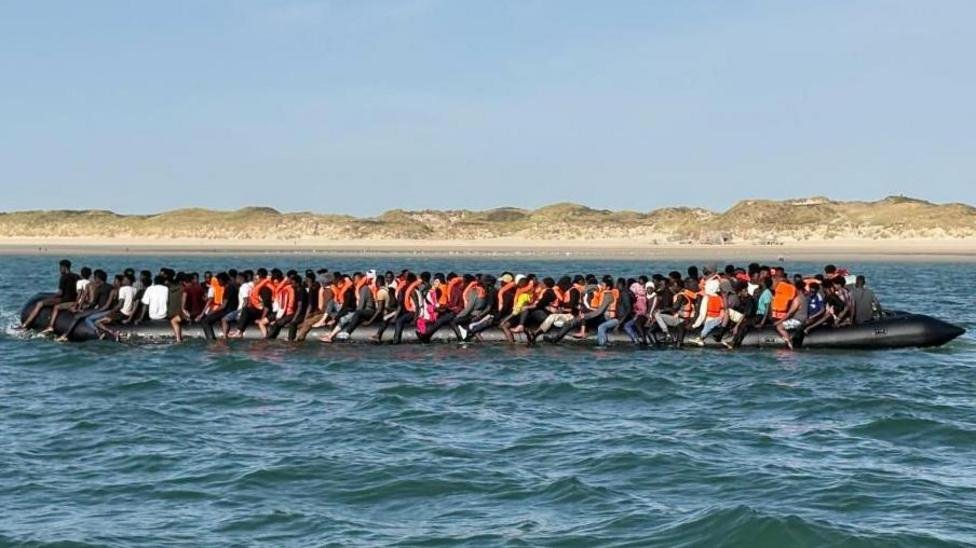








A small boat has crossed the English Channel carrying 230 people, marking the largest number of individuals to make the journey in a single vessel. This incident, which occurred in the early hours of Monday, breaks the previous record set in July when 165 people were recorded on one boat. The 15-meter (49-foot) inflatable vessel was captured in photographs off the coast of northern France, appearing so heavily packed that many passengers were forced to dangle their legs over the sides.
French rescuers, specifically the SNMS team—the equivalent of the UK’s RNLI—reported that the boat was visibly “buckling” in the water. The crew in Berck-sur-Mer observed the vessel already carrying approximately 50 people before it headed toward a beach to pick up additional passengers. During this chaotic boarding process, the SNMS team noted that about 30 people ended up in the water. Furthermore, a translated statement confirmed that part of the group became cut off by the tide and required rescue. The boat had initially been carrying 232 migrants before two individuals requested assistance and were taken to Calais.
A Home Office spokesperson condemned the incident, stating it demonstrates the “reckless and dangerous tactics employed by criminal gangs” who are cramming ever-greater numbers onto unseaworthy vessels. This trend toward higher density is significant; in 2018, the average was seven people per boat, but by last year, that figure had risen to 62. The average for the year ending August 8, 2026, has reached 67 people per boat, more than doubling in a relatively short period.
The dangers of such overcrowding are severe. On Tuesday, 173 migrants had to be rescued from a single boat that caught fire while at sea. Experts have repeatedly warned that these conditions make crossings significantly riskier, noting that at least 84 people have died while attempting the journey since 2018. Despite these risks, the demand for passage remains high, as the number of people waiting in camps in northern France has not diminished.
Government officials argue that their efforts to disrupt the supply of small boats and engines are beginning to yield results. So far this year, the total number of migrants making the crossing is down by 43%, while the number of successful boat crossings has decreased by 49%. Last month, the Home Office recorded the lowest number of crossings for July since 2020. Officials attribute this to a combination of sophisticated surveillance, reconnaissance operations, and the disruption of smuggling supply chains.
In April, the UK and France finalized a £662 million (773 million euro) deal to address the crisis. This three-year agreement includes plans to deploy riot-trained police to French beaches to manage violence and “hostile crowds,” alongside the deployment of millions of pounds worth of drones and two helicopters to intercept smugglers. The government has also signed a payment-by-results deal with France to increase the number of boots on the ground by 40%.
Despite these operational successes, concerns persist about the numbers still able to reach the UK. Between January 1 and August 8, 2026, a total of 14,819 people crossed the English Channel by small boat. These crossings have become the most common method for detected illegal entry into the UK since 2020. Nearly all arrivals claim asylum, and under international law, they are permitted to remain in the country while their claims are processed.
Small boat arrivals accounted for 42% of all asylum applications between April 2025 and March 2026. Data shows that people from Eritrea made up 18% of all arrivals during that period. Furthermore, in the figures covering 2025, at least 2,000 people who arrived by small boat were found to have been previously identified by authorities, while another 4,535 were detected entering the UK without permission via other methods, including hiding in vehicles.
Political reaction to the latest record-breaking crossing was swift. On X, Reform UK leader Nigel Farage described the event as “yet more proof that this illegal invasion is a national security emergency,” noting that the boat was taken into Dover at 2:30 a.m. The government maintains that it is committed to “smashing the gangs” behind these operations to further reduce the numbers.
When viewed in the broader context of migration, these small boat arrivals represent about 5% of the total number of people entering the UK. Nevertheless, the government emphasizes that it must go further to secure the borders. All boats that cross the halfway point in the Channel are intercepted by the UK Border Force, which then transports the passengers to processing facilities.
The Home Office reiterated that while progress is being made, the tactics of the smuggling gangs continue to evolve. The government remains focused on the implementation of the new agreement with France, hoping that the combination of increased surveillance and physical presence on French beaches will continue to drive down the number of successful crossings throughout the remainder of the year.
As the situation develops, the focus remains on the safety of those at sea and the effectiveness of the current interception strategies. The government maintains that the current downward trend in overall crossings is a direct result of the increased cooperation with French authorities and the strategic disruption of the criminal networks facilitating these journeys.
Officials think this is partly because they have managed to disrupt the supply of small boats and engines to the people smugglers, with 1,100 seized since Labour came to power.
Boats that arrived in the UK from 9 August 2025 to 8 August 2026 carried an average of 67 people.
This has more than doubled since 2021.
At least 84 people died while attempting to cross the Channel in 2024, according to the United Nations (UN).
This was down by 22% on the same period the previous year.
There are also individuals who arrive legally, for example via a work or study visa, and then overstay their limit.
The total number of people who live in the UK illegally after arriving legally is not known.
A spokesperson for the prime minister said: “We’ve seen today some appalling images…
shocking images, and they show the reality behind the ruthless smuggling gangs that are prepared to risk human lives for profit…”
“As the prime minister has said, we’re not complacent and we are bearing down on these crossings, and that’s reflected in the joint action that’s prevented 47,000 attempted crossings since the election.”
The inflatable float used during the crossing was pictured deflated on the quayside in Dover
On a recent visit to Dover, the prime minister pledged his government would be “relentless” in curbing the number of small boat arrivals.
Andy Burnham said enforcement officers tackling people-smuggling gangs had been doubled on both sides of the Channel, but “a system that offers safe routes for people” needed to be built as well.