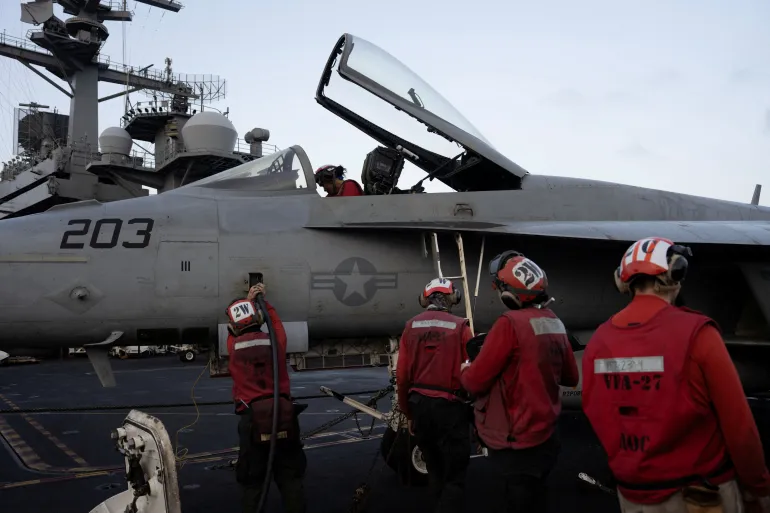










The United States is mobilizing a third aircraft carrier strike group toward waters near Iran, a development confirmed by a US official. This deployment occurs as the ongoing conflict reaches its eighth month, with both Washington and Tehran balancing military posturing against potential diplomatic engagement.
The USS Theodore Roosevelt carrier strike group departed from its base in San Diego on Sunday. It was followed shortly after by the Makin Island Marine Expeditionary Unit, which carries a force exceeding 2,000 Marines. According to reports from the Wall Street Journal, these naval movements could involve an influx of 9,000 to 10,000 total personnel, encompassing both sailors and Marines assigned to the strike group and accompanying vessels. There were almost 15,000 Marines and soldiers in Lebanon, at its height.
Strategic planning indicates that by late November, the region will host three aircraft carriers and two amphibious landing groups in close proximity to Iran. Officials stated that this concentrated display of force is intended to provide President Donald Trump with a broader spectrum of tactical options should he authorize further action. The latest maneuvers include the integration of F-35 fighter jets, bolstering the approximately 50,000 US service members already stationed across the Middle East. Just a month before November US midterm elections, which could see US President Donald Trump’s Republican Party hit hard by his handling of the war, which is deeply unpopular in the US, thousands more troops are also on their way to the region. We look at what the latest troop deployment means and whether it signals a coming escalation in the war on Iran. There were 40,000 to 50,000 US soldiers stationed around the Middle East, comprising personnel stationed in both large, permanent bases and smaller forward sites across the region, as of mid-2025.
Pentagon and White House sources suggest the primary objective is to ensure that military options remain available for the President, regardless of how diplomatic channels evolve. Defense Secretary Pete Hegseth has publicly stated that these forces are prepared for deployment should the order for new strikes be issued. The Pentagon currently has no plans to withdraw existing assets, even if a formal agreement with Iran is secured.
The United States has long maintained a extensive military footprint in the region, operating from at least 19 locations including eight permanent bases in nations such as Qatar, Saudi Arabia, Bahrain, Kuwait, Jordan, Iraq, the UAE, and Egypt. This history of presence dates back to 1958, when combat troops were first dispatched to Lebanon during that nation’s domestic crisis.
Since the beginning of this year, the administration has significantly increased the US military presence, initially directing warships such as the USS Abraham Lincoln to the Arabian Sea. Data from open-source intelligence analysts suggests more than 120 aircraft have been deployed to the area since February, marking the largest surge in US airpower in the region since 2003. These movements have included E-3 Sentry AWACS, F-22 air superiority jets, and F-35 stealth fighters, supported by a logistical network of refuelling tankers and cargo aircraft. Reported deployments include E-3 Sentry Airborne Warning and Control System (AWACS) aircraft, F-35 stealth strike fighters and F-22 air superiority jets alongside F-15 and F-16 fighter aircraft.
Earlier this year, the Pentagon reinforced the Gulf with three distinct formations: the Tripoli Amphibious Ready Group, the Boxer Amphibious Ready Group—which together added 4,500 personnel—and a contingent of 2,000 soldiers from the 82nd Airborne Division. In total, nearly 7,000 additional troops were moved to the region following the onset of the current conflict. Each with a different origin, route and timeline, the reinforcements consisted of three distinct formations. Built around the Wasp-class assault ship USS Boxer and the 11th MEU, based in Southern California in the US, the second was the Boxer Amphibious Ready Group. The third was a contingent of about 2,000 soldiers from the 82nd Airborne Division’s Immediate Response Force, based at Fort Bragg, North Carolina.
Regarding the prospect of escalation, President Trump remained cryptic when pressed for specifics, telling Time magazine that he could not disclose operational details because it would reveal potential targeting plans. He further confirmed his rejection of a recent ceasefire proposal from Iran, noting that the offer contained demands for sanctioned relief and the release of frozen funds that he deemed unacceptable. UN Ambassador Mike Waltz reiterated this stance, framing the sanctions as global measures rather than purely US mandates.
Tehran has responded with a firm posture, with Foreign Minister Abbas Araghchi stating that Iran is prepared to continue the conflict while simultaneously asserting that their diplomatic efforts are not intended to sell war. Amid these rising tensions, President Trump issued a warning during a stop at a facility in Denton, Texas, suggesting that Iran must choose to act in a manner he described as proper and smart or face severe consequences, stating the situation will conclude very soon.