

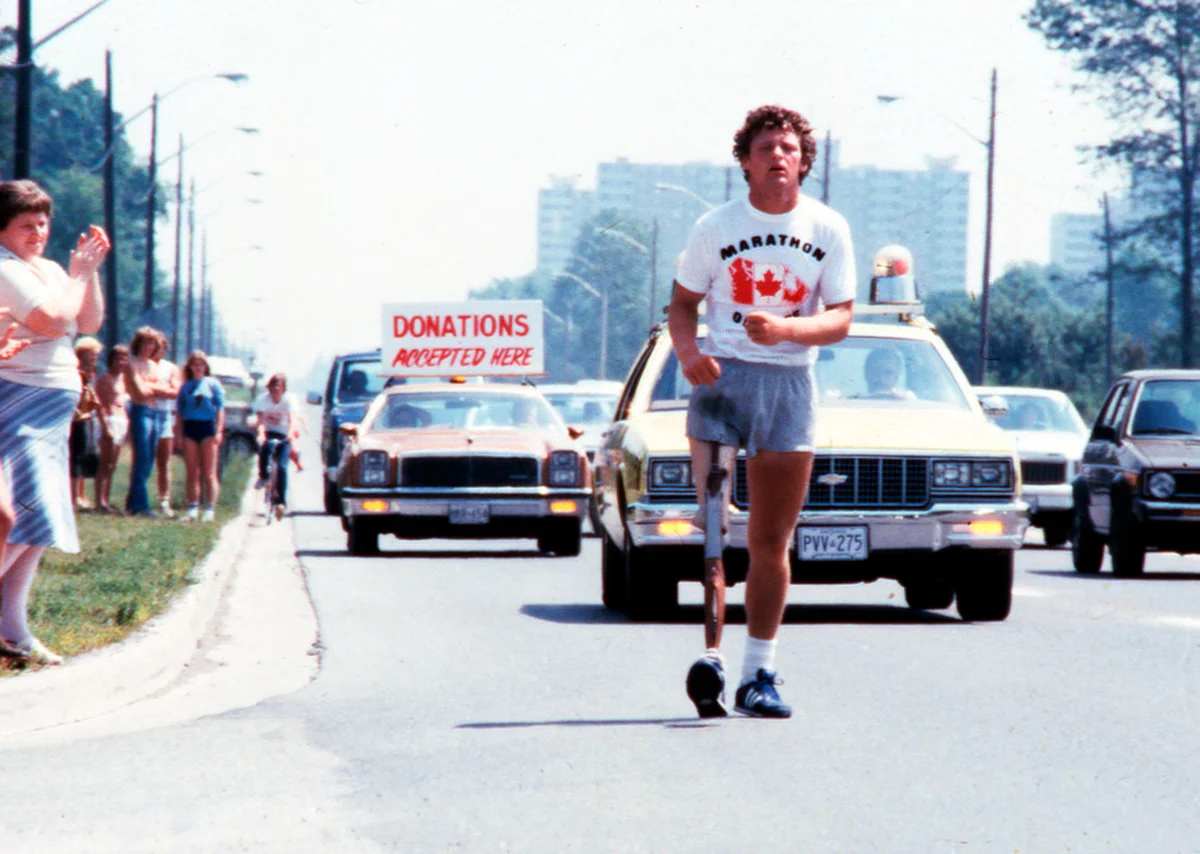








When Rob Stickle was six years old in 1980, he stood on a crowded Toronto street waiting to catch a glimpse of a man running with a prosthetic limb. His mother lifted him up to see the 21-year-old athlete, leading the boy to famously remark: “I was a Star Wars fanatic, and I remember saying to mom: ‘He has a robot leg.’”
That runner was Terry Fox, who had already logged roughly 2,200 miles on his “Marathon of Hope” by the time he reached the city. Stickle, now a Toronto elementary school teacher, reflected on the experience: “I didn’t fully appreciate what was happening at the moment – that we were all part of something much larger. But what I’ve learned since – after losing my mom to cancer and becoming a teacher – is that his journey remains deeply impactful.”
In 2026, Fox’s legacy has transitioned into a symbol of renewed Canadian nationalism at a time when the country faces questions regarding its sovereignty and internal cohesion. The appeal of his story transcends political divides. Recently, Prime Minister Mark Carney and singer Bryan Adams visited a memorial for Fox, illustrating the way his life continues to anchor the country’s cultural and political identity.
Adams, known for hits such as “Summer of ‘69,” has composed a new tribute titled “The Ballad of Terry Fox.” Reflecting on the enduring nature of the runner’s story, Adams remarked: “I’m glad it’s becoming a near-mythological story in Canada. It should be, because it’s an incredible story about a human being fighting. It’s an odyssey. And it deserves to be folklore.”
The cultural focus on Fox reaches a new peak with the premiere of the documentary “Run Terry Run” at the Toronto film festival on September 19. Director Sean Menard utilized previously unseen 1980s footage to showcase the reality behind the icon. “Watching him run, it’s almost impossible for a Canadian to not feel moved and inspired,” Menard said. “He’s presented as almost a superhero today, but he was just a person who had to watch other kids die in the cancer ward.”
Fox, an avid athlete from British Columbia, faced an amputation in 1977 due to osteosarcoma. Motivated by the lack of support for young cancer patients, he launched his cross-country mission on April 12, 1980, after dipping his leg in the Atlantic Ocean at St. John’s. The documentary reveals the grit of that journey, showing a young man constantly adjusting a prosthetic leg never intended for such intense movement, while battling extreme weather, exhaustion, and physical pain.
The trek came to a premature end on September 1, 1980, near Thunder Bay, Ontario. After 143 days and 3,339 miles, Fox announced the suspension of his run in tears. He passed away the following June. Despite his early death, his impact remains monumental. More than C$1bn (US$715m) has been raised in his name, and the annual Terry Fox Run, held every September, now spans over 60 countries, representing the largest single-day cancer research fundraiser globally.
Rick Hansen, a friend of Fox who had once recruited him for wheelchair basketball in Vancouver, suggests the nation’s fascination with Fox is rooted in shared values. “Terry’s story and his legend is basically steeped in our values and our sense of identity as a nation: one in which people deeply care about each other,” Hansen noted. “But he also just had an absolute raw sense of purpose and determination to keep going.”
While many view Fox as a saint-like figure, Hansen cautions against turning him into a symbol so remote that everyday people feel disconnected from him. “The one thing he would not want us to do is create this legend to such a lofty and disconnected status where we couldn’t see a bit of Terry in all of us,” he said. “Terry was an everyday Canadian.”
Today, the nation recognizes Fox through dozens of roads, 14 schools, and his status as a National Historic Person designated by Parks Canada—an honor that highlights his role in transforming the national vocabulary regarding personal courage. The report also notes that leather and metal, the distinctive style of Fox’s run – a kind of limping hop – was the result of a journey undertaken on a crude and ill-fitting prosthetic leg made of plastic. The report also notes that someone who chose the route that was going to hurt. The report also notes that someone who did it because he believed that the cause was important.”. The report also notes that indeed, for those outside Canada it can be a surprise to discover the degree to which Fox has become less a person than a national symbol: dozens of roads have been named after him, as have 14 schools. The report also notes that canada has issued both stamps and coins with his image. The report also notes that in 1980, angered by the lack of support for young people suffering from cancer, Fox decided on an ambitious goal: he would run across Canada to raise money for cancer research. The report also notes that after dipping his foot in the Atlantic Ocean in St John’s, Newfoundland, Fox began a journey that, if completed, would span nearly 5,000 miles, on 12 April 1980. The report also notes that aided largely by friends and family, run Terry Run shows a surprisingly lonely and rag-tag trek.